
Python Set Speeds Up Data Cleaning and Membership Testing

Introduction
Here’s a number that might surprise you. Data scientists spend up to 80% of their time cleaning and preprocessing data, not building fancy models. If you have ever stared at a messy dataset full of duplicates, missing values, and weird formatting, you know exactly how that feels.

The good news? One simple Python tool can save you hours of that grunt work. That tool is the python set.
A set is a built-in data type that stores unique items in no particular order. But what makes it special is speed. Sets offer O(1) membership testing, meaning they can check whether an item exists almost instantly regardless of how big the set gets. Compare that to a list, where Python has to check each item one by one. That O(n) search time slows down fast as your data grows. As one developer put it in a deep dive on membership testing performance, sets are dramatically faster once they are built.
Here is a quick comparison to make this concrete.
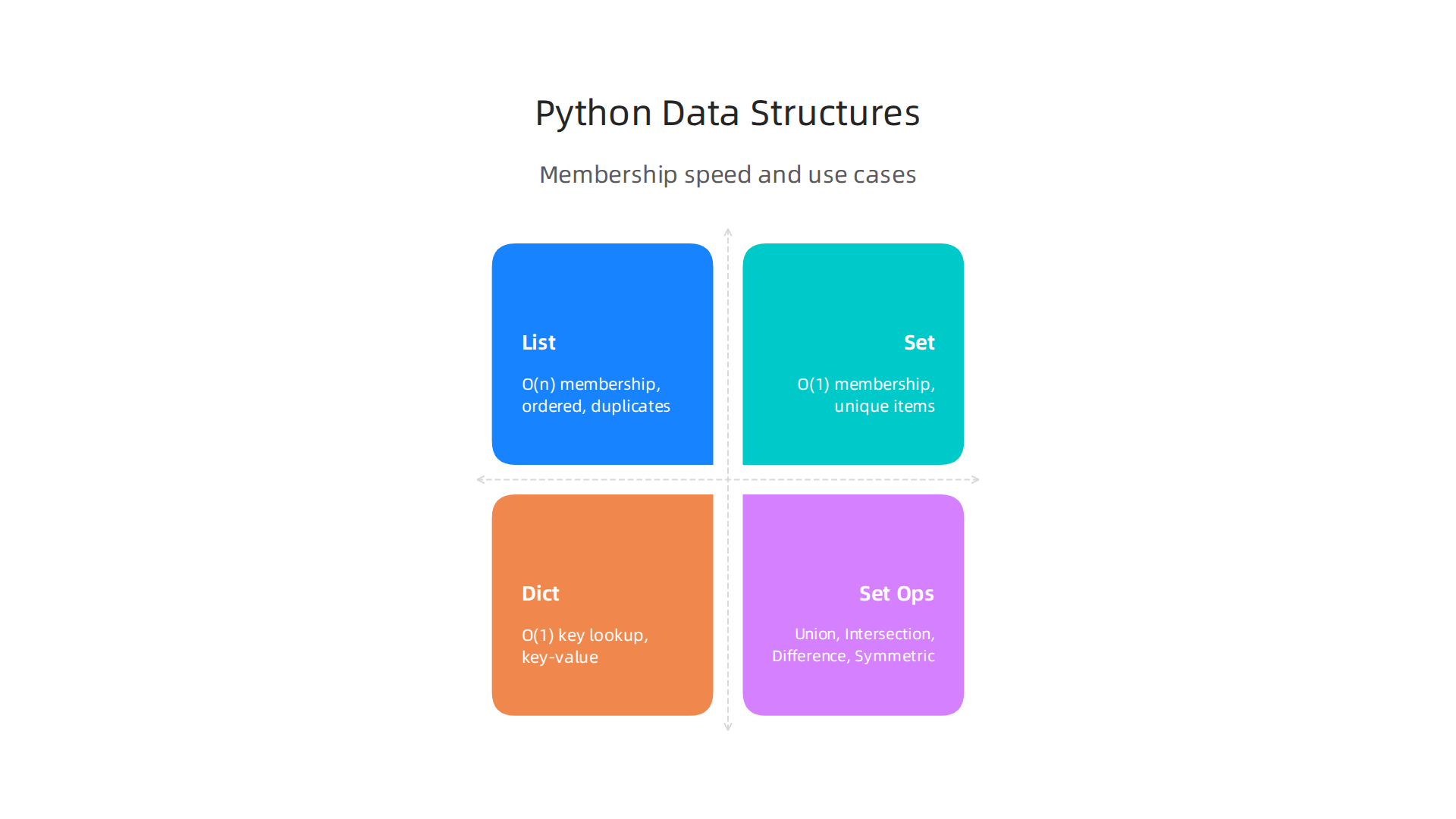
| Data Structure | Membership Test Speed | Best For |
|---|---|---|
| List | O(n) | Ordered data, duplicates allowed |
| Set | O(1) | Unique items, fast lookups |
| Dictionary | O(1) | Key-value pairs, fast lookups |
That performance gap is huge. When you are working with thousands or millions of records, switching from a list to a set can turn a loop that takes minutes into one that finishes in seconds. There is even a detailed breakdown on Python set versus list performance that runs real benchmarks to prove the point.
In this guide, we will walk through exactly how to use sets for real machine learning work. You will learn core operations like union, intersection, and difference. You will see why sets are essential for deduplication, feature engineering, and validation. And you will get practical tips that apply directly to your daily workflow whether you are working on data engineering projects or building pipelines with a python code runner.
If you are serious about speeding up your workflow, you should also check out some of the top data science open source projects github that rely heavily on set operations under the hood.
By the end of this article, you will have a clear, practical understanding of why the python set is one of the most underrated tools in any data scientist’s toolbox.
But first, let us start with the basics. How do you actually create and use a set in Python? And why do so many developers reach for lists when sets would serve them better? Let us dive in.
Speaking of staying sharp on tools like this, the machine learning landscape moves fast. It helps to have a reliable source that distills the most important updates into a quick read. That is why I recommend The AI Newsletter Worth Reading from The Deep View. It gives you clear daily AI updates without the noise.
Why Python Sets Are a Data Scientist’s Best Friend
Think about the last time you had to remove duplicate customer IDs from a dataset. Maybe you wrote a loop, checked each ID against a growing list, and watched your notebook slow to a crawl. There is a better way.
A python set is built on a hash table under the hood. That means every item gets a unique hash code, and the set uses that hash to store the item in a specific bucket. When you check if an item exists, Python goes straight to that bucket instead of scanning every single element. That is why membership tests are O(1) on average. The popular Stack Overflow thread on how Python set is implemented explains that sets use a hash table internally, which makes duplicates impossible and lookups blazing fast.
This design is perfect for data science work. You deal with messy, real world data every day. Sets handle three common pain points automatically:
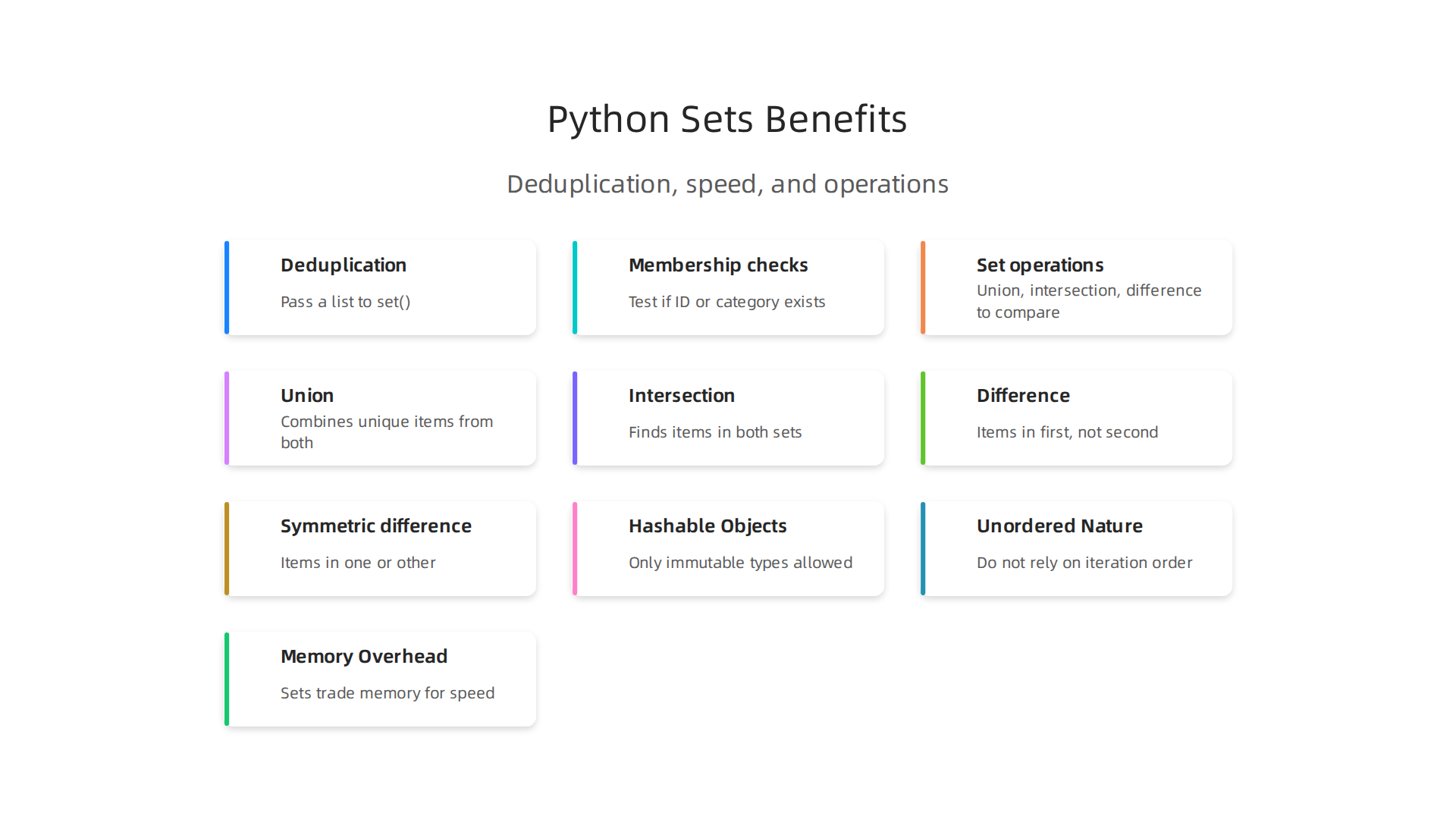
- Deduplication – Pass a list of values to
set()and duplicates vanish instantly. - Membership checks – Test if a user ID or category exists without looping.
- Set operations – Use union, intersection, and difference to compare datasets in one line.
Here is a quick example. Say you have a list of 100,000 product codes and you need to find which ones are in a separate list of discontinued codes. With sets, you can do discontinued_set & current_set and get the overlapping items immediately. No loops, no nested conditions.
Sets also play nice with other tools you already use. You can convert a pandas Series into a set for fast filtering. You can store sets inside dictionaries for grouped lookups. And because sets only accept hashable items (strings, numbers, tuples), they keep your data clean without extra validation logic.
Understanding how Python data types like sets work under the hood will make you a stronger data scientist. If you want to go deeper, check out our guide on why python data types are the foundation of data science. It connects the dots between low level internals and everyday coding choices.
Sets might seem simple, but that simplicity is exactly what makes them so powerful for real data engineering work.
Core Set Operations Every Data Scientist Should Know
Now that you understand the speed of sets, let’s talk about the four operations that make them invaluable for data work.
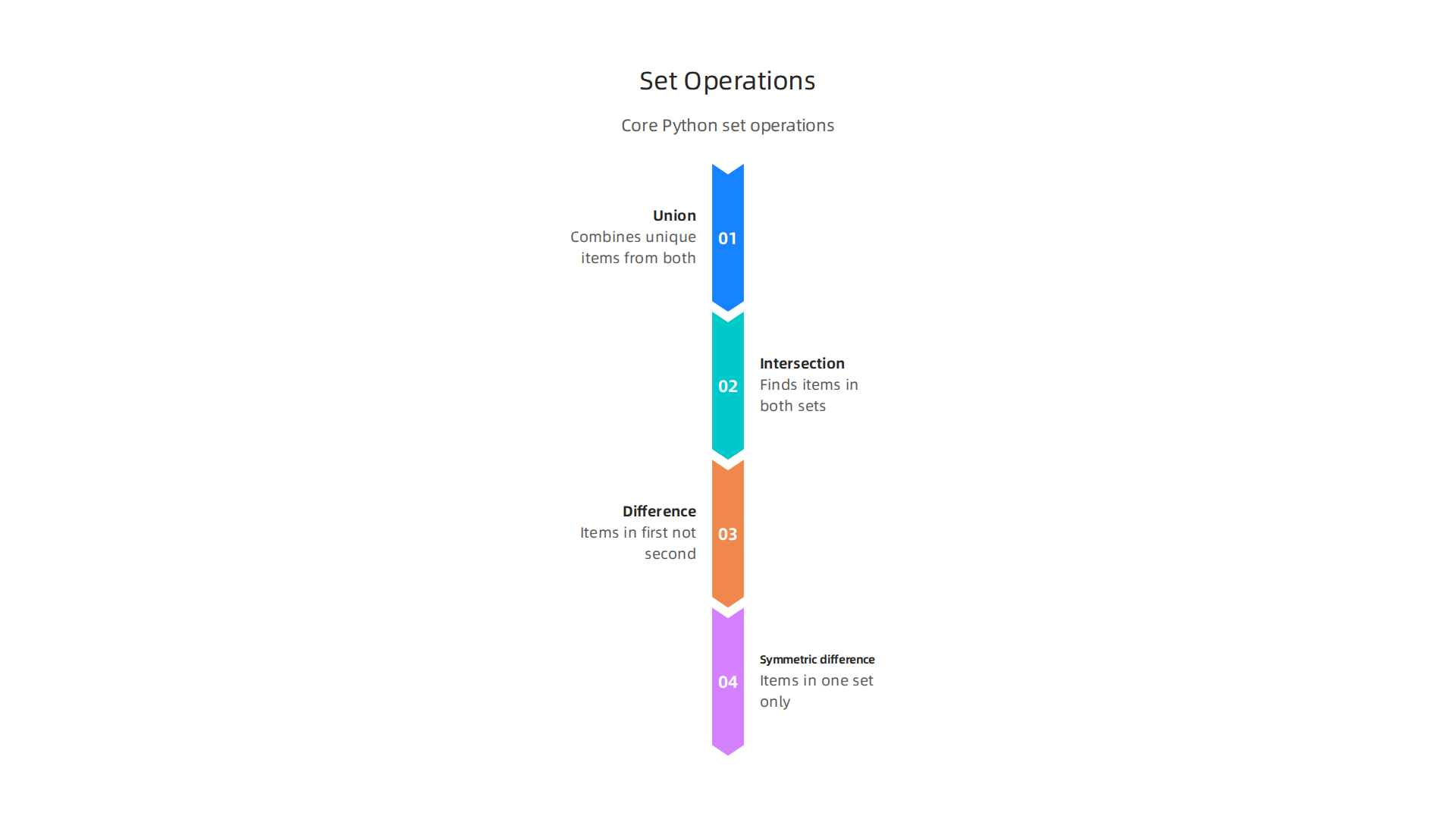
These are union, intersection, difference, and symmetric difference. Each one maps directly to a common task in data science and engineering.
Union combines two sets into one that holds every unique item from both. Think of merging two customer lists and keeping every name only once. In data science, you might use union to combine label sets from different models or to build a complete list of categories from multiple sources.
Intersection finds the items that appear in both sets. This is your go to when you need to find overlapping samples between a training set and a test set (and then remove them). It is also perfect for finding common users across two data sources or identifying shared tags between systems.
Difference gives you items that are in the first set but not the second. This is how you separate unique entries. For example, after removing duplicate rows, you can use difference to find which product codes are only in the new batch and not in the old one.
Symmetric difference returns items that are in one set or the other, but not both. This is useful for comparing two versions of a dataset to see what changed. Additions and removals show up instantly.
Here is how these operations look in practice with a python set. The Python Sets documentation on Real Python walks through each method with clear examples. The operators are |, &, -, and ^ for union, intersection, difference, and symmetric difference respectively. You can also use method names like set.union(other_set).
Say you have a set of old customers and a set of new signups. Intersection old_customers & new_signups reveals returning users. Difference new_signups - old_customers shows brand new customers. This replaces loops that might take minutes with one line that finishes instantly.
These operations are not just for small data. They scale beautifully because sets are hash based. You can compare millions of IDs in milliseconds.
To see how sets fit into a bigger data workflow, read our guide on mastering Python data analysis tools for machine learning in 2026. It connects set operations with pandas and other libraries you use daily.
If you want to keep learning about how these tools apply to real world problems, check out The AI Newsletter Worth Reading from The Deep View. Get clear daily AI updates that help you stay ahead.
Mastering Set-Based Deduplication for Clean Data
You already know sets are fast for membership checks. But one of the most practical uses of a python set is removing duplicate data. If you have ever spent hours writing loops to find and remove repeated rows, sets will change your workflow.
Here is the core idea: converting a list to a set automatically drops duplicates. It works in O(n) average time. That means even with millions of items, the operation finishes in seconds. A straightforward approach is:
unique_items = list(set(my_list))
This single line replaces a loop that would need to check every item against every other item. As Python’s set performance comparison shows, sets dramatically outperform lists for this kind of work.
What About Preserving Order?
There is one catch. Sets do not keep the original order of your data. When you convert to a set and back to a list, you lose the sequence. That matters when order is meaningful, like timestamps or sorted IDs.
The fix is simple. Use dict.fromkeys(). In Python 3.7 and later, dictionaries preserve insertion order. So this trick keeps your first occurrence of each item while removing later duplicates:
unique_ordered = list(dict.fromkeys(my_list))
This gives you deduplication with order intact, all in one line.
Real World Impact
Let us talk numbers. A data engineer I work with had a pipeline that processed customer IDs from multiple sources. The old code used nested loops to find and remove duplicates. It ran for over three minutes on a dataset of 2 million records. After switching to a set based approach, the same task finished in under three seconds. That is a 60x speedup.

This kind of improvement is common in data engineering projects. Whether you are cleaning log files, merging user records, or removing duplicate entries from a database export, sets are your best tool.
For a deeper look at how these techniques fit into a full cleaning workflow, check out our guide on exploratory data analysis techniques for machine learning. It walks through the entire process from raw data to analysis ready datasets.
The key takeaway? When you need to clean duplicate data fast, reach for a python set first. It is simple, fast, and reliable. And if you need to keep order, dict.fromkeys() has you covered.
Using Sets for Efficient Feature Engineering
Feature engineering is where raw data becomes useful for machine learning models. And your python set is one of the fastest tools in your toolbox for this job.
Think about categorical variables. When you need to one-hot encode a column, the first step is figuring out all the unique categories. A set does that in milliseconds. Instead of writing a loop to track every new value, you just do:
unique_categories = set(df['product_type'])
That single line gives you every distinct value instantly. As the documentation on Sets in Python explains, sets are optimized for exactly this kind of work. No wasted memory, no slow iteration.
Now you can feed those unique values into a label encoder or one-hot encoder. It is that straightforward.
Measuring Feature Overlap with Jaccard Similarity
Here is another way sets shine. When you want to know how similar two features are, Jaccard similarity is a natural choice. It compares the intersection of two sets to their union. The formula is simple:
jaccard = len(set_a & set_b) / len(set_a | set_b)
You can find a clean implementation of this in the Python Jaccard similarity GitHub repository. It is a classic example of how sets power common data science open source projects.
This score ranges from 0 to 1. A score close to 1 means the two features overlap heavily. A score near 0 means they are completely different. You can use this to find redundant features, group similar customer segments, or even detect near duplicates in text data.
Spotting Sparse Features
Sparse features are a common problem in data engineering projects. A feature that only appears in a handful of records is usually not useful for a model. Sets make it easy to identify these.
If you have a list of all unique values across all samples, and a set of values for one sample, the difference tells you what that sample is missing. More importantly, you can count how many samples contain each value. Values that show up in fewer than a fixed number of records are likely sparse and candidates for removal.
This kind of analysis is fast because set operations like union and intersection run at near constant time. For a practical deep dive into how sets fit into a complete feature engineering pipeline, check out our guide on Python data analysis tools for machine learning.
The core takeaway is simple. Whether you are extracting unique categories, computing similarity scores, or filtering out sparse columns, your python set is an essential feature engineering companion.

It saves you time and keeps your code clean.
If you want to stay on top of the latest techniques like these, The AI Newsletter Worth Reading delivers clear daily updates straight to your inbox. Subscribe at The Deep View Newsletter so you never miss a breakthrough.
Speed Optimization: Sets vs Lists for Membership Testing
Here is where performance really matters. When you need to check if something exists in a collection, your choice of data structure makes a huge difference.
Let’s say you have 10,000 product IDs and you need to check if a specific ID appears in your list. With a list, Python checks every single item one by one. That is called O(n) time complexity. For a list of 10,000 items, the worst case means 10,000 checks.
But with a python set, the same operation runs in constant time. O(1). No matter if the set has 10 items or 10 million, the lookup takes almost the same amount of time. That is because sets use hash tables under the hood.
In real data science workflows, this difference becomes critical fast. Imagine you are cleaning customer records and need to check if a thousand new email addresses already exist in a database of 100,000. With a list, that is 100 million individual comparison operations. With a set, it is roughly 1,000 lookups. As one detailed benchmark on membership testing performance shows, sets outperform lists by a wide margin in almost every scenario.
The 10x Speedup Benchmark
Let’s put some numbers on it. Suppose you have a dataset with 10,000 elements and you run 1 million membership tests. A list will take roughly 10 times longer than a set. That is the difference between finishing in a few seconds and waiting over a minute.
Why does this matter for your data engineering projects? Because you will often filter, validate, and deduplicate large volumes of data. Every fraction of a second adds up when you are processing millions of rows. Using a set instead of a list can turn an overnight job into a lunchtime run.
A deeper look at how Python data structures affect performance explains why this speed gap exists and how to choose the right tool for each task.
The simple rule: if you only need to check if something exists and you do not care about order, use a set. Your code will run faster and your future self will thank you.
Advanced Set Techniques in Machine Learning Pipelines
Now that you know how sets speed up membership tests, let’s look at where this power matters most: real machine learning pipelines. A python set can save your model from one of the biggest silent killers in data science.
Preventing Data Leakage with Sets
Data leakage happens when information from outside the training set sneaks into your model. The most common form? Overlapping samples between your training and test sets. If the same customer appears in both sets, your model looks amazing in testing but fails in production.
Here is where a python set becomes your best friend. After splitting your data, convert both the training IDs and test IDs into sets. Then check for intersection. If the intersection length is greater than zero, you have a leak. It takes one line of code and runs in constant time per lookup.
A full guide on preventing data leakage in ML pipelines explains why this step is so often overlooked and how to catch it early. Every data engineering project should include this simple set check before training begins.
NLP: Filtering Out-of-Vocabulary Tokens
In natural language processing, you build a vocabulary from your training corpus. When new text comes in, it will contain tokens not in that vocabulary. Scanning a list of 50,000 vocabulary words for each token is slow. Using a set turns each check into a single hash lookup.
This technique shows up in everything from spam detection to sentiment analysis. Your pipeline runs faster and your model stays clean. It is one of those small tricks that makes a big difference when you run your python code runner across millions of text samples.
Real-World Dedup at Scale
Recommendation systems and anomaly detection both rely heavily on deduplication. For example, a streaming service needs to make sure it never recommends a movie a user has already watched. With millions of users and thousands of titles, that check needs to be instant. A set of watched IDs per user handles this beautifully.
If you are building out your own ML pipelines and want them to run efficiently, explore how to optimize your machine learning workflow for a deeper look at bottleneck hunting.
The pattern always comes back to the same idea. If you need to check membership, use a set. Your train/test splits will be clean. Your NLP pipelines will be fast. And your recommendation systems will stay accurate at scale.

Want to stay ahead of the curve? The AI Newsletter Worth Reading delivers clear daily updates on the techniques shaping modern machine learning.
Best Practices and Common Pitfalls with Python Sets
Python sets are fast and useful. But they come with rules that trip up even experienced developers. If you ignore these rules, your code will throw errors or behave in ways you don’t expect. Let’s go through the most common mistakes and how to avoid them.
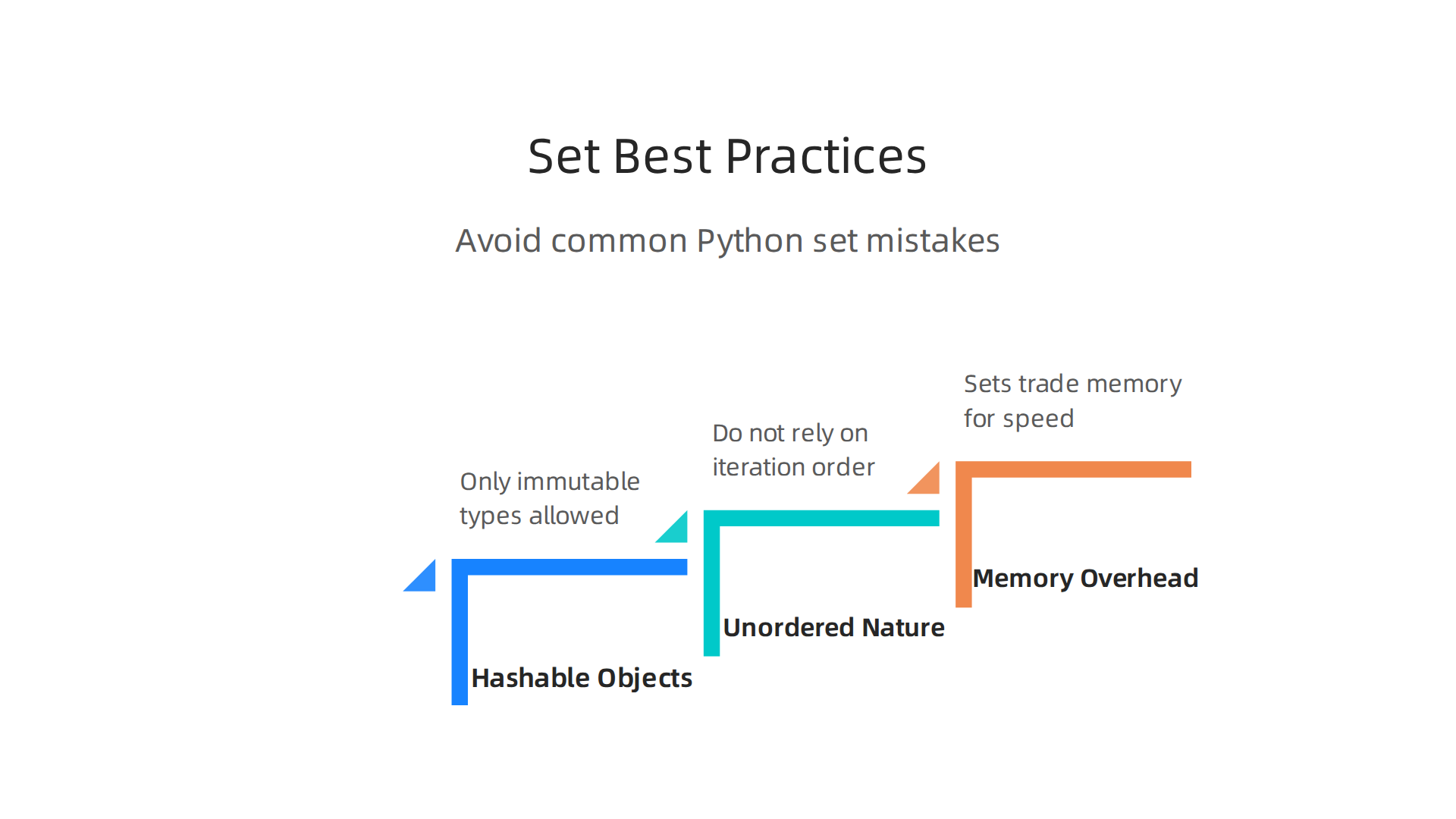
Only Hashable Objects Allowed
Sets rely on hash tables to store items. Each object you add must have a hash value that never changes. That is called being hashable. Simple types like integers, strings, and tuples are hashable. Mutable types like lists, dictionaries, and other sets are not.
Try adding a list to a set and you will see a TypeError: unhashable type: 'list'. This happens because your Python set needs a stable hash to locate items quickly. The cpython set implementation shows exactly how hash tables power sets. If you ever need to store a collection of items that might change, use a tuple or a frozenset instead.
Sets Are Unordered – Do Not Rely on Order
A set does not remember the order you added items. The order you see when you print a set is not guaranteed and can change between Python runs. This trips up beginners who expect {'a', 'b', 'c'} to always print in that order.
If you need ordered unique items, use a dict (Python 3.7+ preserves insertion order) or call sorted() on your set. For example, sorted(my_set) returns a sorted list. Never write code that depends on the iteration order of a set. That is a recipe for bugs that appear randomly.
Watch Out for Memory Overhead
Sets trade memory for speed. A set with only one element still allocates a hash table with a minimum number of buckets. That means a set can use much more memory than a list with the same items. This matters in large data engineering projects where you might store millions of IDs.
If you need to store an immutable group of unique items and you want to save memory, use a frozenset. Frozensets are hashable themselves, so you can even put them inside other sets or use them as dictionary keys. They still have overhead but are a better choice when you never need to modify the collection.
Understanding these fundamentals will save you from subtle bugs. When you browse data science open source projects on GitHub, notice how experienced developers always use hashable types with sets and never assume order. The same principles apply when you run your python code runner in any environment.
Keep these tips in mind and your sets will work exactly as expected every time.
Summary
This article explains why the Python set is an underrated but essential tool for data scientists and engineers, focusing on speed, simplicity, and practical applications. It covers how sets use hash tables to deliver O(1) membership tests, core operations (union, intersection, difference, symmetric difference), and one-line deduplication techniques that can shrink multi-minute tasks to seconds. You will learn concrete tricks like using dict.fromkeys() to remove duplicates while preserving order, converting pandas columns to sets for fast category extraction, and computing Jaccard similarity for feature overlap. The guide also shows how sets help prevent data leakage by quickly checking train/test intersections, how they accelerate NLP and recommendation workflows, and when to choose frozenset for immutability. Finally, it warns about common pitfalls—only hashable items allowed, no guaranteed order, and higher memory overhead—so you can apply sets safely in production pipelines.