
The Open Future AI Companies Leading the Industry in 2026
Introduction
The world of artificial intelligence moves at lightning speed. Every week brings a new model, a new funding round, or a bold claim about what AI can do. Keeping up is exhausting. Worse, it is hard to tell which companies are truly building the future and which ones are just riding the hype wave.

That is exactly where this article comes in. We cut through the noise to give you a clear, data-driven look at the key players and trends shaping what many now call "open future AI." This idea is about more than just open source code. Open future AI represents a shift toward transparency, collaboration, and shared progress in artificial intelligence. Names like Etched AI, Fast AI, and Coactive AI are emerging alongside the giants, each pushing the boundaries in different ways. For a deeper dive into where open source AI is heading, check out our analysis of open-source AI 2026 trends.
To understand where the market stands today, look at the numbers. The largest AI companies by market capitalization show NVIDIA leading near $4.7 trillion, with Alphabet, Microsoft, and Meta following closely. Meanwhile, the Forbes 2026 AI 50 list highlights how model makers like OpenAI ($86 billion valuation) and Anthropic ($18.4 billion) are drawing massive funding, while infrastructure firms like Databricks ($43 billion) are growing fast.
This article will give you a practical framework for evaluating AI leadership in 2026. You will learn which companies are leading, why they matter, and what the "open future" trend means for your work or investments. We also share actionable insights to help you stay ahead.
If you want to keep up with daily AI breakthroughs without the overwhelm, subscribe to The AI Newsletter Worth Reading. It delivers clear, concise updates straight to your inbox.
Defining Market Leadership in 2026
So how do we actually measure who leads the open future AI movement? Market cap alone won’t cut it. Just look at the numbers: NVIDIA sits near $5 trillion, but that raw valuation only tells part of the story. The real question is which companies are shaping the direction of AI for everyone, not just their own shareholders.
Leadership in 2026 requires a blend of four things:
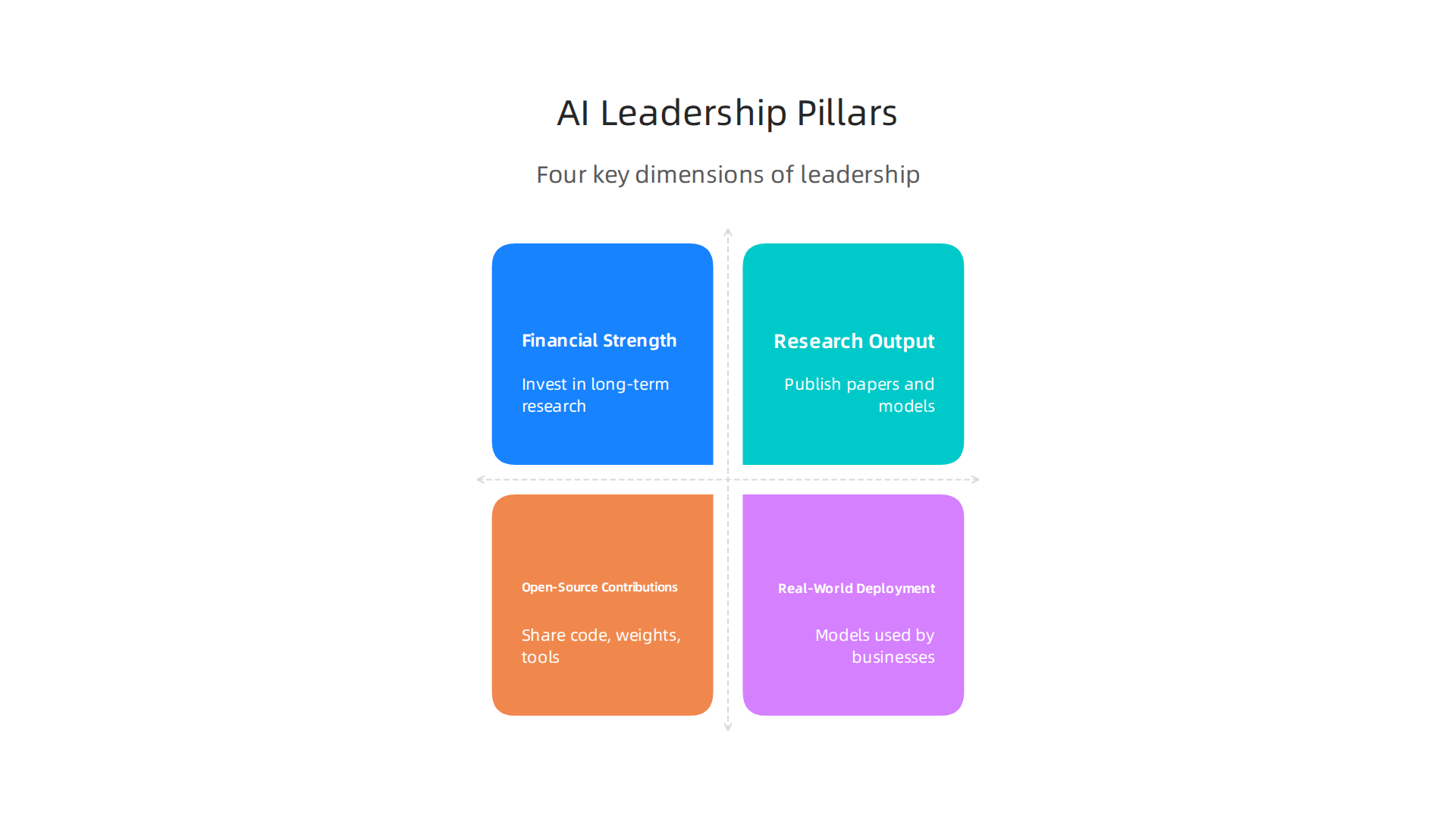
- Financial strength — Can the company invest in long-term research and survive the cost of training massive models?
- Research output — Are they publishing papers, releasing models, and advancing the field?
- Open-source contributions — Do they share code, weights, and tools that others can build on?
- Real-world deployment — Are their models actually being used by businesses and developers outside their own walls?
Traditional metrics like revenue still matter, but they are being supplemented by adoption rates, ecosystem influence, and ethical reputation. A company can have billions in revenue but zero community trust. That does not make it a leader in the open future AI sense.
Let’s look at a quick example. The top AI companies to watch in 2026 list from VanEck highlights NVIDIA, TSMC, and Broadcom for infrastructure. Those are financial leaders. But when you shift to open source leadership, names like Mistral AI and Cohere appear, smaller in market cap but huge in community impact. That is the split we need to understand.
Companies like Etched AI are building custom chips specifically optimized for transformer models, which could shake up the hardware market. Fast AI continues to democratize deep learning education with free courses and libraries. Coactive AI focuses on making unstructured visual data searchable with open tools. Each of these companies leads in a different dimension of the open future AI landscape.
For a deeper look at where the industry is heading, check out our AI predictions for 2026. It covers shifts in funding, regulation, and model release strategies.
The framework we use focuses on this simple question: Does the company make AI more accessible and transparent for the wider community? If yes, it belongs in the conversation about open future AI leadership. We will apply this lens to the biggest players next.
The Open Innovation Shift
Not long ago, the AI world was dominated by closed, proprietary models. If you wanted top performance, you paid for access through an API. Open source models were seen as a nice experiment, but not serious contenders. That has changed fast.
Here is the clearest sign yet: Stanford’s 2026 AI Index shows the performance gap between the best closed model and the best open model has shrunk to just 3.3%. As Forbes reports, open source AI is moving from sideshow to strategy. Hugging Face now hosts over 2 million models and more than 30% of Fortune 500 companies have verified accounts there.
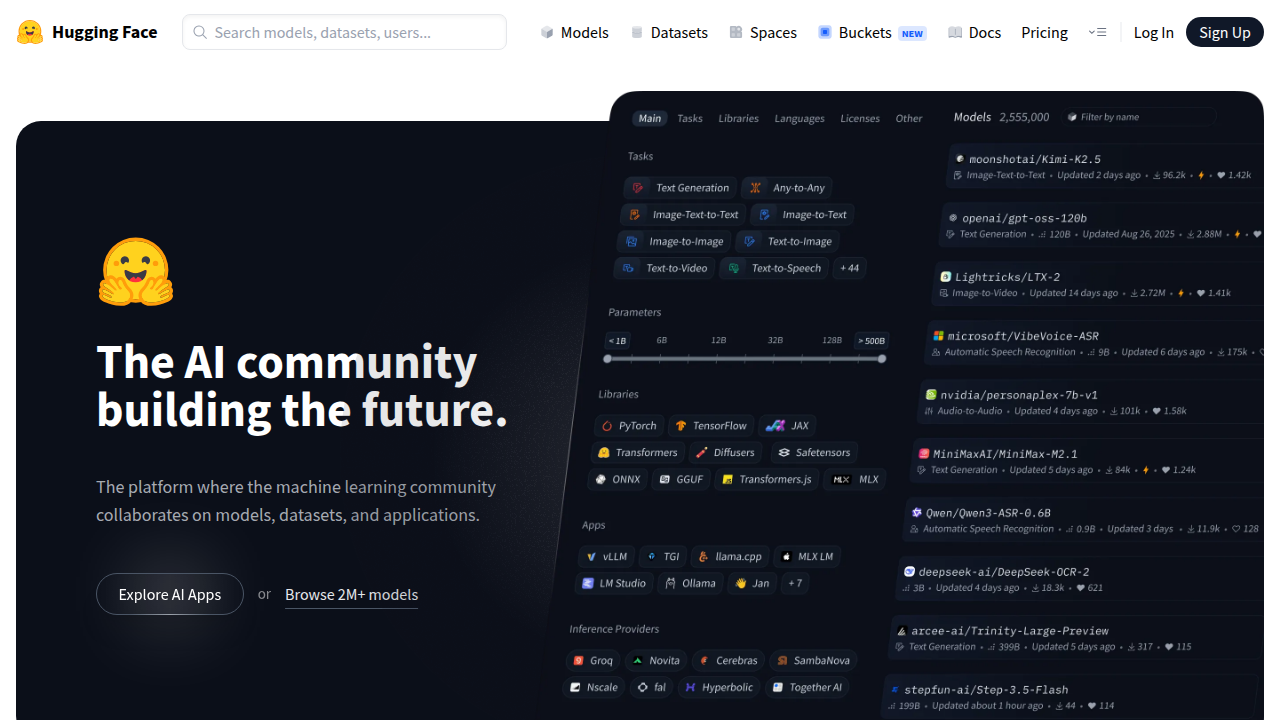
The ecosystem is no longer a side project. It is becoming the foundation of how AI gets built and deployed.

So what is driving this shift? Three things.
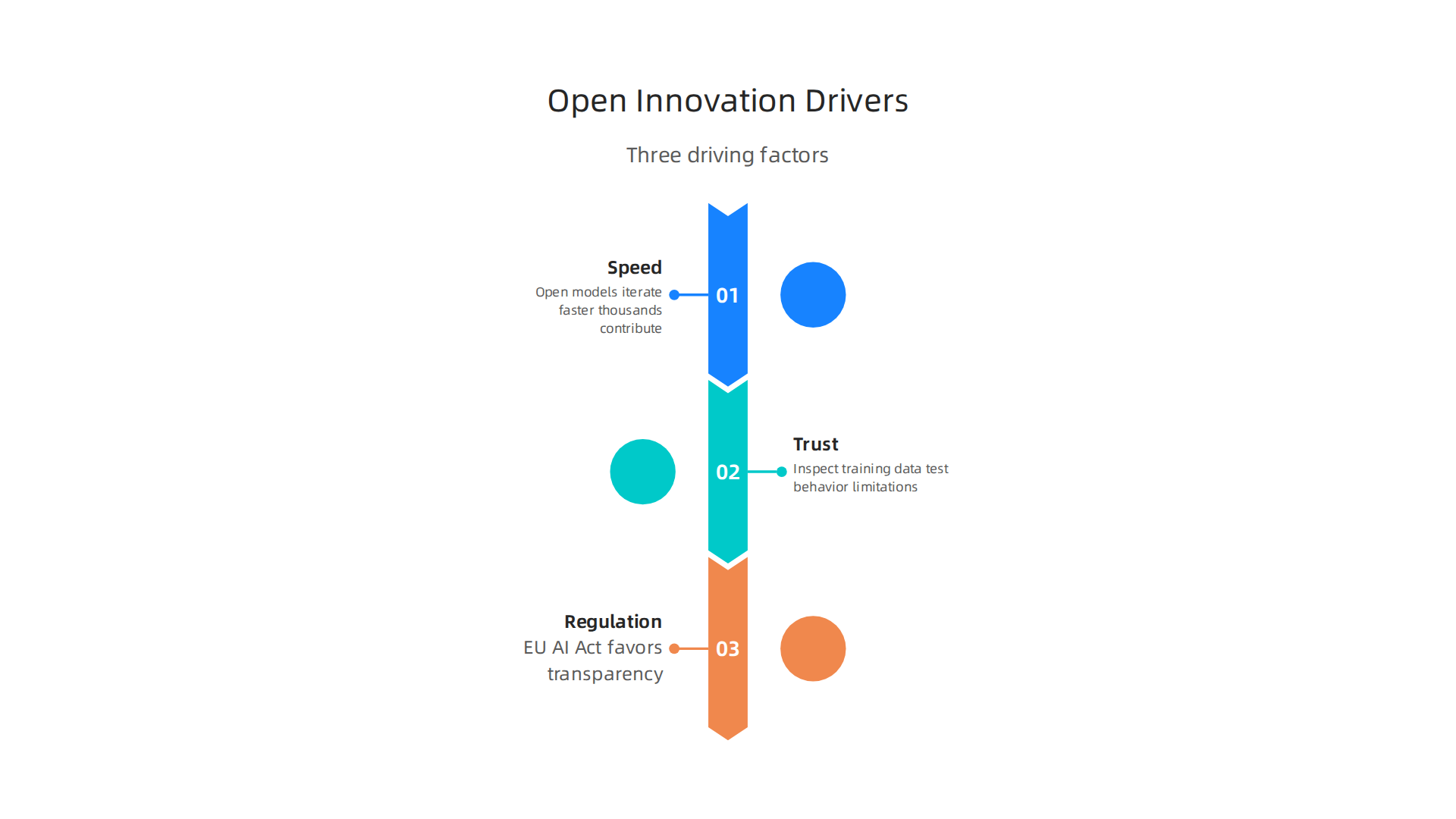
First, speed. Open models iterate faster because thousands of developers can contribute, test, and improve them simultaneously. A closed lab needs to hire more engineers and run more experiments internally. The open community runs experiments in parallel across the whole planet.
Second, trust. When a model is open, you can inspect its training data, test its behavior, and understand its limitations. That builds confidence, especially for industries like healthcare and finance where decisions need to be explainable.
Third, regulation. Governments are waking up to AI risks. The European Union’s AI Act and similar frameworks favor transparency. Open models have a natural advantage here. They are harder to ban and easier to audit.
This is where the open future AI philosophy becomes a real strategic advantage. Companies that embrace it do not just look good. They move faster, earn user trust, and stay ahead of regulation.
Take Fast AI and Coactive AI as examples. Fast AI gives away free deep learning courses and libraries, building a generation of practitioners who trust and use their tools. Coactive AI makes visual data searchable with open components, letting businesses adopt their technology without fear of vendor lock-in. These are not charity moves. They are smart business plays.
To get a fuller picture of how this trend is reshaping machine learning, check out our guide to open source AI trends for 2026. It covers the key frameworks, communities, and models driving this change.
The message is clear: open innovation is not just nice to have. In 2026, it is becoming the default way to build AI that people actually want to use.
And if you want to stay ahead of every twist in this story, get clear daily AI updates from The Deep View Newsletter. It cuts through the noise so you can focus on what matters.
Key Players: The Giants and the Disruptors
So who is actually making the open future AI movement happen? Two groups. The tech giants with deep pockets, and the scrappy startups moving faster than anyone expected.
Let’s start with the big players.
OpenAI is still the revenue king. Even though it has moved toward closed models, its $78 billion in funding and partnerships with Microsoft set the bar for the whole industry. Everyone else is chasing OpenAI’s lead.
Google DeepMind brings decades of research muscle. Its work on reinforcement learning and language models pushes the entire field forward, and its open research papers give the community raw material to build on.
Meta is the clearest champion of open models. By releasing the LLaMA family for free, Meta showed that giving away top-tier AI can be a winning business strategy. More developers trust Meta’s tools than ever before.
Hugging Face is the platform that makes open AI work in practice. With over 2 million models hosted, it is the place where the community shares, tests, and improves models together. No Hugging Face means no open AI ecosystem.
Mistral AI is Europe’s answer to the AI race. It releases most of its models for free, proving that openness can compete with the biggest labs. According to the Forbes AI 50 list, Mistral has raised over $527 million and is valued at $2 billion.
Now the disruptors.
DeepSeek shocked the industry by releasing an open model that rivaled closed alternatives at a fraction of the cost. It proved that transparency can beat secrecy.
Fireworks AI ($4 billion valuation) helps developers get access to the latest open models without managing complex infrastructure. It makes the open future AI accessible to small teams.
Thinking Machine Labs comes from former OpenAI CTO Mira Murati. With $2 billion raised, it is building the next generation of open AI from scratch.
World Labs is the brainchild of Stanford legend Fei-Fei Li. It focuses on spatial intelligence using more than $1 billion in funding, and it shares its findings openly.
Perplexity AI redefined search by combining multiple models into one interface. It proves that openness across models leads to a better user experience.
The lesson is simple. Giants and disruptors are both betting on openness. For anyone building in AI, understanding their strategies helps you decide where to put your energy and your money.

To dive deeper into the frameworks and communities powering this shift, check out our guide to open source AI trends for 2026.
Technological Breakthroughs Driving the Market
All that talk about giants and disruptors matters because of what is actually possible right now. 2026 is the year the technology itself started catching up to the promises. Three specific breakthroughs are making the open future AI vision real: radical model efficiency, native multimodal capabilities, and the shift from chatbots to agents that actually do things.
First, model efficiency has changed everything. For years, the best AI required huge budgets and custom hardware. Not anymore. According to Forbes, the performance gap between the top closed model and the best open model has shrunk to just 3.3% as of March 2026. Open source models from China, Mistral, and Meta now rival GPT and Claude in many tasks. This narrowing gap means smaller teams can build serious products without begging for API access. Tools like fast.ai and Coactive AI are making it easier for developers to fine-tune these efficient models on their own data, cutting both cost and time.
Second, AI has woken up to the real world. Models are no longer stuck with text. They see, hear, and speak. A detailed timeline of AI innovations from early 2024 through early 2026 shows how models like OpenAI’s GPT-4o, Meta’s Llama 4, and Google’s Gemini became natively multimodal. They can understand images, audio, and video in real time. For open future AI, this is huge. Open models that handle multiple senses mean you can build a customer support bot that reads screenshots, a medical assistant that analyzes X-rays, or a creative tool that edits video, all without locking into a single vendor.
Third, we are seeing the agentic transition. AI has graduated from answering questions to taking action. InfoWorld highlights breakthroughs in agent interoperability, self-verification, and memory that are turning isolated tools into full systems. Open source frameworks like LangGraph, CrewAI, and Hugging Face’s Open Responses API let developers build agents that talk to each other, check their own work, and complete multi-step tasks autonomously. In 2026, a developer can stitch together an agent that handles customer inquiries, updates a database, and books meetings, all running on open models.
These breakthroughs are not just academic. They are lowering the barrier to entry for startups and enterprises alike. If you want to dive deeper into the technologies powering this shift, check out our detailed guide on LLM AI technologies and research you need to track in 2026.
The pace of change is fast, and staying on top of every new model and framework is tough. That is why thousands of ML engineers and data scientists rely on daily curated updates. Get clear, daily AI news straight to your inbox from The Deep View Newsletter.
Ethical and Regulatory Landscapes
All these breakthroughs are exciting, but they raise hard questions. As AI spreads into healthcare, hiring, law enforcement, and education, ethical concerns and regulations are moving from the background to center stage. The open future AI community sits right in the middle of this debate.
Why? Because open models give more people power to build and modify AI. That is great for innovation, but it also makes it harder to control misuse. The conversation around transparency, bias, and accountability is heating up fast.
Let’s look at the key risks first. The Stanford Emerging Technology Review breaks down several major concerns with today’s AI.
Models cannot explain how they reach conclusions. Bias lives in training data and gets amplified. Deepfakes can trick voters and juries. And models still hallucinate, confidently giving wrong answers. These issues affect every open future AI project just as much as proprietary ones.
In response, regulators are stepping in. The Info-Tech Research Group highlights that AI risk management is becoming a requirement, even in places without formal laws. Companies are building their own guardrails because the public and investors demand it. Another big trend is AI sovereignty, where countries want to control their own AI models and data rather than relying on foreign providers. That plays directly into the open future AI model, since open weights allow nations to inspect, modify, and host models locally.
Voluntary standards are also emerging. Groups like the Partnership on AI and the National Institute of Standards and Technology (NIST) have published frameworks for trustworthy AI. These cover fairness, transparency, and security. Many open source projects are adopting these standards early, seeing it as a competitive advantage.
The open future AI community has a unique role here. Because open models are transparent by design, they allow researchers and auditors to check for bias and safety issues in ways closed models do not. This transparency is a huge asset for building trust. If you want to understand the specific dangers in more detail, check out our guide on the dangers of AI bias, deepfakes, and job loss in 2026.
The bottom line is that ethical and regulatory pressures are not slowing down open future AI. They are shaping it. Developers who bake transparency and fairness into their workflows from the start will be ahead when stricter rules arrive.
Investing in Open Future AI: Opportunities and Risks
Money is moving fast in AI right now. Venture capital is pouring into the space at record levels, and a growing share of that funding is going to open ecosystems.

But smart investing in 2026 means looking past the hype and understanding the real risks.
According to the latest AI Index Report from Stanford, U.S. private AI investment reached $285.9 billion in 2025. That is more than 23 times what China invested privately in the same year. The U.S. also led in startup activity with 1,953 newly funded AI companies. These numbers show how much capital is chasing the next big breakthrough.
For investors, open future AI companies offer something unique. Open models let anyone inspect, modify, and build on the technology. That transparency attracts developers and creates strong communities around a product. Companies like Mistral AI, with over $500 million raised and a $2 billion valuation, prove that open source AI can attract serious funding from top firms like Andreessen Horowitz and Lightspeed Venture Partners.
But there are real risks too. The Fidelity investment outlook for 2026 flags that some AI stocks may be overvalued based on speculative potential. Hype cycles can push prices up fast, and pullbacks can be painful. Technical risks also exist. Open models can be harder to monetize than closed ones. And regulatory uncertainty means rules could change in ways that affect business models overnight.
So how do you evaluate an AI investment in 2026? Here is a simple framework.
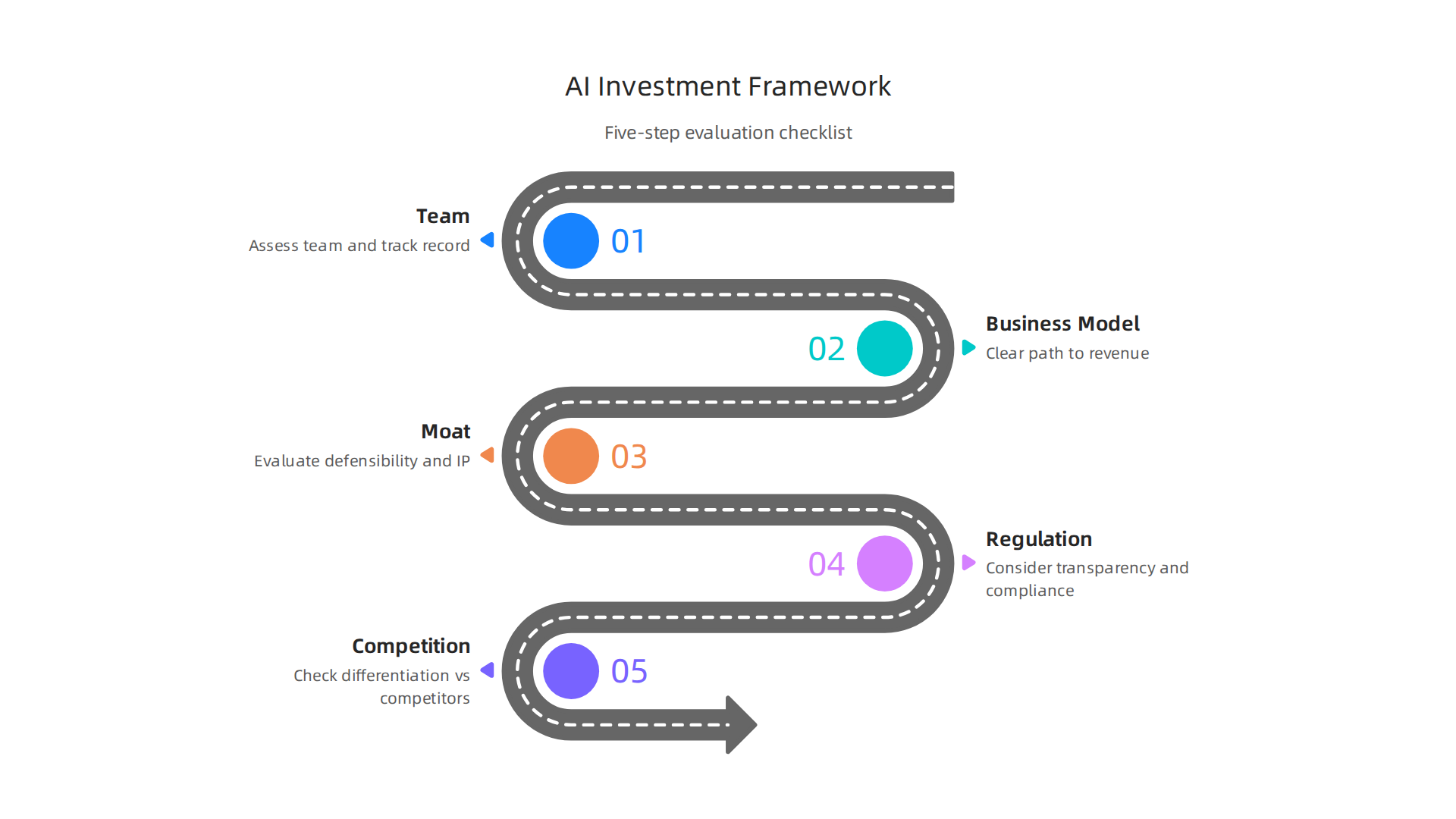
First, look at the team and their track record. Second, examine the business model. Does the company have a clear path to revenue, or is it relying on future promise? Third, assess the technical moat. What makes their open future AI approach defensible? Fourth, consider the regulatory landscape. Is the company building with transparency and compliance in mind from day one? If you want a deeper look at where the entire open source movement is headed, read our guide on open source AI 2026 trends.
Fifth and finally, watch the competitive landscape. The biggest AI companies like OpenAI and Anthropic have raised a combined $242.6 billion. Smaller startups need a clear differentiation to survive.
The opportunity in open future AI is real, but it requires patience and careful research. The companies that survive will be the ones that balance innovation with practical business sense.
Staying on top of all these moving pieces is a full-time job. That is why many investors and builders rely on a daily digest to cut through the noise. Get clear daily AI updates from The AI Newsletter Worth Reading straight to your inbox so you never miss a key development.
Summary
This article maps the rise of