
Why Enterprise Data Systems Are the Backbone of AI Success
The New Parity: Why Enterprise Data Systems Are the Backbone of AI Success
Here’s a quick truth: your machine learning models are only as good as the data infrastructure feeding them. In 2026, that statement isn’t just a best practice. It’s the new baseline.
Here’s the thing. Every week, data scientists, ML engineers, and technical leaders face a flood of new tools, frameworks, and platforms. Researchers drop new papers daily. Cloud vendors launch features monthly. And somewhere in the noise, you need to figure out which architecture choices actually move the needle for your organization.
The stakes are higher than ever. Modern enterprise data systems directly impact model performance and deployment speed. A poorly designed stack doesn’t just slow you down. It creates bottlenecks that compound across teams, delay releases, and inflate cloud costs. On the flip side, a well-structured data architecture can cut your time-to-production in half and give your models a real edge.
2026 marks a clear shift. We’re moving away from siloed data warehouses and batch-only pipelines toward unified data and AI platforms. According to the latest enterprise technology adoption data, two-thirds of organizations have already implemented AI/ML integration in some form. Cloud-native architectures have reached 74% adoption, and the trajectory points higher. That convergence isn’t a coincidence. As companies deploy more models, the underlying data systems need to keep up.
For professionals drowning in information overload, this makes trusted benchmarks essential. You need a clear view of what works, what doesn’t, and which architectural patterns are worth your team’s time. Understanding the entire enterprise data systems and analytics ecosystem is critical for making smart decisions about your stack.

If you want to stay ahead of these shifts, we recommend The AI Newsletter Worth Reading.

It delivers clear daily AI updates that cut through the noise and help you track the trends that matter.
This article breaks down the state of modern enterprise data systems & analytics. We’ll cover the architectures that are winning in 2026, where the industry is heading, and how to choose the right path for your team. You’ll also find practical guidance on how to build trust in your data and evaluate industry analytics platforms. Let’s start by looking at the key trends reshaping the landscape. For a broader look at what’s coming, check out our overview of AI predictions 2026.
Modern Data Architecture Trends Shaping 2026
So what do these winning architectures actually look like in practice? Three major patterns are defining how teams build their enterprise data systems and analytics stacks this year.
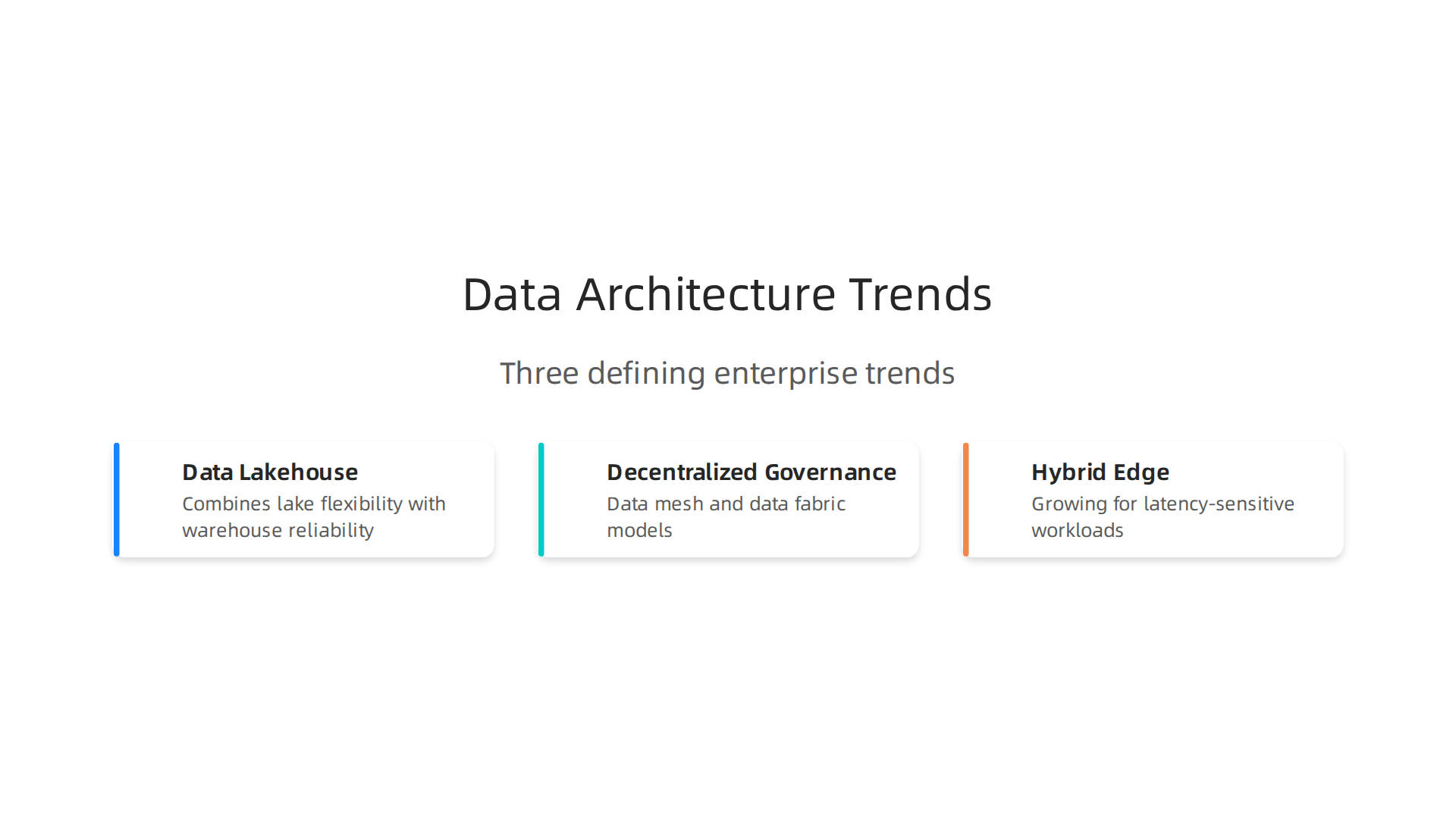
First up is the data lakehouse. This architecture has quickly become the de facto standard for new projects. It combines the flexibility of a data lake with the performance and reliability of a data warehouse. Instead of managing two separate systems, you get one unified platform that handles both raw data storage and structured analytics. The data lakehouse market is growing fast, and according to a recent modern data architecture benchmark report, it is on track to reach 66 billion dollars by 2033. That growth rate makes it the fastest adopted pattern in the industry.
The second trend is the rise of decentralized governance models, specifically data mesh and data fabric. These two sound similar but solve different problems. A data mesh gives ownership back to domain teams. Each team manages its own data as a product, with shared standards for quality and access. This works great for large organizations where a central data team can’t know every use case. A data fabric, on the other hand, focuses on creating a unified layer across all your existing systems. It uses AI-driven metadata to connect legacy databases, cloud storage, and streaming platforms into one logical view. For enterprise data systems and analytics, the real winning pattern in 2026 combines lakehouse storage with fabric metadata and mesh ownership. No single architecture wins alone.
Third, cloud-native still dominates, but hybrid and edge computing are growing fast for latency-sensitive workloads. Cloud-native architecture has reached 74% adoption among enterprises, and Gartner predicts that 95% of new digital workloads will run on cloud-native platforms by 2028. However, operational decisions like fraud detection and real-time personalization need data that is seconds old, not hours. That demand is pushing compute closer to where data lives, meaning more teams are adding edge processing into their hybrid cloud strategies.
For teams looking to evaluate which platform fits their needs, our guide on data analysis tools for ML teams breaks down the key factors to consider.
Analytics Solutions for ML Pipelines: Platforms, ETL, and Feature Stores
So you have your modern data architecture. But how do you actually feed your machine learning models the right data at the right time? That is where analytics solutions for ML pipelines come in. In 2026, three components dominate how teams build and run their applied data tools and analytics: feature stores, modern ETL/ELT tools, and integrated ML platforms.
Feature stores become a must have
A feature store is a central place to store, manage, and serve features for machine learning models. It keeps a record of every feature you create and makes sure your training and prediction data come from the same place. According to the Hopsworks dictionary, a feature store acts as the key data layer in an MLOps platform. It helps you reuse features across models, track how features change over time, and serve them in real time.
Feature stores use two types of storage. An offline store holds historical feature data for training models. An online store delivers fresh feature values for live predictions with very low delay. This dual setup is what makes feature stores so useful. You train on past data and serve on current data, without the two ever getting out of sync.
Many teams now see feature stores as essential for reproducibility and reuse. Without one, data scientists often rewrite the same feature engineering code for each new model. That leads to wasted time and errors. With a feature store, you define a feature once and use it across many models. This consistency is a big reason why industry analytics platforms are adding built in feature store capabilities.
Modern ETL and ELT handle both batch and streaming
The old idea of ETL (extract, transform, load) has changed. In 2026, teams need to process data as it arrives, not just in nightly batches. Modern ELT tools let you load raw data first and transform it later. This gives data scientists more flexibility.
But the real change is that data pipelines now must stream. Real time analytics and live model predictions depend on data that is seconds old, not hours. Tools like Apache Kafka, dbt, and Fivetran now support both batch and streaming workflows. Teams can set up a single pipeline that handles both types, which cuts down on complexity.
For example, when you need to update a recommendation model every few minutes, a streaming ETL pipeline feeds fresh data into the feature store. The model then uses those fresh features to make better predictions. Without this, your model would always be one step behind. Mastering these pipeline patterns requires strong coding skills. Our guide on mastering python data workflows for peak performance can help you build efficient transformations.
Integrated platforms blur the line between data and AI
Big platform providers are making it easier to build end to end ML pipelines. Databricks, Snowflake, and Amazon SageMaker now offer tools that handle everything from data ingestion to model serving.
This means you do not need to stitch together separate tools for data engineering and machine learning.
These integrated platforms come with built in feature stores, automated ETL, and model monitoring. They also work with popular open source frameworks. The goal is to let data scientists and engineers work in one environment without switching between systems. For enterprise data systems and analytics, this unified approach reduces friction and speeds up model delivery.
With so many analytics solutions for ML pipelines available in 2026, picking the right stack can feel overwhelming.

That is why staying informed on the latest tools and best practices matters. A great way to keep up is by following a trusted daily source of AI insights.
The AI Newsletter Worth Reading gives you clear, daily updates on the most important AI and machine learning developments, so you never miss a key trend.
Data Quality and Governance: The Hidden Bottleneck in Enterprise Analytics
Getting your data into the pipeline is only half the battle. The other half is making sure that data is actually good enough to use. In 2026, poor data quality is quietly wrecking budgets and model performance across nearly every industry. A recent report on AI data quality as the top business problem in 2026 found that organizations lose an average of $12.9 million each year because of bad data. That number includes wasted engineering time, failed AI projects, and decisions made on faulty numbers.
The problem goes deeper than just money. When your training data has errors, missing values, or hidden biases, your models learn those flaws. The effects show up later as wrong predictions, uneven customer treatment, or compliance headaches.

With new laws like the AI Act in Europe and stricter enforcement of GDPR and CCPA, companies cannot afford to ignore data quality. Weak governance exposes you to audits and fines that can top 20 million euros.
So what can you do about it? The first step is knowing what you have. Data cataloging tools help you list every dataset, where it came from, and where it is used.
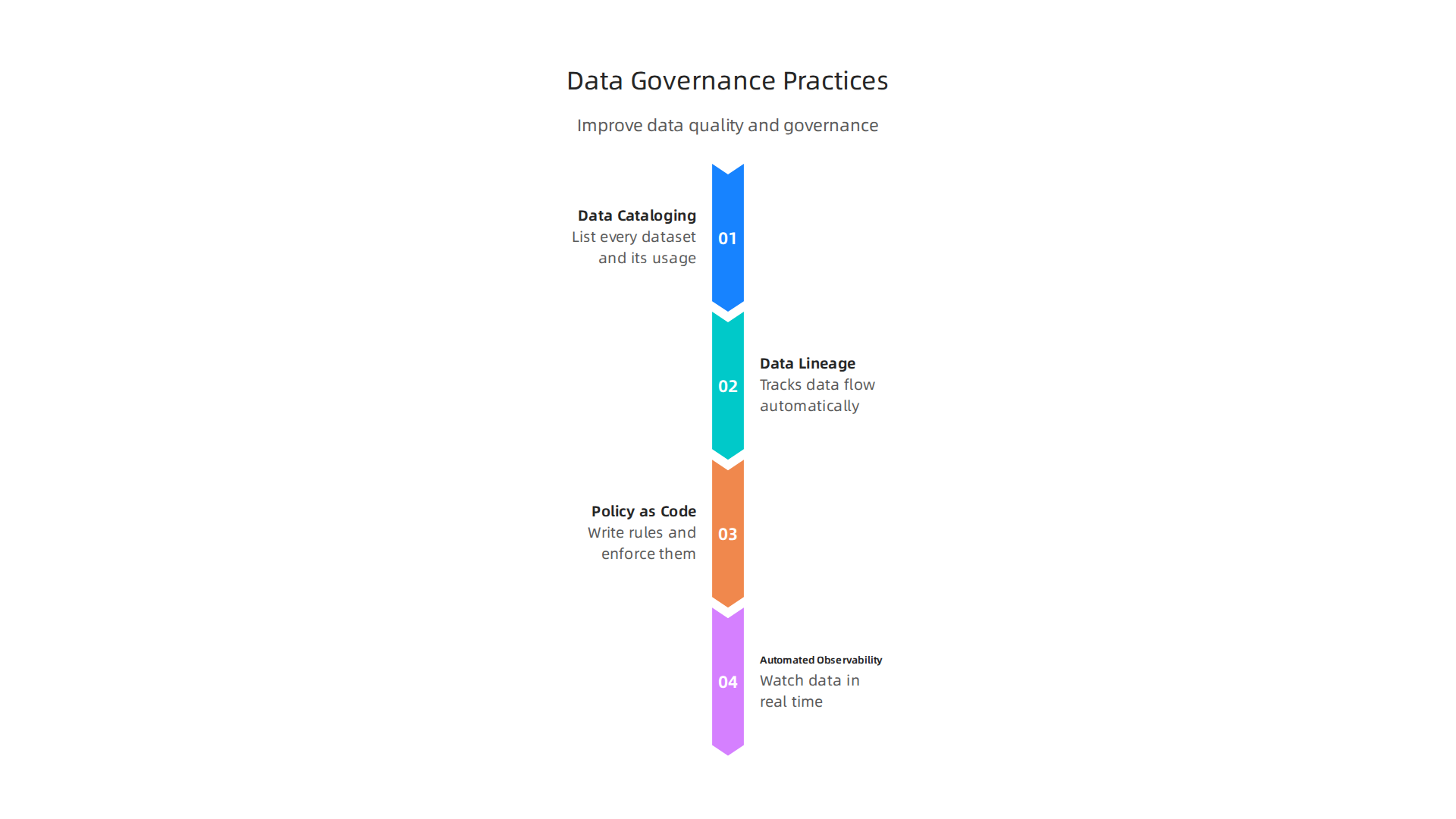
Data lineage tracks that flow automatically, so you can trace a prediction back to the raw input that caused it. Policy as code then lets you write rules like "no personal data in the training set" and enforce them automatically across your pipelines.
Beyond cataloging, automated data observability tools watch your data in real time. They check for anomalies such as sudden volume drops, missing fields, or distribution shifts. When something looks wrong, they alert you before your model starts making bad recommendations. These tools measure freshness, schema changes, and consistency so you can catch drift early.
If you want to cut the hidden bottlenecks in your enterprise analytics, start by measuring the cost of bad data in your own organization. Assign clear ownership for the most critical datasets. Embed quality checks into your existing workflows. And consider adopting a modern platform that ties governance, observability, and model monitoring together.
For a deeper look at how to streamline your entire machine learning lifecycle, check out this practical guide on how to optimize your machine learning workflow to cut bottlenecks and speed up model delivery. It covers many of the same governance and quality principles, but with step by step advice you can apply today.
Real-Time Analytics and Streaming Data for AI Applications
Once your data is clean and governed, the next big challenge is speed. Your models need fresh features to make accurate predictions, especially for AI applications that act in seconds. That is where real-time analytics and streaming data come in. In 2026, enterprise data systems increasingly rely on streaming platforms like Apache Kafka, Amazon Kinesis, and Apache Flink to move and process data as it happens. These tools power low-latency feature engineering and real-time inference across industries from fraud detection to recommendation engines.
Streaming data platforms are the backbone of modern feature engineering. Instead of waiting for nightly batch jobs to compute features, streaming pipelines transform raw events into ready-to-use feature values within milliseconds. This matters most during model inference, where stale features can lead to wrong predictions. According to IBM, a feature store uses an online store to maintain current feature values and support low-latency lookup during model inference. Platforms like Flink handle event-by-event processing, while Kafka acts as a durable event log. Choosing the right architecture means balancing consistency, latency, and cost. A true streaming setup gives sub-second freshness but costs more to operate. Many teams start with micro-batch processing using Spark to get near-real-time results at a lower price point.
Event-driven architectures are making it easier to retrain models continuously. Instead of rebuilding a model on a fixed schedule, your pipeline can trigger a retraining run as soon as new data arrives. This keeps models aligned with changing patterns and reduces the lag between data generation and deployment. Tools like Kafka and Flink work together to support exactly-once processing and stateful operations, which are critical for production ML workloads. By adopting this architecture, your team can build industry analytics platforms that react to events in real time rather than playing catch-up.
To build effective applied data tools and analytics, start by defining your latency requirements. Measure the gap between a source data change and when your model sees that change. Then choose the right streaming engine for your workload. For a deeper look at selecting the right platforms for your team, check out our guide on choosing the right data analytics platform for ML teams. And if you want to stay ahead of these trends with daily insights, get clear daily AI updates from The Deep View Newsletter. It covers real-world examples of how companies are scaling real-time analytics, event-driven ML, and modern data infrastructure.
Scalability and Cost Optimization in Data Systems for ML
As your ML pipeline grows, so does your cloud bill. In 2026, enterprise data systems & analytics face a tough balance: you need more compute and storage to handle larger datasets and more frequent model runs, but budgets don’t stretch forever.

The good news is that you can scale your data systems without breaking the bank if you pick the right strategies.
One of the fastest ways to cut costs is to use spot instances for non-critical workloads. Spot instances let you rent spare cloud capacity at a huge discount, often 60% to 90% less than on-demand prices. They work great for batch training jobs, data preprocessing, and model evaluation tasks that can tolerate interruptions. Pair spot instances with auto-scaling groups so your cluster grows and shrinks based on actual demand. This way you never pay for idle resources.
Data partitioning and compression also save serious money. Instead of storing your entire feature table as one giant blob, split it by date, region, or customer segment. Then compress the data using columnar formats like Parquet or ORC. These techniques shrink storage costs by 50% or more and speed up query times because your processing engines only read the partitions they need. For older data that you access less often, use tiered storage. Move stale features and logs to cheaper object storage like Amazon S3 Glacier or Azure Archive. Your critical model inference still uses fast hot storage, but everything else sits in a low-cost tier.
Serverless data processing is another game-changer for cost. Platforms like AWS Lambda, Google Cloud Run, and Azure Functions let you run code only when events happen. You pay per execution, not for a server sitting idle. This works well for real-time feature computation, where you only process data when a new event arrives. For heavier batch loads, serverless Spark offerings like Databricks Serverless or Google Dataproc Serverless scale automatically and charge by the second. These applied data tools and analytics platforms remove the guessing game of capacity planning.
When you scale your data pipelines, choosing the right streaming engine also affects your wallet. Some engines like Apache Flink give low latency but require more memory and dedicated clusters. Others like Apache Spark with micro-batching offer a better balance for high-throughput workloads at lower cost. As a detailed comparison of Apache Kafka vs Flink vs Spark shows, the trade-off between latency and throughput directly impacts your infrastructure spend. If you over-provision for peak load, you waste money. If you under-provision, your models get stale. The key is to match your chosen tool to your actual SLA.
A practical starting point: set cost budgets per pipeline and monitor utilization closely. Use tools like AWS Cost Explorer or Google Cloud Billing to spot waste. Automate shut-down of dev clusters outside working hours. And for a deeper look at one specific way to slash GPU compute costs in your data systems, check out this guide on how Vast AI cuts GPU costs by 80% for enterprise machine learning. It shows the real savings you can unlock by rethinking your compute strategy.
Finally, don’t overlook pay-per-use data warehouses and lakes. Services like Snowflake, BigQuery, and Databricks SQL charge based on the data you scan, not the servers you reserve. That means you can run huge analytical queries on your training datasets without committing to a monthly server bill. For industry analytics platforms, this flexibility lets you experiment freely and only pay for what you actually use.
Scaling your data systems for ML does not have to cost a fortune. Build with cost-aware architecture from day one, and your models will run faster and your finance team will thank you.
Future Directions: Data Mesh, Automated Analytics, and AI-Driven Operations
So you have your cost-optimized data systems running smoothly. What comes next? The future of enterprise data systems & analytics is heading in three exciting directions that change how you own data, build models, and keep everything running.
Data mesh organizes data by business domain. Instead of one giant central lake, each team owns its own data pipelines and serves them as products. This lets you scale without a single bottleneck. The market is growing fast. According to a 2026 data mesh market report from SNS Insider, the market is projected to reach over $5 billion by 2035. But data mesh is not just a tech change. It requires a serious cultural shift. Getting leadership buy-in and changing how teams collaborate are the real challenges. For a deeper look at these hurdles, you can read about data mesh adoption from a business leader’s perspective. Some people even say data mesh is too hard and might fail. But as one analyst explains, data mesh is not dead yet. It just needs the right strategy, governance, and tools to work.
Automated analytics reduce manual grunt work. AutoML tools let data scientists try many model types automatically. Augmented analytics platforms help business users find patterns in data without writing code. These applied data tools and analytics are making machine learning accessible to more people. Instead of spending weeks on feature engineering, teams can focus on high-value problems. To see what open source tools are leading this shift, check out the open source AI trends shaping machine learning in 2026.
AI-driven operations (AIOps) bring self-healing to your data infrastructure. Imagine a system that spots a slow query or a failing pipeline and fixes it before anyone notices. AIOps uses machine learning to monitor performance, detect anomalies, and automatically restore normal operation. This cuts downtime and frees your team from firefighting. It is proactive optimization that keeps your enterprise data systems & analytics running at peak efficiency.
These three directions are reshaping industry analytics platforms. Staying ahead means staying informed. For daily updates on the latest AI and data developments, consider subscribing to The AI Newsletter Worth Reading. It delivers clear insights straight to your inbox so you never miss what matters.
Summary
This article explains why enterprise data systems are the foundation of successful AI in 2026 and walks through the architectures, tools, and practices that materially affect model performance and delivery speed. It covers why lakehouses, data mesh/fabric hybrids, and cloud‑native (plus hybrid/edge) deployments are winning patterns, and explains how feature stores, modern ETL/ELT, and streaming pipelines supply fresh, consistent inputs to models. The piece also details the hidden costs of poor data quality, how observability and governance reduce risk, and practical levers to scale without exploding cloud spend (spot instances, partitioning, serverless). You’ll learn how to evaluate integrated analytics/ML platforms, choose streaming engines to meet latency SLAs, and align ownership and metadata to improve reuse and trust. Finally, the article looks ahead to data mesh, automated analytics, and AIOps as the next phase of enterprise data evolution.