AIMA The Definitive AI Textbook for Machine Learning Practitioners

Why AIMA Still Matters in the Age of LLMs and Deep Learning
You scroll through another AI news feed and feel your brain overheating. New models drop every week. Another research paper claims to have cracked AGI. It is easy to get lost in the noise. That is exactly why thousands of professionals still turn to a book first published in 1995: Artificial Intelligence: A Modern Approach by Stuart Russell and Peter Norvig, commonly called AIMA.

AIMA is the most cited AI textbook in the world. It has shaped how an entire generation of engineers, researchers, and students actually understand the field from the ground up. In 2026, with AI adoption rates among students hitting 92% and institutional use climbing fast, having a structured mental model is more valuable than ever. A recent report showed that while use is nearly universal, confidence in understanding AI has not kept pace. That gap is where AIMA shines.
The fourth edition came out in 2021 and still covers everything from search algorithms and logic to probabilistic reasoning and reinforcement learning. It gives you the vocabulary and concepts you need to cut through the hype around large language models and deep learning. You learn not just what works, but why it works. That kind of foundation makes you a better practitioner, not just a prompt jockey.
Many in the community are already asking about a fifth edition. As of 2026, no official release has been confirmed. But the fourth edition remains completely relevant for anyone serious about building a career in machine learning. If you want a broader look at where the field stands today, check out this AI overview for 2026.
Whether you are just starting to study AI or you have been in the field for years, AIMA gives you a framework that no single YouTube video or blog post can replace. It is the difference between knowing how to use a tool and understanding how that tool was built.
Want to stay sharp on the latest AI breakthroughs without the noise?
What Makes ‘Artificial Intelligence: A Modern Approach’ the Gold Standard?
You want to study AI seriously. You open your browser and find a hundred course options. Free tutorials. Bootcamp ads. University programs. How do you choose the right starting point? For over two decades, the answer has been the same: Artificial Intelligence: A Modern Approach by Stuart Russell and Peter Norvig, often called AIMA.
This book covers the entire field. It starts with simple search algorithms you could code in an afternoon. It builds up to neural networks, probabilistic reasoning, and natural language processing. You do not just learn one method. You learn the whole landscape of AI, from classical logic to modern deep learning foundations and concepts. That breadth is why AIMA became the standard textbook.
What really sets it apart is how it teaches. Every chapter includes exercises that make you apply what you just read. The pseudo-code is clean and works in any programming language. You also get historical context that explains why certain ideas mattered and how they evolved over time. That structure turns a huge subject into something you can actually digest step by step.
The numbers back up its reputation. More than 1,500 universities around the world use AIMA as their textbook. Researchers have cited it over 50,000 times in academic papers. Those numbers do not happen by accident. Instructors trust it because it gets the fundamentals right.

This growing reliance on structured resources mirrors a larger trend in education. A recent report on AI adoption trends in higher education shows that institutions are moving toward strategic integration of AI tools, and resources like AIMA provide the backbone for that shift.
Once you have AIMA’s foundation under your belt, you are ready to explore the latest developments with confidence. For a practical look at where the field is headed, check out our AI overview for 2026 that covers what machine learning practitioners need to know right now.
And if you want to keep learning beyond the book, stay sharp with clear daily updates from The Deep View Newsletter. It is a simple way to keep your finger on the pulse of AI without getting lost in the noise.
The Evolution of AIMA Editions: What Each Version Added
AIMA is not a static book. It has evolved with the field over three decades.
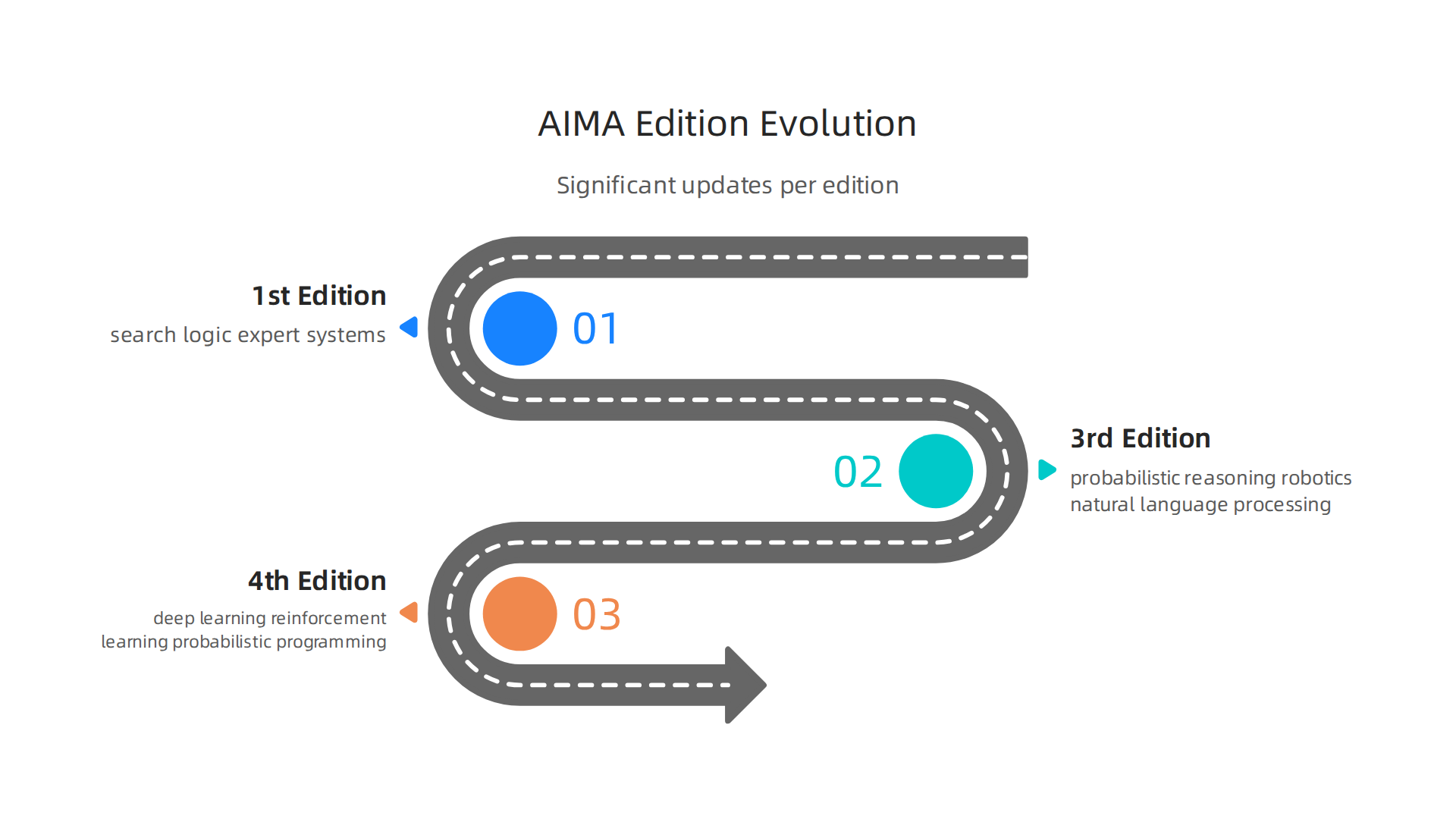
The first edition hit shelves in 1995. Back then, AI was mostly about search algorithms, logic, and early expert systems. That edition set the agenda and became the go to textbook for a generation of students.
The third edition arrived in 2010. By then, probabilistic reasoning, robotics, and natural language processing had grown more important. Russell and Norvig rewrote large sections to reflect that shift. They added coverage of machine learning algorithms and expanded the robotics chapter. About 20% of the citations in that edition were to works published after 2003, according to the book’s own preface.
The fourth edition came out in 2020, and it is the biggest jump yet. It added a full chapter on deep learning and an expanded chapter on reinforcement learning. The book also introduced probabilistic programming and multiagent systems as standalone chapters. Overall, about 25% of the material in the fourth edition is completely new, and 22% of the citations are to works published after 2010. You can see the full table of contents and updates on the 4th US edition of Artificial Intelligence: A Modern Approach official page.
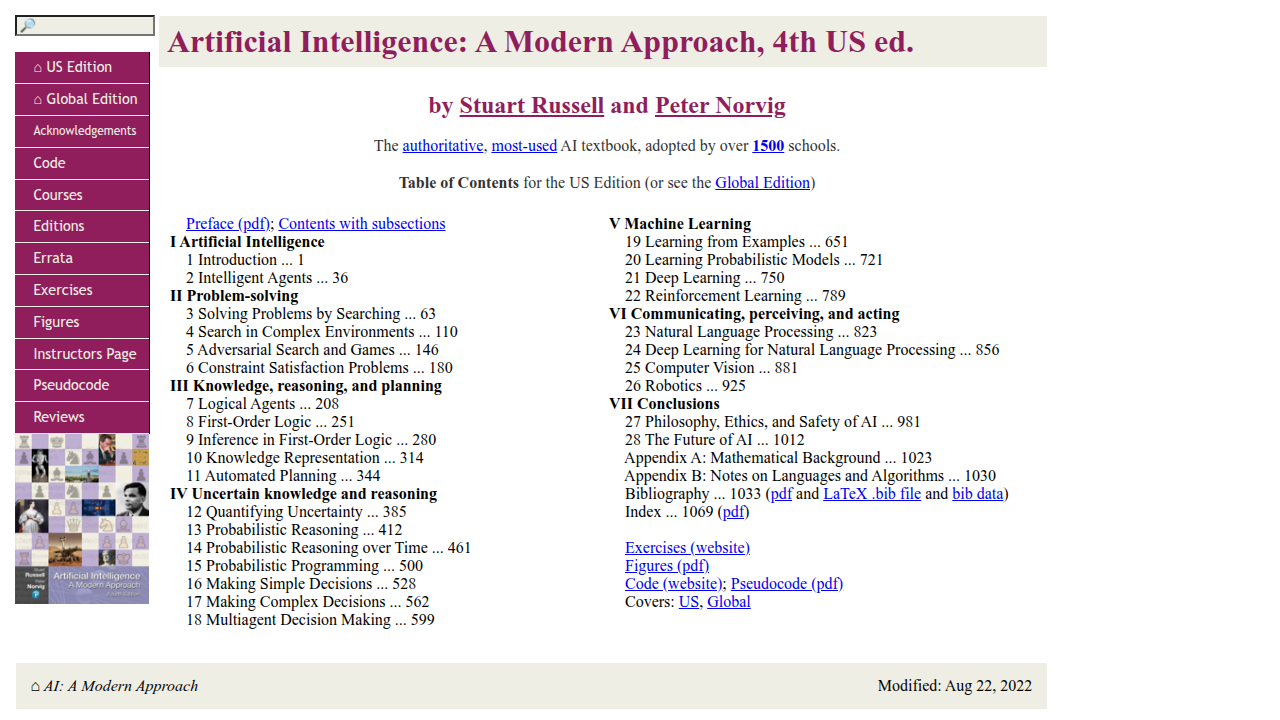
This edition shift matters for you. If you want to understand modern AI, including the LLM and AI technologies to track in 2026, the fourth edition is the one to study. It brings the book in line with the deep learning revolution and prepares you for the real world of AI. The older editions are still valuable for foundational concepts, but they miss too much of what makes AI exciting today.
Navigating AIMA: A Tour of Key Topics Every ML Professional Should Master
Now that you understand how Artificial Intelligence: A Modern Approach by Stuart Russell and Peter Norvig has changed over time, let’s take a tour of the key topics inside the fourth edition. The book is divided into multiple parts, and each one builds on the last.
If you want to study AI the right way, focusing on the parts most relevant to modern machine learning will save you time and effort.
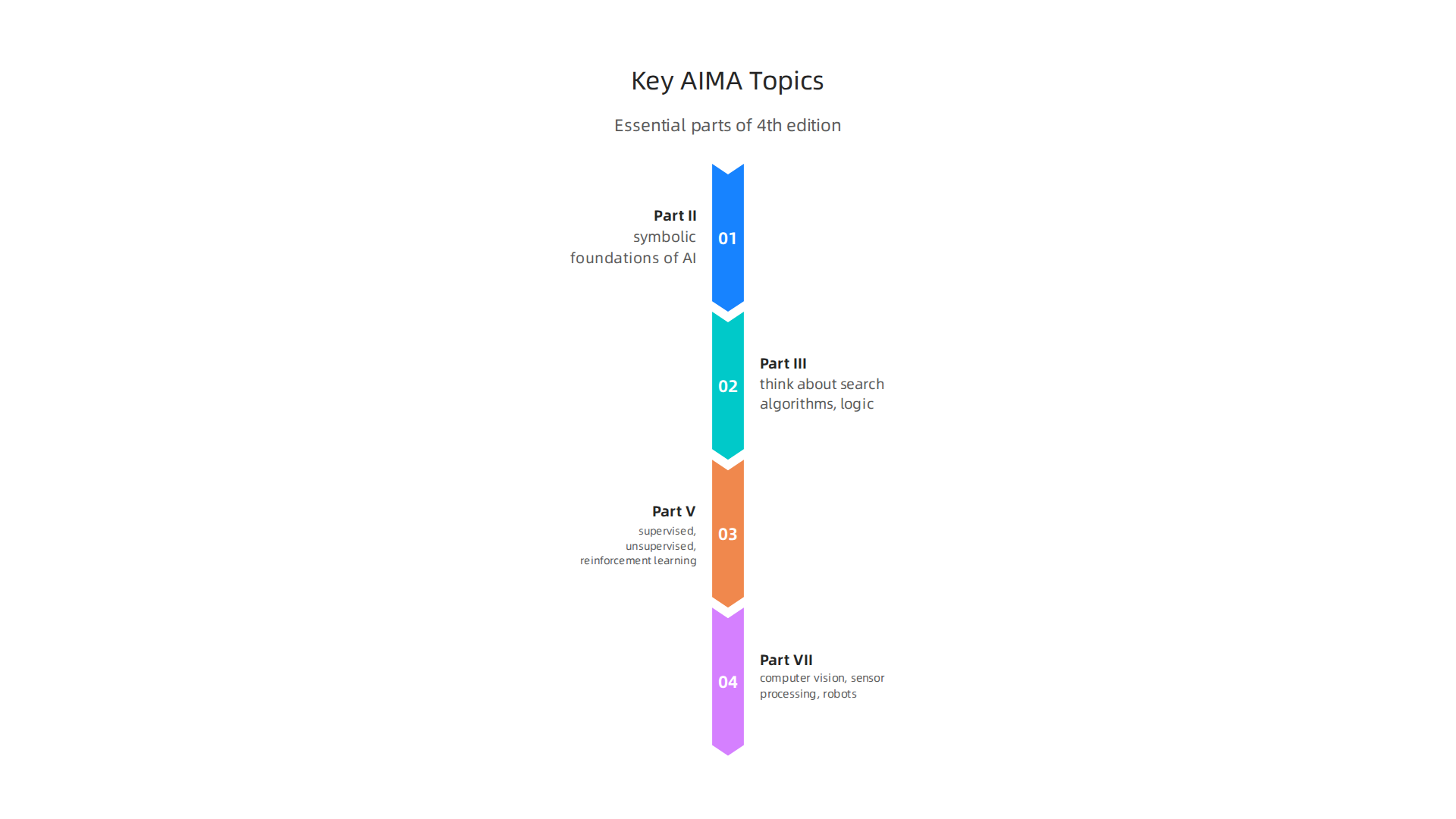
Part II (Problem-Solving) and Part III (Knowledge & Reasoning) lay down the symbolic foundations of AI. These sections teach you how to think about search algorithms, logic, and reasoning. They may seem old-school next to deep learning, but they are still essential. Many real-world systems combine symbolic reasoning with neural networks. Understanding these basics will make you a more complete ML engineer.
Part V (Machine Learning) is the heart of the fourth edition for most practitioners. It covers supervised learning, unsupervised learning, and reinforcement learning. This is where you find the deep learning foundations and concepts that power today’s AI tools. The book explains everything from simple linear models to complex neural networks. If you are serious about machine learning, this part alone is worth the price of the book. To understand how these skills lead to real jobs, you can read about how to get started as a machine learning engineer.
Part VII (Robotics & Perception) might surprise you if you only work with software. This section connects theory to physical systems. You learn about computer vision, sensor processing, and how robots act in the real world. Even if you never build a robot, the perception techniques here transfer directly to image recognition and autonomous systems. For a deeper look at related technology, check out building and deploying autonomous AI agents in 2026.
The fourth edition of AIMA brings all of these pieces together. Whether you are starting your journey or brushing up on fundamentals, this book gives you a structured way to master the field. And if you want daily updates on the latest AI research and tools, subscribe to The AI Newsletter Worth Reading.

Study Strategies for Busy ML Professionals: Getting the Most from AIMA
Let’s be real. You are busy. Between meetings, deadlines, and learning new tools, sitting down to read artificial intelligence a modern approach stuart russell peter norvig cover to cover might feel impossible. But you don’t have to read it that way. The best strategy is to treat the book like a reference and a workout plan. Here are three practical ways to get the most out of AIMA without burning out.
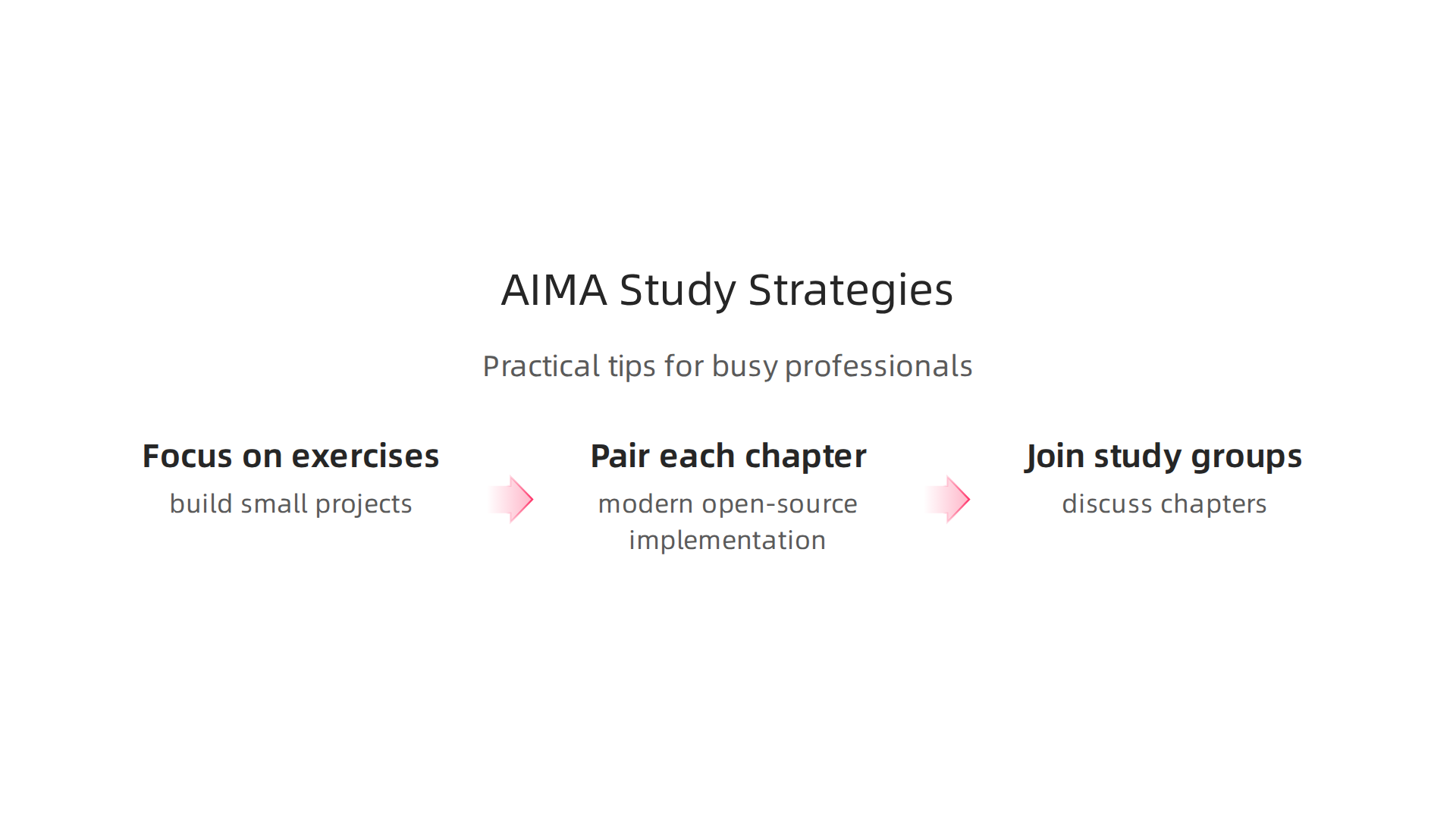
1. Focus on exercises and mini-projects instead of passive reading.
It is easy to highlight pages and feel like you learned something. But real understanding comes from doing. After each chapter, pick one exercise and build a small project around it. For example, after the search algorithms chapter, write a simple pathfinding program. This forces you to apply the deep learning foundations and concepts you just read. Plus, building things keeps you motivated. A common piece of advice from experienced engineers is to pair theory with hands-on practice, as shown in this guide on the 5 steps to become an ML / AI Engineer.
2. Pair each chapter with a modern open-source implementation.
AIMA explains algorithms with pseudocode. That is great for understanding the logic. But you also need to see how these ideas work in real code. After reading about neural networks in Part V, open a notebook with PyTorch or TensorFlow and rebuild the example. This bridges the gap between theory and modern tools. For a broader look at the current landscape, check out this AI overview for 2026. It helps you see where the book’s fundamentals fit into what companies use today.
3. Join study groups or online communities to discuss chapters.
Learning alone can be slow. When you explain a concept to someone else, you spot gaps in your own understanding. Look for forums, Discord servers, or local meetups where people work through AIMA together. Even a weekly 30-minute chat about one chapter can make the material stick. And after you finish reading, keep the learning momentum going. For clear daily updates on AI research and tools, subscribe to the AI Newsletter Worth Reading. It helps you stay current long after you close the book.
Complementing AIMA with Modern Resources (2025–2026)
AIMA gives you a rock-solid foundation. But if you try to build a 2026 career using only a textbook from 2020, you will miss a lot. The field moves fast. Tools like Jupyter notebooks, MLflow, and Hugging Face Transformers are now standard. You need hands-on practice using these tools alongside your reading. For example, after reading about supervised learning in AIMA, you can run a real notebook that trains a model using scikit-learn or PyTorch. This hands-on step is critical for building real confidence. For a deeper look at the current ecosystem, check out this guide on choosing the right AI tools. Getting comfortable with these modern tools is a big part of optimizing your machine learning workflow.
Next, pair your study of artificial intelligence a modern approach stuart russell peter norvig with a modern online course. The theory in AIMA is essential. But a structured course forces you to apply it through real assignments. Three of the best options in 2026 are Fast.ai’s Practical Deep Learning, Stanford CS229, and the DeepLearning.AI specializations.
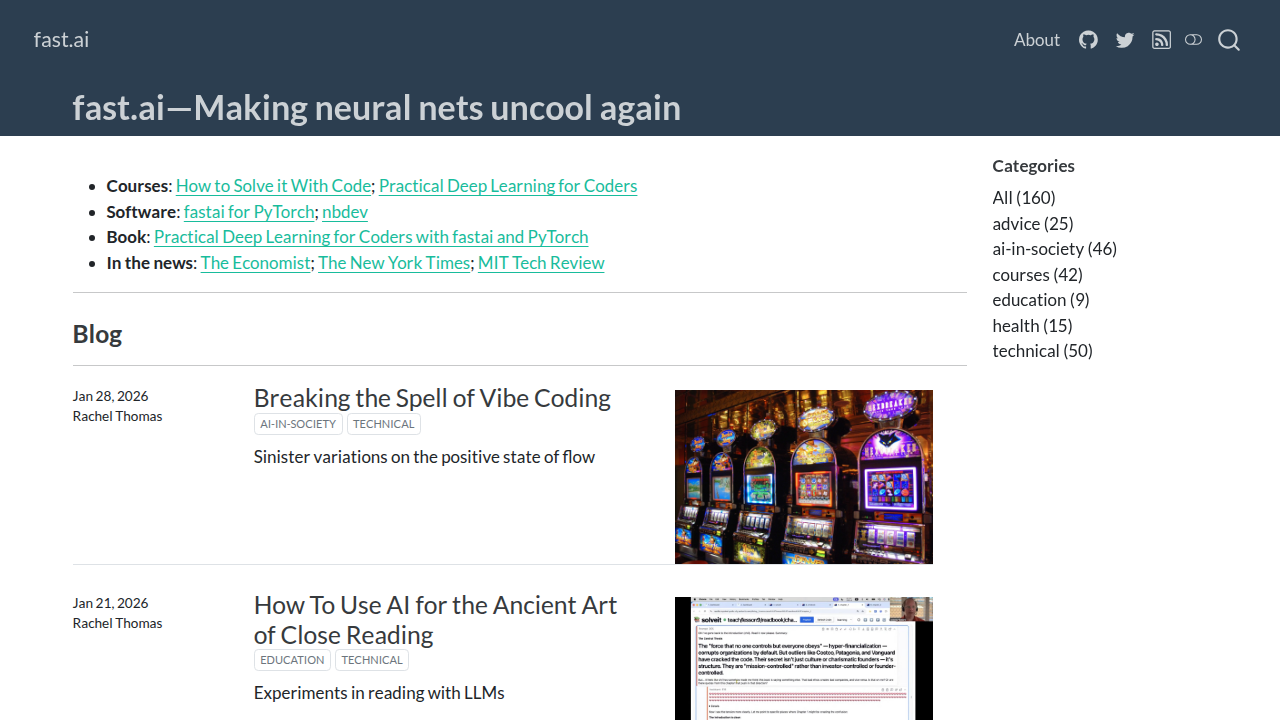
All of them help bridge the gap between deep learning foundations and concepts and what you actually build at work. For a full list of free options, DataCamp put together an excellent roundup of the best resources to learn AI for free in 2026.
Finally, do not stop with AIMA alone. The book was published before large language models and diffusion models changed everything. To stay current, follow the source blogs from OpenAI, Google DeepMind, and Hugging Face.
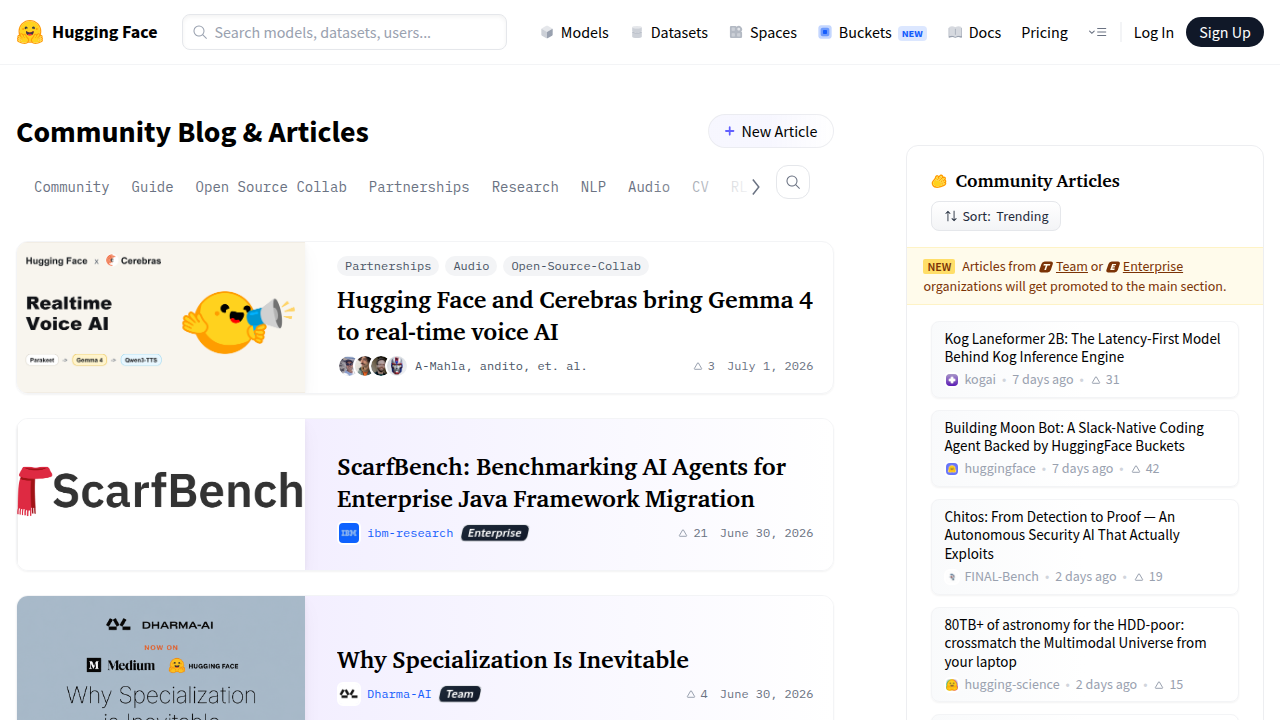
Reading just one or two posts each week helps you see how your skills apply to today’s biggest breakthroughs. A really well-organized list of these sources is the AI learning resources for 2026 list on LinkedIn, which breaks down the best books, blogs, and courses you should track. Keeping up with these modern resources is the best way to complement your AIMA studies and stay ahead in the field.
From Theory to Practice: Applying AIMA Concepts in Real‑World Projects
Studying AIMA gives you a rock‑solid framework. But the real growth happens when you take those concepts and use them on actual problems.

Let’s look at three big areas where AIMA’s lessons turn into working code.
Search algorithms are a perfect starting point. AIMA covers A*, BFS, and other search methods in detail. These aren’t just academic exercises. Companies use them every day for path‑planning in delivery logistics, robot navigation, and game AI. The best way to learn is to implement a simple route‑finder in Python. Start with a grid map and code A* step by step. Once it works, you can scale it up. This hands‑on practice is a big part of optimizing your machine learning workflow.
Probabilistic reasoning is another core topic. Bayesian networks help machines make decisions under uncertainty. In real‑world projects, they show up in risk assessment tools and recommendation systems. For example, an e‑commerce site might use a Bayesian network to predict what a customer will buy next, based on their browsing history. AIMA’s chapters on probability give you the math. To apply it, try building a small network using a library like pgmpy in Python. It’s a great way to connect deep learning foundations and concepts to everyday business problems.
Reinforcement learning is where AIMA really shines for modern careers. The book lays out the theory behind Q‑learning and Markov decision processes. These methods drive autonomous vehicle systems, game AI (think AlphaGo), and industrial robotics. After reading, skip the textbook for a weekend and train a simple agent in a simulated environment like OpenAI Gym. Watching an agent learn to balance a pole or play a game from scratch is one of the most satisfying experiences in AI. For a deeper dive into building agents that work at scale, check out this guide on autonomous AI agents.
As you move through each area, remember that applying AIMA is a process. Pick one algorithm a week, code it in Python, and test it on a small dataset. That’s how theory becomes skill. And to stay sharp on the latest breakthroughs that build on these foundations, get clear daily AI updates from The Deep View Newsletter. It helps you see how the classics from AIMA still power today’s most impressive systems.
Building Your AI Knowledge Ecosystem: AIMA + Continuous Learning
Artificial Intelligence a Modern Approach Stuart Russell Peter Norvig is a fantastic foundation. But no single book can keep you current in a field that changes this fast. The real secret is to build a learning ecosystem that combines AIMA with daily habits that feed your curiosity.
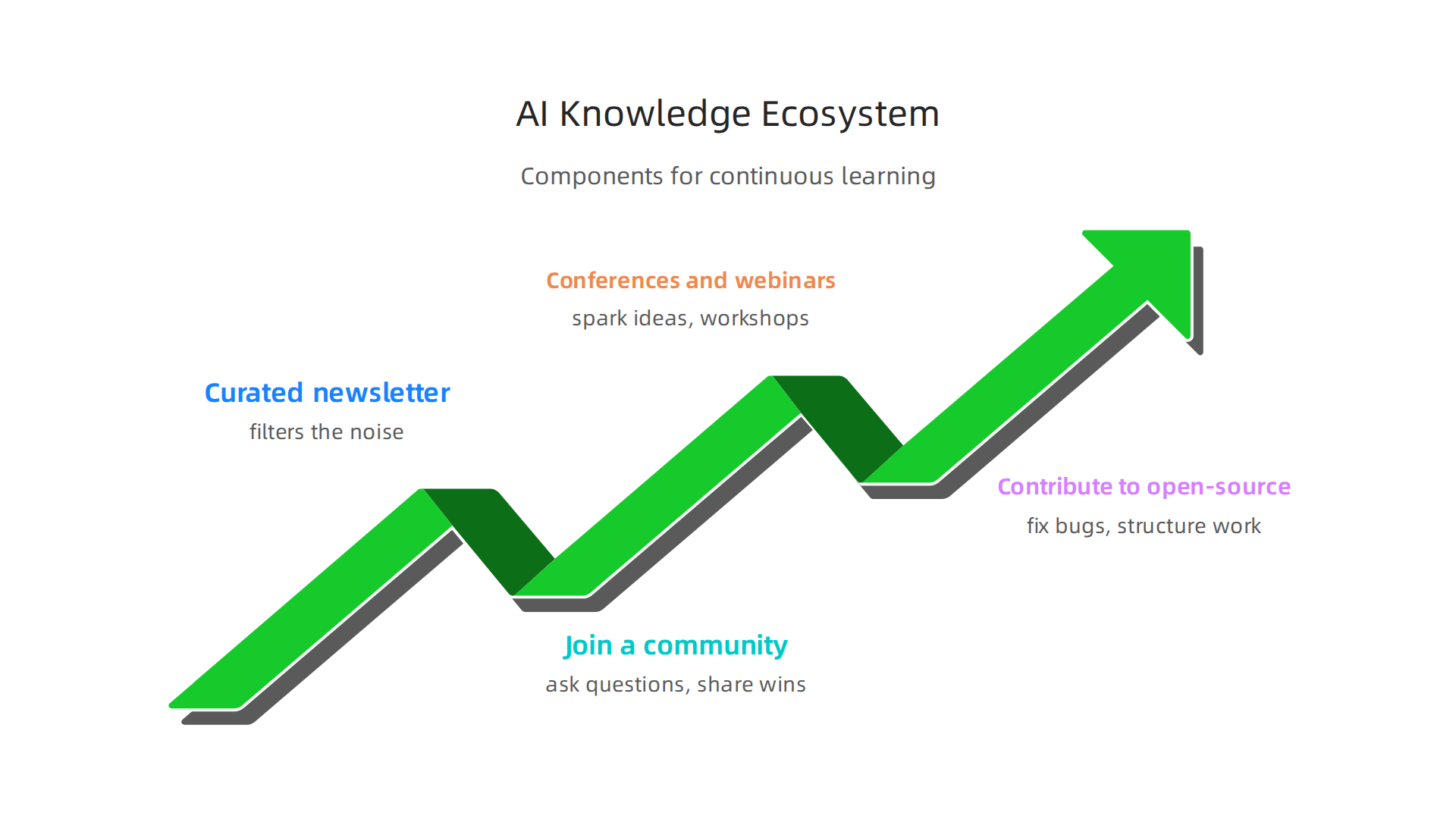
Think of AIMA as your reference library. You go back to it when you need to understand the core theory. Then you layer other resources on top to stay sharp.
Start with a curated newsletter. The AI world pumps out hundreds of papers and product launches every week. You don’t have time to read them all. A good newsletter filters the noise and delivers only what matters. For example, many professionals follow a 5-step roadmap to becoming an ML engineer that includes structured learning and hands-on practice.
Next, join a community. Online forums, Discord servers, and local meetups connect you with people who face the same challenges. You can ask questions, share wins, and learn from mistakes others have already made. This is where abstract concepts from AIMA turn into practical know-how.
Conferences and webinars are another piece of the puzzle. You don’t need to attend every event. Pick one or two a year that focus on your area. The talks, workshops, and hallway conversations can spark ideas you would never get from reading alone.
Finally, contribute to open-source projects. This is one of the fastest ways to truly learn. You read real code, fix real bugs, and see how professionals structure their work. It also gives you something concrete to show employers. If you are building your career, you should also learn how to build a data analysis portfolio that gets you hired.
Here is the simple habit that ties it all together: every morning, spend ten minutes scanning your curated sources. Read one article. Save one thing to explore later. Then get back to coding. Over time, this tiny daily ritual compounds into deep expertise.
The key is to stay consistent without burning out. AIMA gives you the map. But the journey requires steady fuel from sources that keep you inspired and informed. To keep that fuel flowing, get clear daily AI updates from The Deep View Newsletter. It helps you connect the dots between AIMA’s timeless lessons and the breakthroughs happening right now.
Summary
This article explains why Artificial Intelligence: A Modern Approach (AIMA) remains a crucial resource for anyone learning or working in AI, even after the rise of large language models and modern deep learning. It traces AIMA’s evolution across editions, highlights the fourth edition’s additions (deep learning, reinforcement learning, probabilistic programming), and shows which parts of the book are most valuable for practitioners today. The piece offers practical study strategies for busy professionals—focus on exercises, pair chapters with open‑source implementations, and join study groups—and outlines how to complement the textbook with modern tools, courses, and daily news sources. It also gives concrete project ideas (search, Bayesian networks, RL agents) to turn theory into portfolio work and describes how to assemble an ongoing learning ecosystem combining AIMA with newsletters, communities, and hands‑on practice. After reading, you’ll understand where AIMA fits in the modern AI stack and how to use it as a foundation for real-world machine learning work.