
LlM AI 2026 Technologies and Research You Need to Track

Introduction
If you work in technology, you already know the feeling. Every morning brings another flood of AI news, research papers, product launches, and hot takes. The pace of innovation in 2026 is truly staggering. According to a recent analysis, Global AI spending will total $2.5 trillion in 2026, a 44 percent jump from last year. Companies are pouring record amounts of money into infrastructure, models, and tools. Large language models keep getting bigger and smarter. New buzzwords like deepsearch AI, virtual intelligence, and svr intelligence appear almost weekly. It feels impossible to keep up.
Here is the problem. Most professionals do not have hours each day to sift through thousands of articles, tweets, and papers. You need to separate real breakthroughs from hype.

You need to understand what actually matters for your work. And you need to do it without burning out.
That is exactly why this article exists. We have done the filtering for you. This guide gives you a structured, research-backed overview of the most critical emerging AI technologies and research areas you need to track in 2026. We will look at LLM AI advancements, new reasoning techniques, agentic workflows, and much more.
Think of this as your cheat sheet for staying current without the overwhelm. By the end, you will know what to watch, what to ignore, and where the field is heading next. And if you want to stay ahead every single day without the noise, we recommend The AI Newsletter Worth Reading for clear daily updates. For a broader look at what is coming, check out our overview of AI predictions 2026.
Let us jump in.
The State of LLM AI in 2026
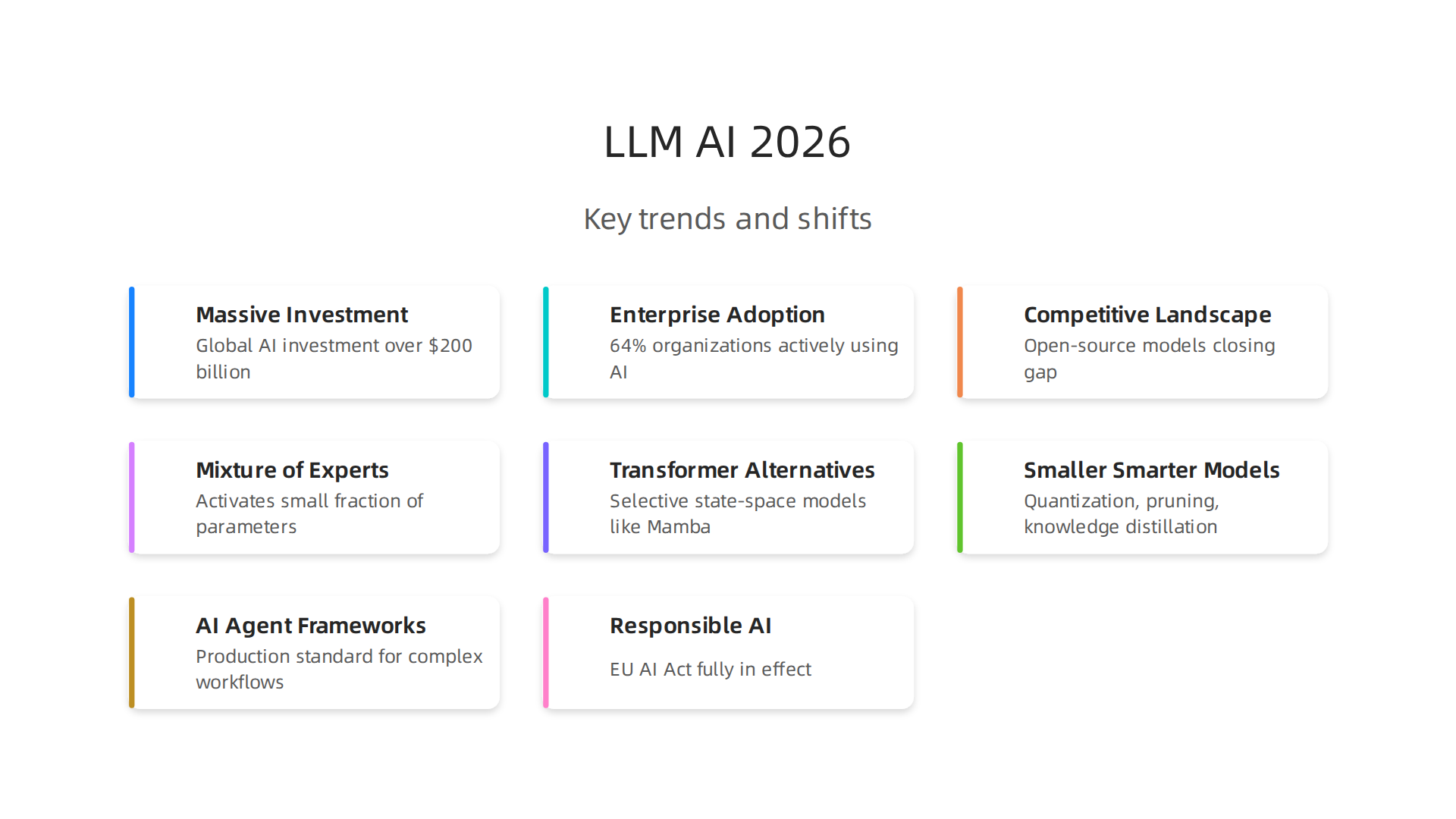
To understand where LLM AI is heading, you first need to see the money behind it. Investment in generative AI and large language model startups hit levels last year that most people would have called impossible. Global AI investment reached over $200 billion in 2025, and that number is still climbing in 2026. According to the State of AI 2026: Investment, Models, and the Adoption Frontier, foundation model companies alone captured $80 billion in 2025. That is 40 percent of all global AI funding. OpenAI and Anthropic together took 14 percent of every venture dollar invested worldwide across all industries. Those numbers tell you one thing. The world is betting big on llm ai.
Enterprise adoption is no longer experimental either. In 2026, most large companies are past the pilot phase. They are running custom LLMs tuned for their own data and specific workflows. A recent survey shows that How AI Is Driving Revenue, Cutting Costs and Boosting Productivity for 64 percent of organizations actively using AI in their operations. Nearly 90 percent say AI has directly increased their annual revenue. Companies are not just testing the waters. They are building domain-specific models for healthcare, finance, legal, and manufacturing. This shift from general-purpose chatbots to specialized llm ai applications is one of the biggest trends shaping 2026.
The competitive landscape is also shifting fast. Open-source models are closing the gap with proprietary leaders. Models from Meta, Mistral, and other open-source projects now rival closed systems on many standard benchmarks. New evaluation methods are redefining what state-of-the-art actually means in 2026. Concepts like deepsearch AI, virtual intelligence, and svr intelligence are emerging as fresh categories that challenge old assumptions about how these systems should work. If you want a deeper look at how the open-source side is evolving, check out our breakdown of open source AI 2026 trends shaping the future of machine learning.
The bottom line is simple. LLM AI in 2026 is more invested, more widely adopted, and more competitive than ever before.
Whether you are building models or using them, the pace of change demands that you stay informed.
Breakthroughs in Model Architecture and Efficiency
In 2025 and into 2026, the AI world stopped trying to build bigger models just for the sake of it. The focus shifted hard toward efficiency. The smartest teams realized you could get more power without blowing up your compute budget. Three big changes are leading the way.
First is Mixture-of-Experts (MoE). Instead of turning on every parameter for every task, MoE activates only a small fraction. Think of it like having a team of specialists where only the right expert for the job shows up. This keeps costs low while letting the total model size grow. Combined with sparse attention mechanisms that skip unnecessary calculations, these models now handle huge context windows without melting your GPU. The LLM Architecture 2026: Key Changes and Deployment Insights page explains how techniques like hybrid attention and KV cache compression reduce memory usage by about 90 percent during inference. DeepSeek V4-Flash uses this approach to deliver frontier-level reasoning at roughly one-sixth the cost of comparable proprietary systems.
Second is the rise of alternatives to the Transformer. Selective state-space models like Mamba are gaining ground. They process sequences in linear time instead of quadratic, which makes a massive difference for long-context tasks. New hybrid architectures are fusing Transformers with state-space layers. The LLM Architecture Gallery: 38 Models from 2024-2026 shows how models like Nemotron 3 integrate Mamba-2 with Transformer layers to scale long-context agentic workflows affordably. This blending of old and new designs is one of the most exciting trends in llm ai right now.
Third, smaller models are getting smarter thanks to quantization, pruning, and knowledge distillation. These techniques shrink model size dramatically while keeping most of the performance. The result? Powerful models that run on your phone or laptop. Qwen 3.5, for example, fits a 0.8 billion parameter model with 262K-token context directly on a mobile device. That would have been unthinkable just a year ago.
These architectural shifts are what make buzzwords like deepsearch AI, virtual intelligence, and svr intelligence possible in 2026. Efficient models unlock new use cases everywhere. If you want to see how these efficiency gains cut real costs, check out our guide on how Vast AI cuts GPU costs by 80% for enterprise machine learning.
The bottom line is simple. Smarter architecture, not just bigger models, is winning 2026. To keep up with every breakthrough as it lands, consider subscribing to The AI Newsletter Worth Reading for clear daily updates on what matters most in AI.
Multimodal and Foundation Models
Here is where things get really interesting. All those efficiency gains we just talked about are unlocking something huge in 2026: models that don’t just read text but see, hear, and understand video too. This is the big shift toward multimodal AI.
Think about how you experience the world. You don’t just read about things. You see them, hear them, and piece together information from multiple sources. The latest llm ai models work the same way. Instead of training a text model and bolting on vision later as an afterthought, new architectures use early fusion. That means they train on interleaved text, image, video, and audio data from day one. The result is a model that genuinely understands relationships across formats.
OpenAI kicked this off with GPT-4o back in 2024, but 2026 is where the approach really matured. GPT-5, released in 2025, brought together multimodal and reasoning capabilities into one flagship system with a 400K token context window and much lower hallucination rates. The complete timeline of these shifts is covered in the History of LLMs: Complete Timeline & Evolution (1950-2026) page, which tracks how we got from text-only models to the seamless multimodal systems we use today.
What does this mean for you? A lot. Foundation models can now handle zero-shot transfer across domains. You feed them a mix of data types and they figure out the patterns without needing separate fine-tuning for each task. A single model can analyze a chart, listen to a voice note, read a PDF, and summarize everything in one coherent response.

That is the power of modern deepsearch AI at work.
Video generation models like Sora and Emu Video have also moved from experimental to practical. Real-time multimodal agents can now watch a video feed, listen to audio, and respond in milliseconds. This is what people mean when they talk about virtual intelligence and svr intelligence becoming real.
If you want to see how these advances connect to real-world data analysis, check out our guide on artificial intelligence images and how to use visuals to understand complex AI models. It shows how multimodal techniques make model explanations clearer and more useful.
The bottom line is simple. In 2026, a model that only handles text is already behind. The future belongs to systems that see, hear, speak, and reason together.
AI Agents and Autonomous Systems
That reasoning ability is what powers another huge trend in 2026: AI agents and autonomous systems. Instead of just answering questions, these llm ai models take action. They plan, use tools, and complete multi-step tasks without a human guiding every step.
Think about what a traditional chatbot does. You ask a question, it gives an answer. An AI agent does more. It can search the web, run code, book a meeting, or even negotiate with other agents. And it can chain those actions together to reach a bigger goal.
Making this work requires the right framework. Several emerged as the top choices in 2026. LangGraph has become the production standard for complex, stateful workflows. CrewAI lets you quickly spin up teams of agents with assigned roles. AutoGen, from Microsoft, handles conversation-driven multi-agent systems.
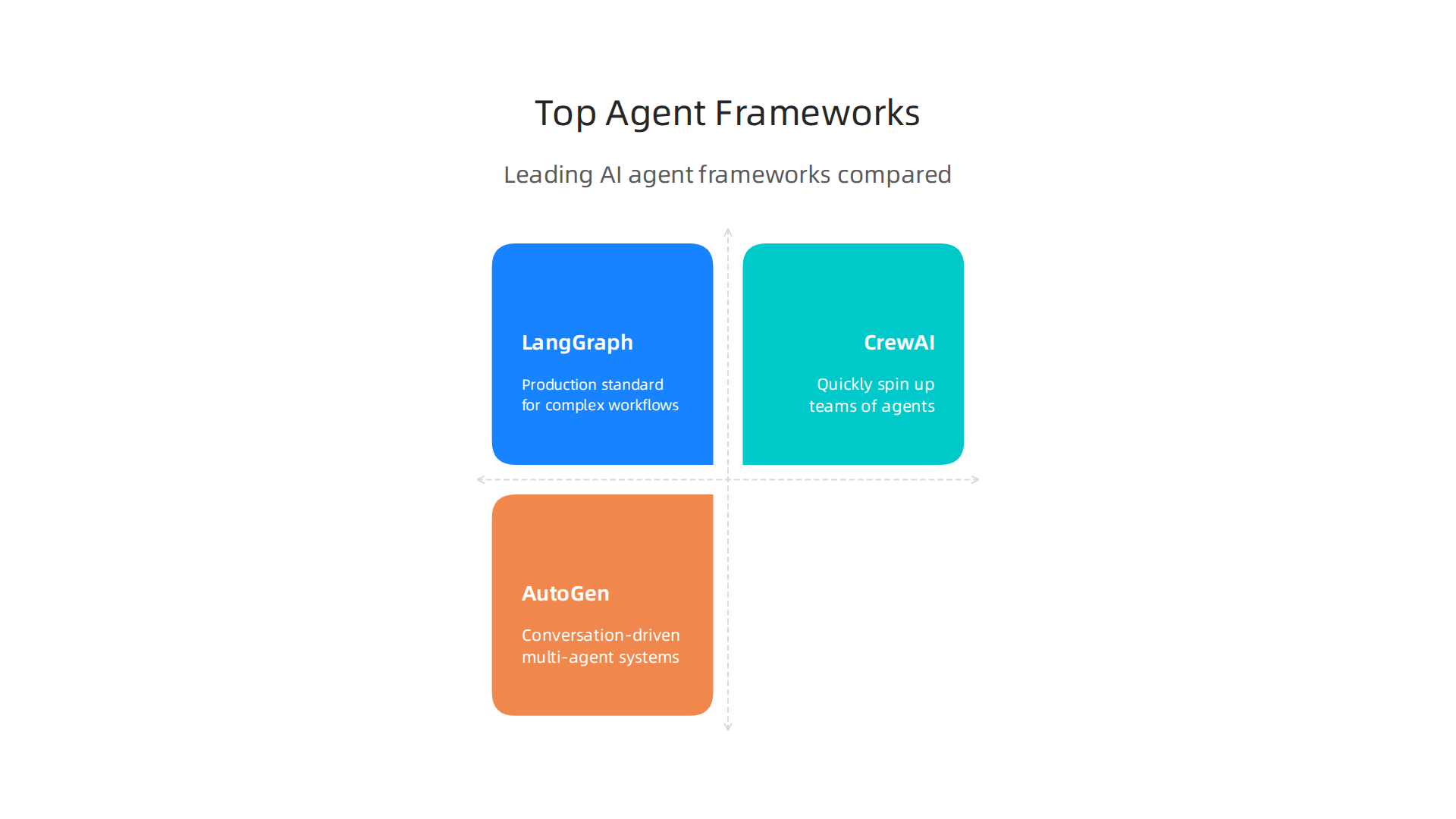
A detailed comparison of these options is available in the AI Agent Frameworks: Top 7 Picks for 2026 guide.
You can already see these frameworks at work in real world products. Customer support agents handle entire tickets without escalation. Coding agents write tests and review pull requests automatically. Data agents pull information from multiple sources, analyze it, and deliver a report in minutes.
But here is the catch. As agents gain access to external tools and act on the open web, safety becomes a bigger concern. A badly designed agent could delete files, send embarrassing emails, or expose private data. That is why alignment and guardrails are now a top priority for every team building these systems.
If you want to go deeper into how to build and deploy these agents safely, check out our guide on autonomous AI agents and how to evaluate their performance in 2026. It covers the practical steps to get started.
Staying updated on agent developments takes effort. For a quick daily summary of the most important AI news, including agent breakthroughs, consider The AI Newsletter Worth Reading. It delivers clear updates straight to your inbox.
MLOps and Production AI at Scale
Getting an llm ai model to work in a demo is one thing. Keeping it running reliably in production for thousands of users is another. That is where MLOps comes in.

In 2026, the MLOps ecosystem has matured fast to handle the unique needs of large language models.
The old MLOps tools were built for traditional machine learning. They tracked experiments and managed model versions. But LLMs bring new challenges. You need to version prompts, track which model version produced which output, and evaluate responses for quality and safety. New tools now handle these tasks directly. Platforms offer prompt management, A/B testing for different system messages, and automated evaluation suites that score outputs for coherence, accuracy, and bias.
Observability is the second big priority. Once a model is live, you cannot afford blind spots. Teams want to know exactly how the model behaves with real user requests. They track latency, token usage, and error rates. They also monitor for drift — when the model starts giving different answers over time. Good observability helps you catch problems before users notice them. For a deeper look at improving your pipeline, check out this guide on optimizing your machine learning workflow to cut bottlenecks and speed up model delivery.
The third piece is cost. Running an llm ai at scale can burn through your budget fast if you are not careful. Smart teams use several tricks to keep costs down. Speculative decoding speeds up generation by having a smaller model draft tokens that a larger model verifies. Caching frequently used prompts reduces redundant computation. Some platforms also support model quantization to reduce memory and compute needs. These techniques make sustained production deployments affordable.
Even deepsearch ai systems or virtual intelligence platforms benefit from these MLOps practices. And as svr intelligence models become more common, the same lifecycle management principles apply. Teams that invest in solid MLOps foundations now will have a big advantage as the production AI landscape keeps evolving.
Responsible AI, Bias, and Governance
Building powerful models is only half the story. The other half is making sure they behave fairly and follow the rules. That is where responsible AI comes in.
In 2026, the biggest shift is regulation. The EU AI Act is now fully in effect as of August 2026. This law groups AI systems by risk level. High-risk systems must meet strict rules around data quality, documentation, human oversight, and transparency. If you build or deploy an llm ai that serves users in Europe, you need to comply even if your servers are elsewhere. The same goes for US companies under new Executive Orders focused on AI safety and fairness. For a solid breakdown of what these rules mean for your team, check out this overview of EU AI Act compliance requirements for companies.
Bias is another front that demands attention. Models trained on real-world data can pick up and magnify harmful stereotypes. In 2026, new benchmarks help teams measure fairness in LLM outputs. Tools now flag biased language across race, gender, age, and other dimensions. The goal is not just to detect bias but to fix it during training and fine-tuning. This matters whether you work with a general virtual intelligence model or a specialized deepsearch ai system. If you want a deeper look at how bias shows up in practice and what you can do about it, read this article on the critical risks of AI bias and deepfakes.
Explainability has become standard practice too. If your model makes a decision, users and regulators want to know why. Techniques like attention visualization and local explanations help. Red-teaming is another norm. Teams simulate attacks and edge cases to find weak spots before bad actors do. This is especially important for svr intelligence systems used in high-stakes fields like healthcare and finance.
Responsible AI is not a checkbox. It is an ongoing practice. Teams that build governance into their workflow stay ahead of regulations and earn user trust. If you want to stay on top of fast-moving AI developments without getting buried, subscribe to The AI Newsletter Worth Reading for clear daily updates.
H2: Edge AI and On-Device Machine Learning
The biggest AI models used to live only in the cloud. But in 2026, a huge shift is happening. Powerful AI now runs directly on your phone, watch, and even home sensors.
Companies have optimized large language models to fit on a single phone chip. These small language models (SLMs) handle tasks like smart replies, real-time translations, and photo editing without needing the internet. Specialized models like deepsearch ai can even run complex research and retrieval locally. You can see how this trend pushes hardware innovation with tools like samsung galaxy ai on-device machine learning.
Hardware is a huge part of this story. The Apple Neural Engine and Qualcomm AI Engine are now standard in most new devices. They are built to run AI tasks fast while using very little power. And many of the best small models are openly available. That speeds up everything. You can explore the key ecosystem trends in this article about open source AI 2026 trends.
So why does edge AI matter so much? First, it is incredibly fast. There is no round trip to the cloud. Second, it protects your privacy. Your data stays on your device. This helps companies follow strict privacy rules. Developers can explore the latest updates on what companies need to know about the EU AI Act in 2026 to understand how edge deployment directly supports compliance.
The applications are real. In healthcare, svr intelligence models on a smartwatch can spot irregular heartbeats instantly. In finance, fraud detection happens on your phone before a transaction even finishes. Consumer apps use virtual intelligence to learn your habits and respond without ever sending your private data away. Edge AI is not just a trend. It is how intelligent computing works now.
The Research Ecosystem, Conferences, and Career Paths
The field of AI and machine learning is not just growing. It is exploding. You can see it in the numbers. Top conferences like NeurIPS, ICML, and ICLR set new records every year. For example, ICML 2026 received 23,918 submissions and accepted 6,352 papers. That is an acceptance rate of 26.6%. You can check the detailed ICML 2026 acceptance rate data for yourself. NeurIPS now hosts satellite events in Sydney, Atlanta, and Paris, with thousands of attendees. The competition is fierce, but that is what pushes the field forward.
So what is everyone researching? Three big directions are taking off. Mechanistic interpretability tries to understand exactly how large models think inside. Neuro-symbolic AI blends deep learning with traditional logic and reasoning. And AI for science uses machine learning to speed up drug discovery, climate modeling, and physics experiments. If you are working with an llm ai model, these are the spaces where breakthroughs happen. Even specialized models like deepsearch ai are being tuned for deeper retrieval and knowledge work in these areas.
All this research activity creates new career paths. You are not limited to being a machine learning engineer anymore.

Companies now hire AI ethics specialists to check models for bias and fairness. Policy advisors help teams navigate regulations like the EU AI Act. And LLM operators manage the deployment and monitoring of large language models in production. Roles that did not exist three years ago are now in high demand. If you are looking to break in, consider starting with hands-on work like remote data annotation jobs in 2026 to build real experience.
The research landscape is moving fast. To stay ahead, you need a steady stream of clear, trustworthy updates. That is exactly why we recommend signing up for The AI Newsletter Worth Reading. It cuts through the noise and delivers the most important daily developments in AI and machine learning straight to your inbox. Whether you are a researcher, a practitioner, or just starting out, this is the easiest way to keep your finger on the pulse of the ecosystem.
Summary
This article is a concise, research-backed guide to the most important AI and LLM developments to follow in 2026. It explains how investment and enterprise adoption have pushed large language models from experiments into production and why efficiency — not just scale — is now the priority, with techniques like Mixture-of-Experts, sparse attention, and quantization lowering cost and enabling long-context reasoning. You will learn how multimodal foundation models fuse text, images, audio, and video for more capable systems, how agentic workflows let models take multi-step actions, and which frameworks and guardrails teams use to keep those agents safe. The piece also covers practical MLOps needs for versioning prompts, observability, and cost controls, plus regulatory and bias concerns such as the EU AI Act and explainability requirements. Finally, it highlights the rise of edge and on-device AI, evolving career paths, and where to find deeper resources so you can prioritize what to watch and implement next without getting overwhelmed.