
R vs Python for Data Science 2026 Evidence Based Comparison

Introduction: The Enduring Data Science Dilemma
You are starting a new data science project. Maybe you are building a machine learning model or analyzing survey results. The first big question hits you: R or Python?

This choice has sparked debates for years. And honestly, it is not getting any simpler. Both languages have changed a lot since they first appeared. Python, once just a general-purpose language, now has powerful libraries for machine learning. R, born for statistics, has modern tools that make it easier to use in real projects.
In 2026, the old advice does not work anymore. The lines between these two languages are blurring. A recent R vs Python for Machine Learning in 2026 report shows that while Python dominates deep learning and production systems, R still leads in pure statistical analysis.

The truth is, neither language is dying. Both are growing.
So how do you choose? That is what this article is for. We dug into the latest 2026 surveys, job market data, and expert opinions to give you a clear, evidence-based comparison. No outdated opinions. No bias. Just facts.
We will look at where each language shines, what the job market says, which tools work best for specific tasks, and how salaries compare. By the end, you will know exactly which language fits your goals.
The data science world moves fast. If you want to stay ahead, you need the right tool. And sometimes, the best answer is both. If you want to keep up with the latest AI breakthroughs every day, checking out The AI Newsletter Worth Reading can help you stay informed.
Let us dive in and settle the debate.
Historical Context and Current Adoption Trends (2020–2026)
To understand the r vs python for data science debate, you need to know where each language came from. R was built in the 1990s by statisticians, for statisticians. Its whole purpose was to run advanced stats and make publication-ready graphs. That is why universities and research labs loved it from day one. Python, on the other hand, was a general-purpose language. It was not born for data. But once libraries like NumPy (2005) and pandas (2008) arrived, Python started sneaking into data work. Then came TensorFlow in 2015 and PyTorch in 2016. That was the explosion. Python suddenly became the language of deep learning and AI. By 2020, Python had already taken over the data science conversation.
Fast forward to 2026. Python is the clear leader in overall usage. The numbers are huge. But R is far from dead. An honest look at where things stand shows that R dropped from number 8 in the TIOBE index in 2021 to around number 18 by 2025. But here’s the thing: that drop is mostly because Python grew so fast in AI and machine learning, not because R lost users. R’s actual user base has grown every single year. And about 4.4% of professional developers still use R, which means hundreds of thousands of active users working in high-value fields.
So where do you find each language today? It really depends on the industry.
Tech startups and enterprise AI teams almost always pick Python. It is faster to prototype, easier to deploy in the cloud, and the go-to for deep learning and production systems. On the other side, bio tech and pharmaceutical companies lean heavily on R. About 70% of those teams use R for FDA reporting and clinical trial analysis. Quantitative finance is a split world. Python drives algorithmic trading, while R handles risk modeling and statistical work. Academia and research still treat R as the gold standard.
Looking at job postings, Python data science roles outnumber R roles by about three or four to one. But about 35 to 40 percent of job listings ask for both languages. That means you can have a strong career knowing just one, but knowing both makes you much more flexible. The real answer to r vs python for data science is not a winner. It is about what you want to do and where you want to work.
If you are curious about how these adoption trends connect to bigger changes in the machine learning world, checking out open source AI trends in 2026 gives you a broader picture of what is driving Python’s growth and where R still holds firm.
Ecosystem and Package Landscape: Breadth vs. Depth
When you are looking at the r vs python for data science question, the tools each language gives you matter a lot.
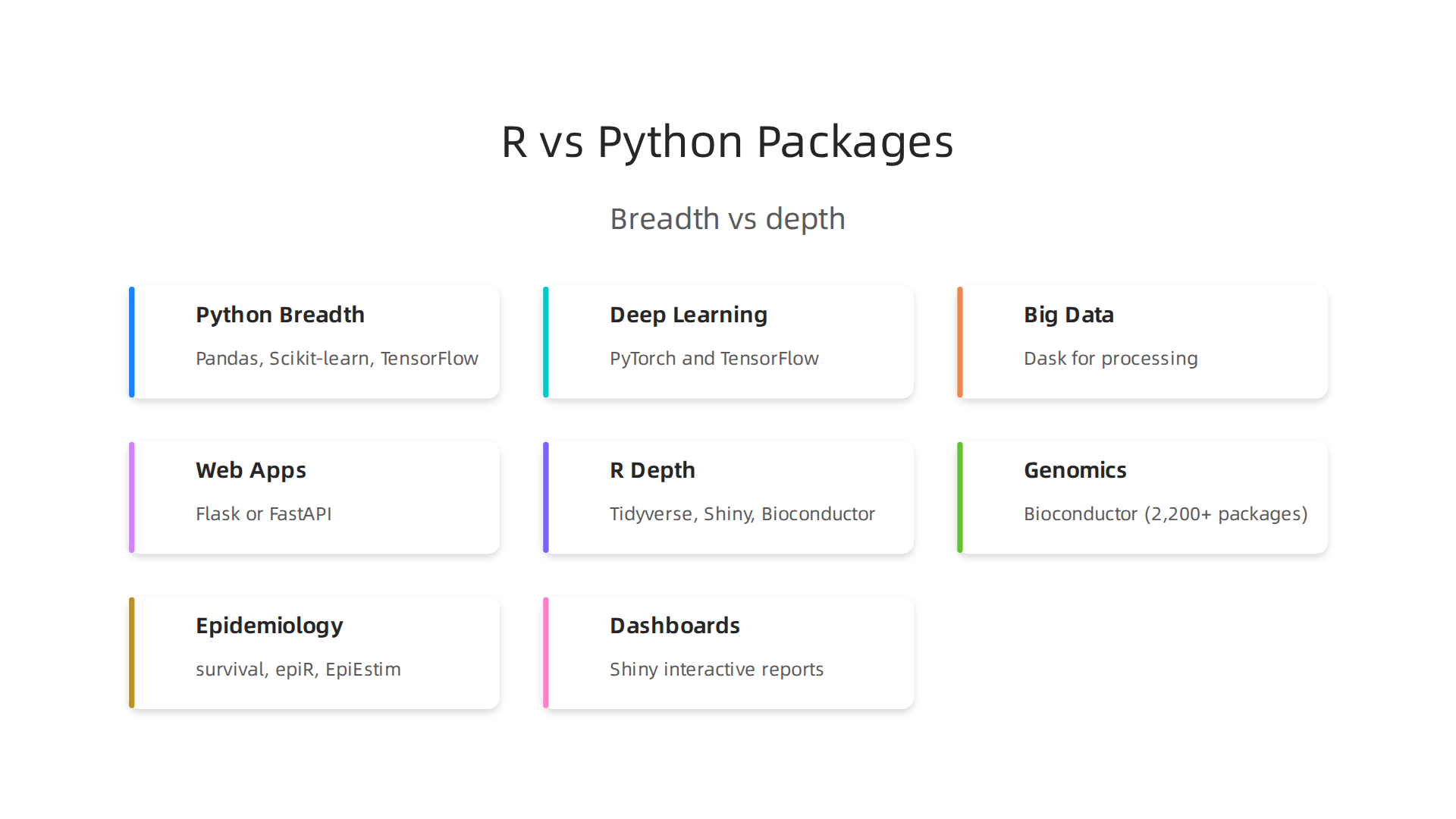
Think of it like choosing between a giant toolbox and a specialized tool set. Python gives you the giant toolbox. R gives you the specialist’s kit.
Python’s ecosystem is huge. You have Pandas for cleaning and shaping data. Scikit-learn handles machine learning. PyTorch and TensorFlow cover deep learning. For big data, there is Dask. And when you need to put your model into a web app, you use Flask or FastAPI. That last one is a semantic keyword that fits because Flask is a Python web framework often used in data engineering to serve predictions. Python also has list comprehension which lets you write clean, fast loops.
All these tools work together to cover everything from data ingestion to production deployment. A study from early 2026 shows that Python’s package ecosystem is about 25 times larger than R’s when counting total packages on repositories like PyPI versus CRAN. You can see this in the R vs Python 2026 package gap analysis. That breadth makes Python the natural choice for data engineering and end-to-end machine learning pipelines.
R is different. Its ecosystem is all about depth. The tidyverse is a set of packages like dplyr and ggplot2 that work beautifully together. They make data manipulation feel like reading plain English. R also has Shiny for building interactive dashboards and reports without needing a web developer. And for specialized work, R shines. Bioconductor gives you over 2,200 packages for genomics. Packages like survival, epiR, and EpiEstim are the gold standard in epidemiology. The IBM comparison of R and Python points out that R was built for statistics from day one, so its packages are written by statisticians for statisticians. That means when you do a t-test or build a survival model in R, the math is rock solid.
Package quality and community support differ too. Python’s huge community means more tutorials and faster answers on Stack Overflow. But R packages are often more stable. One LinkedIn user noted that R beats Python in stability and reproducibility, with fewer package compatibility issues. R’s packages are also more likely to be peer-reviewed, especially those in CRAN. That matters when your analysis needs to pass regulatory scrutiny, like in clinical trials.
When it comes to MLOps and cloud integration, Python has the edge. Tools like Kubeflow, MLflow, and cloud SDKs all speak Python first. R is catching up with Sparklyr for big data and mlr3 for modern machine learning workflows. But if you need to deploy a model as a microservice or run it in a Docker container on AWS, Python is smoother.
So which ecosystem wins? It depends on your job. If you work in data engineering, production ML, or building AI applications, Python’s breadth serves you better. If you work in biostatistics, clinical research, or academic publishing, R’s depth is unmatched. Understanding this difference is key to choosing where to invest your learning time.
If you want to stay on top of how these ecosystems are evolving every day, many professionals trust a daily digest. The The AI Newsletter Worth Reading delivers clear AI updates straight to your inbox so you never miss a shift in the landscape.
Performance and Scalability for Machine Learning Workloads
You have a 50 GB dataset on your desk and need to train a model by tomorrow. Which language lets you move faster? The answer is not simple. When comparing r vs python for data science performance, the winner changes depending on what you are actually doing.
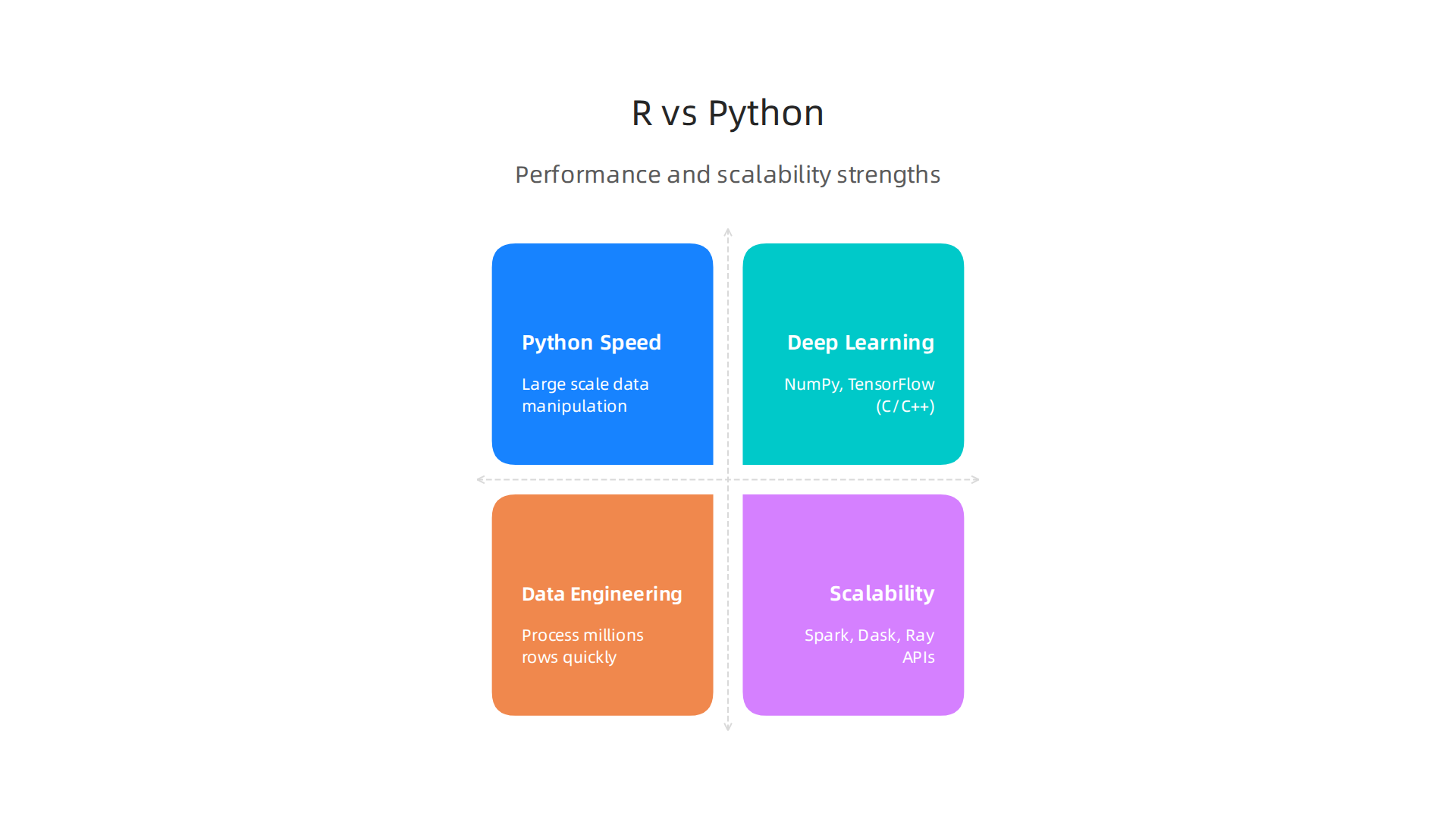
For large scale data manipulation and deep learning, Python has a clear speed advantage. Libraries like NumPy and TensorFlow run optimized C and C++ code under the hood. The NumPy backend uses highly tuned linear algebra routines that fly through matrix operations. This makes Python faster for most machine learning workloads that involve big datasets. According to a thorough R vs Python performance comparison, Python is much faster than R overall when you need to process lots of data quickly. For data engineering tasks like cleaning millions of rows or building real time pipelines, Python keeps you moving without waiting for code to finish.
But R has its own speed advantages. For certain statistical routines, R can actually be faster than Python. Think about running a complex survival model or a mixed effects regression. R’s core was built by statisticians specifically for these calculations. The math is highly optimized. Also, R handles memory bounded operations well when your dataset fits in RAM. Recent improvements like byte compile and alt rep have made R noticeably faster. Alt rep allows R to handle large vectors without copying them into memory, which cuts down execution time. A detailed R vs Python statistics cheat sheet shows that for standard data wrangling tasks like filtering and grouping, Pandas and dplyr perform similarly for datasets up to 10 million rows. The gap is narrowing, especially for statistical analysis.
When it comes to scaling up beyond a single machine, Python is the leader. Frameworks like Apache Spark, Dask, and Ray all have mature Python APIs. These tools let you distribute work across clusters of computers. Python also integrates smoothly with cloud services like AWS, GCP, and Azure. R has good tools too. You can use Sparklyr to connect R to Spark, and disk.frame helps with out of memory data. But the ecosystem is less developed. For enterprise level machine learning pipelines, Python’s scalability is hard to beat. Companies that need to handle terabytes of data every day almost always pick Python. If you are working in a data engineering role, this matters a lot. To get the most out of Python’s performance, check out this guide on mastering Python data workflows for peak performance. It covers practical tips for writing faster data pipelines.
Benchmarks from 2026 show the gap between Python and R is closing for some tasks. Python’s latest versions (3.12 and 3.13) include speed improvements that can boost performance by more than 40 percent compared to older versions. Meanwhile, R’s byte compile and alt rep features have made common operations like group by and summarise much faster. A lively Python dominance in 2026 discussion points out that while people have called Python slow for years, it still runs most of the world’s AI workloads because its ecosystem and ease of use outweigh raw speed. R fans argue that for the specific tasks statisticians do every day, R is plenty fast and often more reliable.
So which language performs better for machine learning? It depends on your workload. If you are training deep neural networks or processing massive unstructured data, Python wins on raw speed and scalability. If you are running sophisticated statistical models on moderate sized datasets, R can keep up and sometimes surpass Python. The best approach is to know both and pick the right tool for each job.
Learning Curve and Team Onboarding
Imagine you are a manager building a new data science team. You have two open roles to fill. One candidate knows Python inside out. The other has spent years mastering R. Who do you hire? The answer depends on how fast you need them to contribute and what the rest of your team already knows.
Python is famous for being easy to pick up. Its syntax reads almost like plain English. You do not need to learn strange symbols or unusual rules to write your first script. A beginner can open a Jupyter notebook and start analyzing data within an hour. According to a detailed Python or R for Data Analysis guide, Python’s readable syntax gives it a smoother learning curve than R.
This makes it the preferred first language for most new data scientists. If your team already uses Python for data engineering or web apps, onboarding a new member who knows Python is fast.

They can start contributing to production code right away.
R has a steeper initial learning curve. That is not a secret. Things like 1-based indexing, the <- assignment operator, and factor variables can trip up people who learned to code in other languages. But here is the thing: once you get past the basics, R’s tidyverse is incredibly powerful for data analysis. The tidyverse was designed specifically for readability. Functions like filter(), select(), and mutate() do exactly what they sound like. For teams that focus on statistical modeling and research, R can actually be easier to use day to day than trying to wrestle with pandas. The learning curve becomes a ramp, not a wall.
Your team’s existing skill set changes the equation. If most of your data scientists already know R, switching to Python means a big investment in training. People will be less productive for weeks or months. On the other hand, if your organization runs on Python for everything else, adding R might create a maintenance burden. A smart move is to let your team use both where each shines. Many companies use R for early exploration and visualization, then move to Python for deployment and production pipelines. This bilingual approach reduces friction during onboarding because people can play to their strengths.
If you are still wondering which language to learn first, think about your career goals. For industry roles in machine learning and engineering, start with Python. For research, academia, or biostatistics, R is a solid choice. And if you want the strongest resume, learn both. Over time, the data science vs software engineering choice matters more than the language debate.
Staying up to date on both languages takes effort. A great way to keep learning is to get a daily dose of AI and machine learning news. You can subscribe to the The AI Newsletter Worth Reading for clear updates that help you stay sharp no matter which language you use.
Community, Support, and the 2026 Job Market
Beyond the learning curve and how fast your team can get started, the size of the crowd backing each language makes a real difference. Python has a vast global community. More people use it, answer questions on Stack Overflow, share code on GitHub, and write tutorials. When you hit a bug or need a new library, you can almost always find a solution in minutes. R’s community is smaller but deeper. It is packed with statisticians, researchers, and academics who produce exceptionally rich resources for advanced stats and visualization. If your work involves complex modeling or publication-ready charts, that specialized support can save you hours.
The job market in 2026 paints a clear picture. Python shows up as a near-universal requirement in data science, machine learning, and AI roles. According to the 2026 job market data for programmers, Python alone appears in over 137,000 job postings. That is more than prompt engineering, React, and many trendy frameworks combined. If you want the widest range of options, Python gives you that.

But R is far from dead. Specific roles, especially in biostatistics, pharmaceuticals, and academia, still demand R expertise and often come with premium salaries. The positions are fewer, but the pay can be better because the skill is rarer.
So what does this mean for your career? If you are aiming for a broad path in tech, finance, or startups, Python is the safer bet. For specialized research or clinical work, R is a strong choice. And as the data analyst jobs in 2026 landscape shows, the most competitive candidates know both. Employers are looking for people who can switch between the two depending on the task. Learning both may take extra effort, but it lets you chase more opportunities and earn more over time.
Making the Decision: Organizational Fit and Future‑Proofing
So you know the strengths of each language. Now comes the real question for 2026. How do you pick the right one for your team or your career? The answer is not about which language is technically better. It is about your team’s existing skills, the projects you work on, and where you want to be in a few years.
What Your Team Already Knows
If your team is full of statisticians and researchers, R is probably the natural choice. It was built for their workflow. The tidyverse makes data exploration feel intuitive. And for creating publication-ready charts, nothing beats ggplot2. On the other hand, if your team comes from a software engineering background, Python fits like a glove. Its syntax is familiar. Tools like Flask make it easy to turn a model into a web API. And for data engineering tasks that involve moving and transforming large volumes of data, Python has mature libraries and pipeline support.
But here is the trend that smart organizations are following in 2026. They are not choosing one over the other. They are using both. Teams use R for deep statistical analysis and beautiful visualizations. Then they hand off the results to Python for production, scaling, and integration with cloud systems. This polyglot approach is becoming the standard for top data teams. As the Python vs. R comparison from IBM notes, "the question isn’t which to choose, but how to make the best use of both programming languages for your specific use cases."
Tools That Make Both Languages Work Together
New tools in 2026 make this mixed approach even smoother.
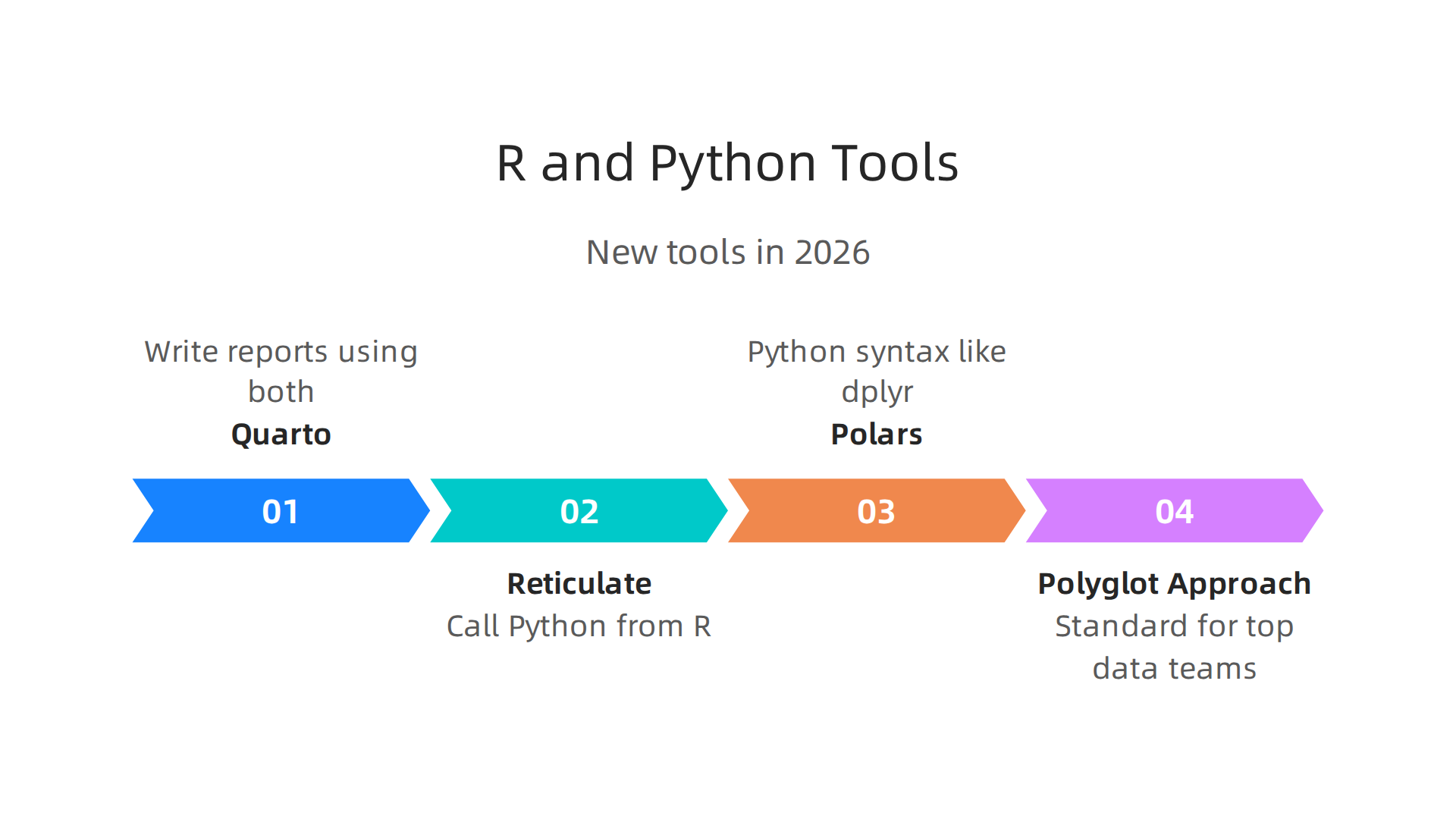
Quarto is a great example. It lets you write reports, dashboards, and websites using either R or Python code blocks. You can switch between languages in the same document. Another powerful tool is the reticulate package in R. It lets you call Python code directly from R scripts. So you can keep your statistical workflow in R while tapping into Python’s machine learning libraries like TensorFlow or scikit-learn.
On the Python side, libraries like Polars now offer a more readable syntax that feels closer to R’s dplyr. So the gap between the two languages is shrinking. For a deeper look at the best Python tools available, check out this guide on mastering Python data analysis tools for machine learning.
Future-Proofing Your Skills
If you are still wondering about the r vs python for data science debate, the safest move is to learn both over time. Start with the language that matches your current field. If you are in academia or research, start with R. If you are in industry or engineering, start with Python. But do not stop there. Add the other language once you are comfortable. Employers in 2026 want people who can switch between R and Python depending on the task. This adaptability protects your career no matter how the market shifts.
Stay Ahead of the Curve
The data landscape changes fast. To keep up with the latest tools, techniques, and trends across both Python and R, consider subscribing to a daily newsletter that curates the most important updates. The AI Newsletter Worth Reading delivers clear, actionable insights every day to help you stay ahead.
Summary
This article compares R and Python for data science in 2026 and helps you choose the best language for your goals. It reviews historical context and current adoption trends, showing Python’s dominance in production and deep learning while R remains indispensable for advanced statistics, biostatistics, and reproducible research. The piece breaks down ecosystem differences—Python’s breadth versus R’s depth—then compares performance, scalability, and when each language wins on speed. It covers learning curves, team onboarding, community support, job market demand, and salary signals so you can plan hiring or personal upskilling. The article also outlines practical ways to use both languages together with tools like Quarto and reticulate, and explains how to future‑proof your career by learning the right language first and adding the other later. Overall, readers will learn which language fits specific tasks, how to structure bilingual workflows, and what to prioritize for industry or research roles.