
AI Overview 2026 What Machine Learning Practitioners Need to Know

Introduction: Navigating the AI Landscape in 2026
You’ve probably felt it. The pace of AI news in 2026 is relentless. One week a new model breaks records, the next week a Chinese AI company surprises everyone with a cheaper alternative. Keeping up feels like drinking from a fire hose.
Here’s a reality check. The global artificial intelligence market is projected to hit $375.93 billion this year and could soar to $2.48 trillion by 2034 according to Fortune Business Insights. That’s massive growth. And Stanford HAI reports that generative AI reached 53% population adoption within just three years. Faster than the personal computer or the internet ever did.
The real challenge? Cutting through the noise. With so many new tools and trends emerging weekly, finding what actually matters for your work can feel impossible.

You need a clear ai overview that separates signal from hype.
That’s exactly what this article delivers. We’ve done the hard work of tracking the most important shifts, the most popular ai tools, and the key trends every ML practitioner should know in 2026. Whether you’re building models, managing teams, or making investment decisions, this guide gives you a structured look at what’s happening right now.
We start with what business leaders need to understand: how AI predictions for 2026 are shaping enterprise strategy. Then we dive into the tools, the companies, and the practical resources that can actually move your work forward.
If you want daily updates without the clutter, consider subscribing to The Deep View Newsletter. It delivers clear, actionable AI insights straight to your inbox every day.
The 2026 AI Market Landscape: Growth, Investment, and Adoption
Let’s start with a number that might surprise you. The global artificial intelligence market is worth about $375.93 billion in 2026, and experts expect it to reach $2.48 trillion by 2034 according to Fortune Business Insights. That’s not just growth. That’s a full on explosion.
So what’s driving this? For one, enterprise AI adoption has hit a tipping point. Companies are no longer running small experiments in isolated teams. They are moving AI into full production. Deloitte’s 2026 report shows that worker access to AI rose by 50% in 2025, and the number of companies with at least 40% of their AI projects in production is set to double in the next six months.
This shift from "let’s try it" to "let’s build it" is huge. It means organizations need reliable systems for deployment, monitoring, and fairness.
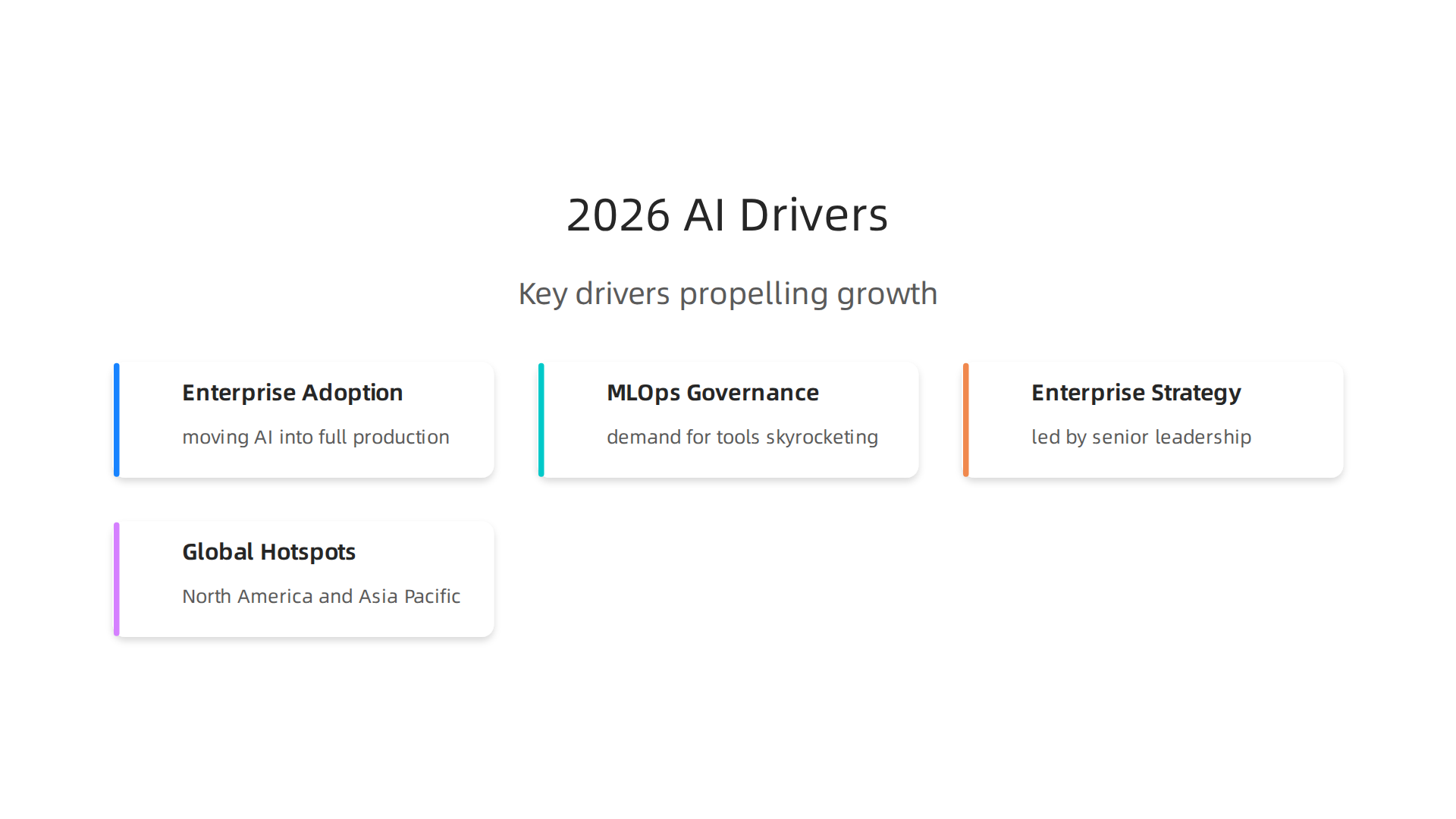
That’s why demand for MLOps and AI governance tools is skyrocketing. PwC predicts that more companies will adopt enterprise wide strategies led by senior leadership in 2026. They are moving beyond hobby projects.
Where is all this happening? The two big hotspots remain North America and Asia Pacific. In Asia, countries like China are pushing hard. If you want to understand the competitive landscape, you’ll want to know which Chinese AI companies are rising fast. At the same time, Europe and the Middle East are seeing fresh growth as governments invest in local AI ecosystems.
This AI overview shows one clear pattern: the market is growing fast, and the winners will be the ones who invest in both technology and good practices. If you want daily updates without the overwhelm, consider subscribing to The Deep View Newsletter. It delivers clear, actionable AI insights straight to your inbox every day.
Dominant Trends Reshaping AI in 2026
The market is growing fast, but what does that mean in practice? Three major trends are reshaping how businesses think about and use AI this year.
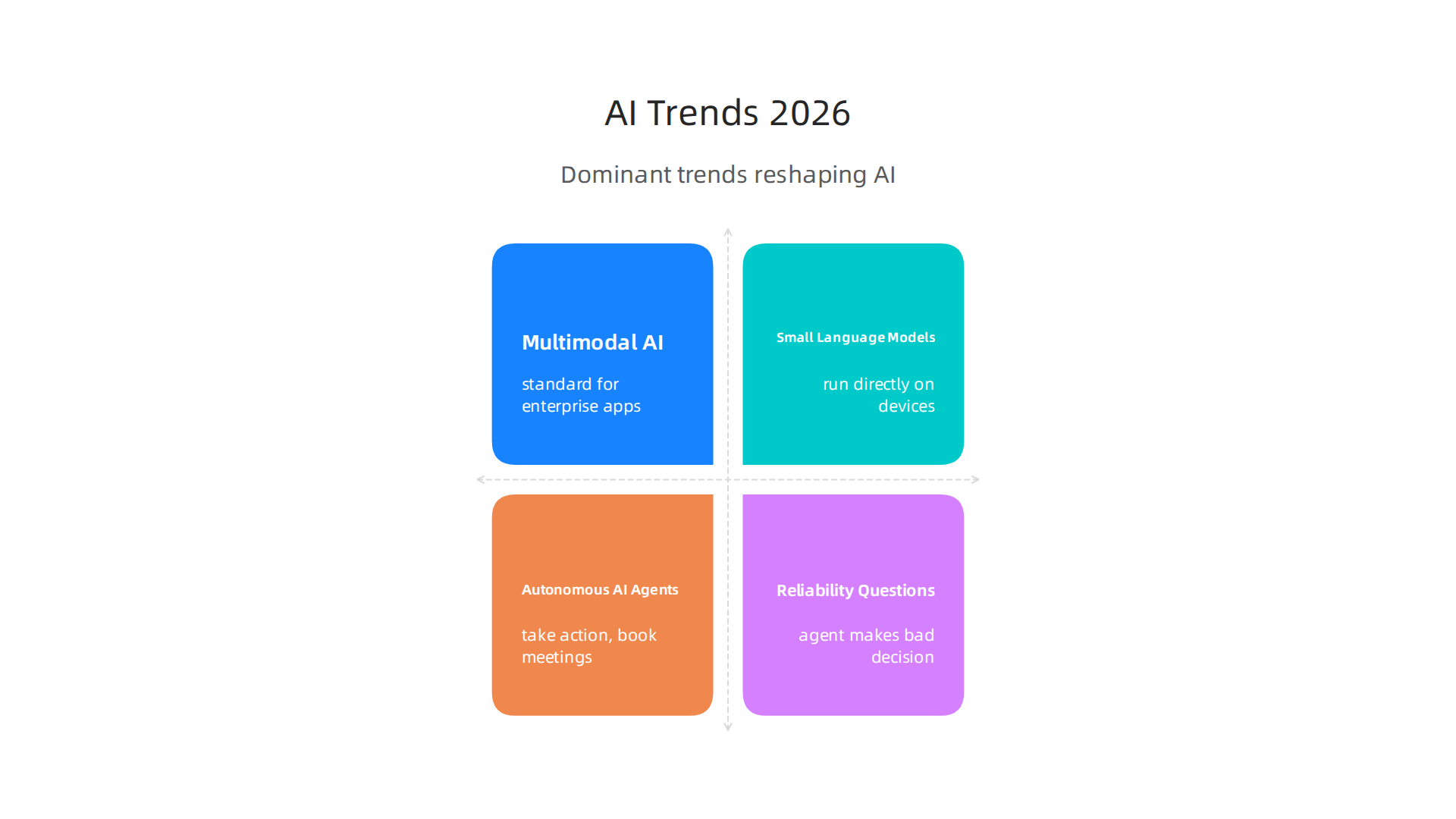
First, multimodal AI has become the standard for enterprise applications. Instead of separate models for text, image, video, and audio, companies now want one system that handles all formats. According to a Dev Genius analysis of 2026 AI trends, multimodal models are a key shift. Real business problems rarely fit in just one format. A customer support bot that reads text, sees screenshots, and hears voice tone is simply more useful.
Second, small language models (SLMs) are gaining serious traction. These compact models run directly on devices instead of needing massive cloud servers. They are perfect for edge deployment and domain-specific tasks where speed and privacy matter. The same Dev Genius source highlights on-device AI as an emerging trend. A medical diagnosis tool does not need a billion parameter model when a smaller, focused one works better and faster.
But the biggest story in 2026 is the rise of autonomous AI agents. These systems do not just answer questions. They take action. They book meetings, adjust supply chains, and write code. IBM’s AI predictions for 2026 place agentic AI at the center of the conversation. Companies are moving agents from labs into live customer environments. However, this raises serious reliability questions. What happens when an agent makes a bad decision? How do you audit its actions? For a deeper look, explore what business leaders need to know about AI risks in 2026.
If you want to stay ahead of these trends without drowning in daily noise, The Deep View Newsletter delivers clear, actionable AI insights straight to your inbox every day.
The Rise of Generative AI and Agentic Systems
We just looked at the big trends shaking up AI in 2026. Now let us zoom in on two of the biggest forces: generative AI and agentic systems.
You probably know generative AI from chatbots that write text. But in 2026, it does way more than that. These models now generate working code, realistic synthetic data for training other models, and even full video clips. Some of the most popular AI tools on the market today offer code generation as a core feature. The Adobe Digital Trends Report shows how brands are using generative AI to create customer experiences that blend text, images, and video seamlessly. This is a far cry from the simple text generators of just a couple years ago.
But the bigger story is agentic AI. Instead of just generating content, these systems take actions on their own. They book your travel, adjust your inventory, or fix bugs in your codebase.

Even Chinese AI companies are pushing hard into this space, building agents for everything from factory automation to customer service. According to CloudKeeper’s analysis of agentic AI trends, both startups and big companies are racing to build agents that handle real business tasks without human supervision. This is where the excitement is right now.
Agentic systems represent a big leap forward. They move AI from a helpful assistant into an active worker. But here is the catch. Reliability and safety are still serious problems. What happens when an agent makes a wrong decision with real money on the line? How do you check its work after it acts? These questions do not have easy answers yet. For a deeper look at these challenges, check out our guide on AI predictions 2026 for business leaders.
If you want to keep up with how generative and agentic AI are reshaping industries, The Deep View Newsletter breaks down the latest developments every day in plain language.
Essential Tools and Frameworks for ML Professionals in 2026
So we have seen how generative AI and agentic systems are taking off. Now the question is: what tools do you actually need to build and run these systems in 2026? The good news is you do not have to start from scratch. A set of proven frameworks has emerged, and a few new players are shaking things up.
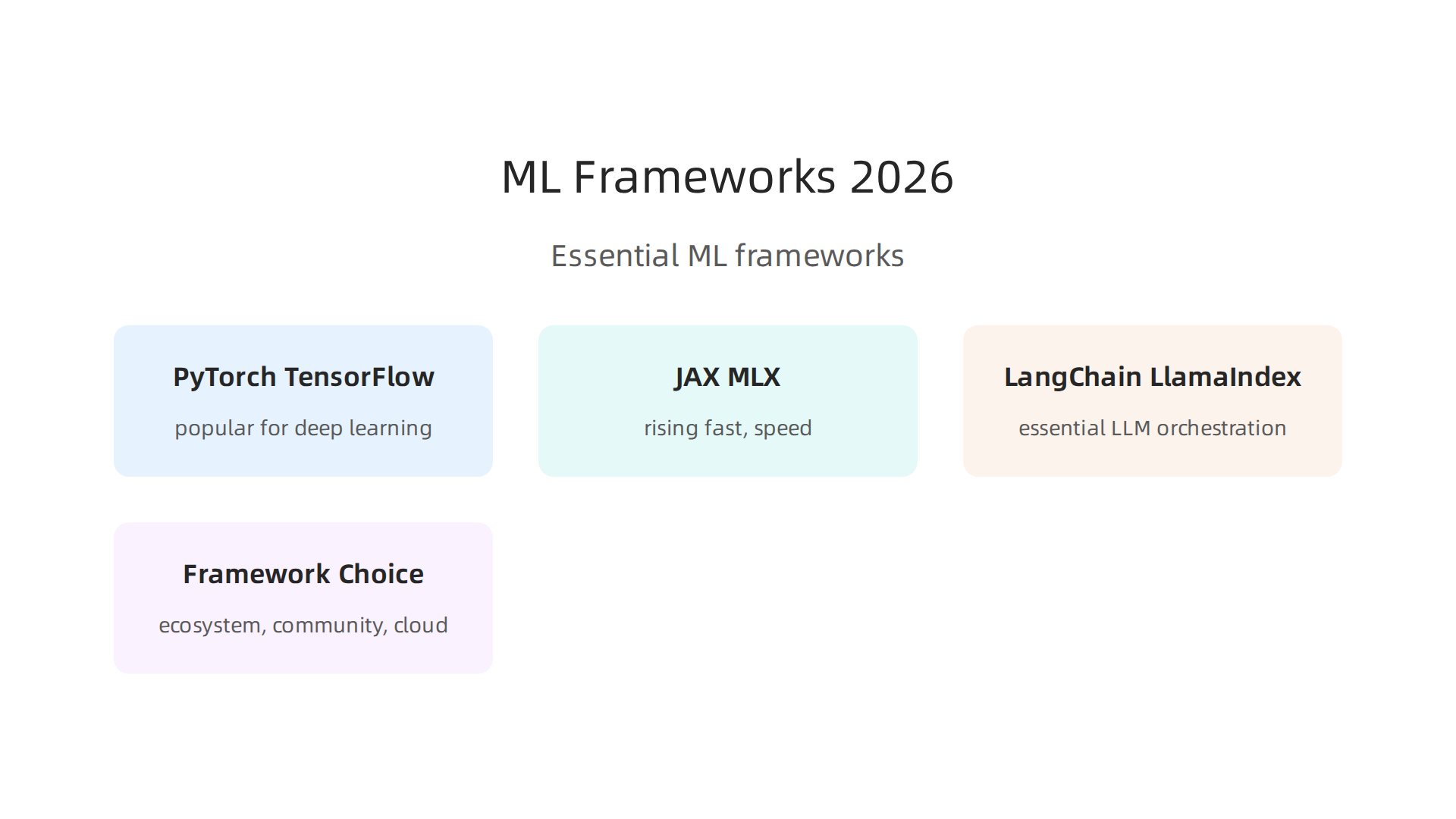
Let us start with the heavyweights. PyTorch and TensorFlow are still the most popular frameworks for deep learning. According to the Sprintzeal guide on machine learning frameworks, these two remain the top choices for most ML pros. They have huge communities, tons of tutorials, and deep support in the cloud. But here is the thing. Newer frameworks like JAX and MLX are rising fast. Label Studio’s roundup for 2026 names JAX as a top pick for natural language processing because of its speed and flexibility. MLX, built by Apple, is gaining traction for running models on Apple Silicon hardware. So you need to know both the old guard and the newcomers.
Beyond the core training frameworks, you also need tools to build generative AI applications. That is where LLM orchestration frameworks come in. LangChain and LlamaIndex have become essential in 2026. They help you connect large language models to your data, build chains of prompts, and manage memory. As Splunk explains in its AI frameworks overview, choosing the right framework now depends on ecosystem maturity, community support, and how well it integrates with your cloud setup. You do not want to pick a tool that nobody else uses or that does not work with your cloud provider.
How do you decide which frameworks to learn first? Start with the ones that solve your biggest pain point. If you are working on generative AI apps, master LangChain and LlamaIndex. If you are training custom models, stick with PyTorch and start exploring JAX for performance gains. For help choosing the right platform for your team, check out our guide on data analysis tools for ML teams in 2026.
The tool landscape shifts fast. If you want to keep your skills current and know which frameworks are winning, subscribe to The Deep View Newsletter. It delivers daily, no-fluff updates on the tools that matter.
MLOps and Production Deployment Best Practices
This section provides an AI overview of best practices for MLOps and production deployment. Once you have built your models using the right frameworks, the next challenge is getting them into production and keeping them reliable. That is where MLOps comes in.
MLOps platforms like MLflow, Kubeflow, and Weights & Biases are now standard tools for managing the full model lifecycle. They help you track experiments, package models, and automate deployment pipelines. As noted in the 7 Machine Learning Trends to Watch in 2026, ML systems are becoming deeply integrated into business processes, making robust deployment and monitoring essential.
**Key practices for production reliability include:
**
- Monitoring and observability. You need to track model performance, data drift, and system health in real time.
- Automated rollback. When a model degrades, you must quickly revert to a previous version without manual intervention.
- Version control for models and data. Treat models like code, with full lineage tracking.
Another growing trend is edge deployment and on-device AI. Running models directly on phones, IoT devices, or local hardware reduces latency and protects user privacy. Many companies now prioritize edge inference for applications like real-time translation, camera-based analytics, and predictive maintenance.
For a deeper look at how to streamline your entire ML workflow and avoid common bottlenecks, check out this practical guide on optimizing your machine learning workflow.
The MLOps landscape evolves fast. To stay current on the most popular AI tools for deployment, monitoring, and edge AI, subscribe to The Deep View Newsletter. It delivers straightforward daily updates so you never miss what matters.
Research Breakthroughs You Need to Know in 2026
If you thought 2025 moved fast, 2026 is a whole new game. Researchers are making leaps that change what’s possible with AI almost every month. Here are three breakthroughs that deserve your attention.
First, fine tuning large language models is getting easier and cheaper. Methods like LoRA and QLoRA let you adapt a massive model to your own data without retraining everything from scratch. That means even small teams can build custom AI tools that actually work for their specific use case. As TechTarget notes, this kind of efficient customization is driving adoption across industries. You no longer need a supercomputer to get a model that understands your business.
Second, the architecture itself is evolving. For years, Transformers ruled the roost. But now new designs like State Space Models are emerging. These models can handle longer sequences of data without the memory cost of Transformers. Google Research highlights that AI is enabling a new era of scientific discovery, and part of that comes from better foundational models. These new architectures promise faster inference and lower energy use a big win for production systems.
Third, alignment and oversight are no longer afterthoughts. As AI systems become more autonomous think agentic AI the need for scalable oversight grows. Stanford AI experts predict that opening the black box of AI will become a scientific mandate. Without proper alignment, agentic systems can drift or behave unpredictably. Researchers are building new techniques to keep models on track even when they act independently.
These breakthroughs connect directly to the production challenges we talked about earlier. Better fine tuning makes it easier to deploy custom models. New architectures improve efficiency at scale. And alignment research helps you trust what your AI does. To stay on top of these fast moving developments and get a daily dose of what matters, consider subscribing to The Deep View Newsletter. It delivers clear, practical updates so you never miss a breakthrough.
Ethical AI and Regulatory Developments
With new breakthroughs happening all the time, a big question follows: how do we keep AI safe and fair? 2026 is the year that regulations really started catching up to the technology.

If you’re building or using AI, you need to know what’s changing.
The European Union’s AI Act is now in full effect. It sets clear rules for high-risk AI systems, forcing companies to document their data, test for bias, and be transparent about how models make decisions. Across the Atlantic, new US executive orders are pushing federal agencies to adopt similar standards. As TechTarget reports, standardization is finally coming to how we measure AI performance and safety. That’s good news for everyone who wants to trust the tools they use.
Fairness and bias remain top concerns for ML practitioners this year. You might have a model that performs great on paper but treats different groups unfairly. That’s why frameworks like the NIST AI Risk Management Framework are gaining traction. They give teams a practical way to check for bias and document their work. For a deeper look at the risks, check out our guide on the dangers of AI bias, deepfakes, job loss, and other critical risks in 2026.
Transparency is another big push. Stanford AI experts predict that opening the black box of AI will become a scientific mandate this year. That means more explainable AI tools and techniques to help you understand why your model gave a certain answer. It’s not just about compliance. It’s about building systems you can actually trust in production.
The regulatory landscape is complex, but staying informed doesn’t have to be hard. For clear, daily updates on AI ethics and regulations, consider subscribing to The Deep View Newsletter. It delivers the practical news you need to keep your projects on the right side of the rules.
How to Stay Ahead: Curated Learning and News for ML Professionals
So after all that talk about regulations and ethics, you might be wondering: how do I actually keep up with everything in 2026? The field moves fast, and staying informed is a challenge in itself. But with the right sources, you can turn information overload into a real advantage.
Start with a solid AI overview. Daily newsletters are the easiest way to get a quick pulse on what matters. The Jotform Blog recommends ten of the best AI newsletters to follow this year, including The Rundown, Ben’s Bites, and The Neuron. These give you a snapshot of the top 5 AI breakthroughs and the most popular AI tools making waves. For professionals who want depth without the noise, Readless highlights three free newsletters that together reach over four million subscribers. The Deep View, which we mentioned earlier, fits right in here if you want clear, balanced coverage.
But newsletters alone won’t build your skills. You need structured learning too. Courses, hands-on labs, and open-source projects are where real growth happens. If you’re serious about advancing your career, take a look at what data roles are demanding right now in our guide on data analyst skills employers demand in 2026 and how to master them. The same goes for understanding which tools are most popular. Chinese AI companies like DeepSeek and ByteDance are releasing models that change the game, and you’ll want to know what they offer and how they compare.
Finally, don’t underestimate the power of community. Discord servers, Reddit communities like r/MachineLearning, and focused LinkedIn groups help you filter signal from noise. When something breaks, these platforms buzz with real-time discussion from people who actually build and deploy models. Follow the right conversations, and you’ll catch trends before they hit the mainstream news. For a broader look at where things are heading, our AI predictions 2026 article covers what business leaders expect this year.
The key is to be intentional. Pick one newsletter, one learning path, and one community. Start there. You don’t need to follow everything. You just need to follow what moves you forward.

Summary
This article gives a practical, up-to-date overview of the AI landscape in 2026, explaining why the market’s explosive growth matters for practitioners, managers, and investors. It summarizes where adoption is highest, the enterprise shift from experiments to production, and the three dominant trends—multimodal systems, small on-device models, and agentic AI—that are reshaping real-world use cases. The guide walks through the tools and frameworks you should learn (from PyTorch and JAX to LangChain and LlamaIndex), concrete MLOps practices for deployment and monitoring, and the research advances making fine-tuning and new architectures cheaper and faster. It also covers the evolving ethical and regulatory environment—like the EU AI Act—and how teams can test for bias, increase transparency, and meet compliance. Finally, the article recommends ways to stay current without overload: pick focused newsletters, hands‑on learning paths, and active communities. After reading, you’ll know which trends to prioritize, which tools to learn first, and how to operationalize and govern AI systems responsibly.