
AI Predictions 2026 What Business Leaders Need to Know

The pace of AI advancement in 2025 was incredible. It set the stage for a truly transformative 2026. But here is the challenge: separating hype from reality is more critical than ever.
Decision makers face serious information overload. Scattered signals make it hard to find a credible path forward. You need research-backed insights to guide your strategy.
We created this guide to give you clarity.

We have analyzed the most authoritative sources, including the Gartner Hype Cycle for AI 2025, which reveals a shift from hype to scalable AI foundations. This article distills the top ai predictions for 2026 into a clear, actionable roadmap.
We will explore what is real and what is noise. We will look at key areas including what is new with openai latest news and the critical risks we must navigate. The goal is to help you scale artificial intelligence effectively this year.
This field moves fast. To get clear, daily updates on the trends shaping our future, subscribe to The Deep View Newsletter. It is the AI newsletter worth reading.
Let us dive into the predictions that will define 2026.
The State of AI in 2025: Setting the Stage for 2026
2025 was the year AI moved from demo to duty. We saw massive leaps in models like GPT-4 class systems, multimodal AIs that could understand images, text, and audio all at once, and early agent frameworks that actually took actions for you. These breakthroughs were real. They changed what we thought was possible.
But here is the thing. While researchers were buzzing about early hints of artificial general intelligence openai might chase, most businesses stayed cautious. The hype was loud, but the adoption was slow.

That gap matters because it directly shapes the ai predictions for 2026.
Regulation also kicked into high gear. The EU AI Act, which entered into force in August 2024, moved steadily toward its full application date of August 2, 2026.

By 2025, companies already had to start preparing for high-risk AI system rules that take effect this year. This regulatory push is driving how organizations plan to scale artificial intelligence safely.
Let us look at some numbers. AI funding stayed strong but shifted from flashy startups to practical tools. Compute costs, while still high, started to level off. A major focus became model efficiency: smaller, cheaper models that could match big ones on key tasks. AI patent filings hit new records, showing that the race for intellectual property is heating up.
All of this created a tricky mix. On one side, researchers felt like we were close to something huge. On the other, enterprise leaders worried about real risks like bias, deepfakes, and job loss. That tension is exactly what makes the openai latest news and other developments so critical to watch now.
If you want to understand the dangers that kept businesses cautious, read our guide on the critical risks of AI in 2026. It explains why many organizations are moving slowly.
Now, with that background, we can turn to the predictions that will actually matter this year.
Predictive Trend #1: The Rise of Autonomous AI Agents
You have used chatbots. You ask a question, it answers. But what if the AI could keep working after you leave? What if it planned steps, used tools, fixed mistakes, and finished tasks on its own? That is the shift happening right now. 2026 is the year autonomous AI agents move from research labs into real business workflows.
Autonomous agents are not just smarter chatbots. They are systems that can set goals, make decisions, take actions, and learn from the results. Last year, frontier models gained 30 percentage points on Humanity’s Last Exam, a benchmark designed to be hard for AI and easy for humans, according to Stanford HAI. That jump in reasoning ability is a key reason agents can finally work reliably in messy, real world situations.
So what makes these agents possible now? Three things came together:
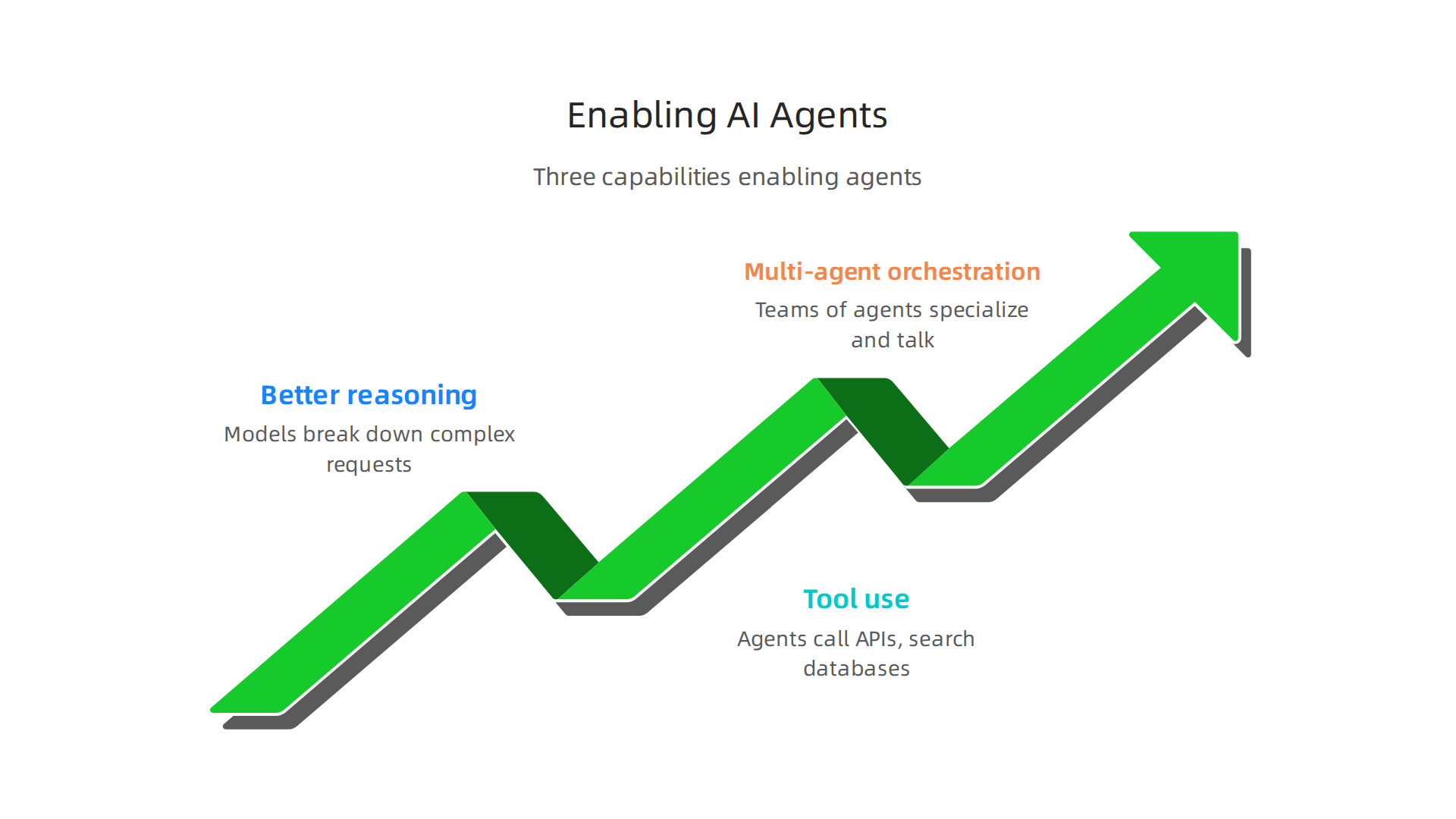
- Better reasoning and planning. Models can now break down complex requests into smaller steps.
- Tool use and memory. Agents can call APIs, search databases, and remember context across long tasks.
- Multi agent orchestration. Teams of agents can specialize and talk to each other, just like human teams do.
This is not theory anymore. The State of AI Agents 2026 report shows that over 200 data points confirm a massive increase in enterprise agent deployments. Common uses include automated customer support, coding assistants that write and debug code, research agents that scan thousands of documents, and workflow automation that connects your entire tool stack. A growing list of awesome AI agents and frameworks now includes hundreds of options across coding, creative work, voice, and enterprise tasks.
But there are real risks. Agents can make mistakes in ways that are hard to catch. They can be exploited if security is weak. And aligning their goals with human intentions is still a tough problem. That is why enterprise leaders are moving carefully, testing agents in low risk areas first.
If you want to stay ahead of the ai predictions that matter, especially as models like those in openai latest news push toward more general capabilities, you need a reliable source of daily insights. That is exactly why we recommend The Deep View Newsletter. It delivers clear, practical AI updates every day so you never miss a shift in agent technology.
For a deeper look at how businesses are using these systems, read our guide on electronic data gathering and retrieval for machine learning pipelines in 2026. It covers the data infrastructure that makes autonomous agents work at scale.
Predictive Trend #2: Multimodal and Open Foundation Models
Think about the last AI tool you used. Did it only read text? That is quickly becoming old news. In 2026, the default for new foundation models is multimodal. This means they can handle images, video, audio, and code, not just words.
Why does this matter? Because the real world is multimodal.

A doctor wants to show a scan and ask questions. A designer wants to sketch a layout and get feedback. An engineer wants to share a code snippet and a bug screenshot. According to the State of AI Agents 2026 report, multimodal agents are now being deployed in domains where visual precision matters, such as robotics, healthcare, and autonomous driving. The ability to measure and trust these outputs is becoming critical.
At the same time, a big debate is heating up: open models versus closed models. On one side, you have powerful proprietary systems. On the other, open models that anyone can download and fine-tune. Regulatory pushes in Europe and other regions are pressuring companies to open up their models for auditing. And the cost of training frontier models is enormous, which makes open collaborations more attractive. But here is the interesting part: performance is starting to converge. Open models are catching up to closed ones in many benchmarks. The Foundation Model Transparency Index average fell to 40 in 2026 from 58 in 2025, meaning the most capable frontier models are becoming less transparent, even as open alternatives improve.
For startups, this shift is huge. You no longer need a massive budget to use a top tier model. Open multimodal models let you fine-tune for your specific niche. Want a model that understands your industry jargon? You can adapt a base model without sharing your data with a third party. That is a big deal for privacy. You can also run models on your own infrastructure, avoiding cloud costs and latency.
This trend connects directly to the ai predictions we are watching closely. As models become more capable across modalities, the path toward artificial general intelligence openai and other research labs becomes clearer. The openai latest news shows they are pushing fully into multimodal and reasoning. Meanwhile, companies like scale artificial intelligence are providing the data labeling infrastructure to support these systems.
If you work with image or video data, you might want to check out our practical guide on using artificial intelligence images to understand complex AI models. It shows how multimodal outputs can help you debug and explain your models.
To stay on top of these fast moving trends, you need a daily source you can trust. That is why we recommend The Deep View Newsletter. Every day it delivers clear, practical AI updates so you never miss the next big shift in foundation models or multimodality.
Predictive Trend #3: AI-Native Software Development
Remember when AI coding tools just autocompleted your lines? That was 2024. In 2026, AI-native software development means something much bigger. We have moved past simple code completion to full lifecycle automation: design, testing, deployment, and even monitoring.
The shift is massive. Instead of a developer typing a function and AI suggesting the next line, teams now let AI draft entire microservices, write unit tests, and configure CI/CD pipelines. According to industry projections, the MLOps market is scaling rapidly to support this new reality. It was valued at $4.39 billion in 2026, and is expected to hit almost $90 billion by 2034
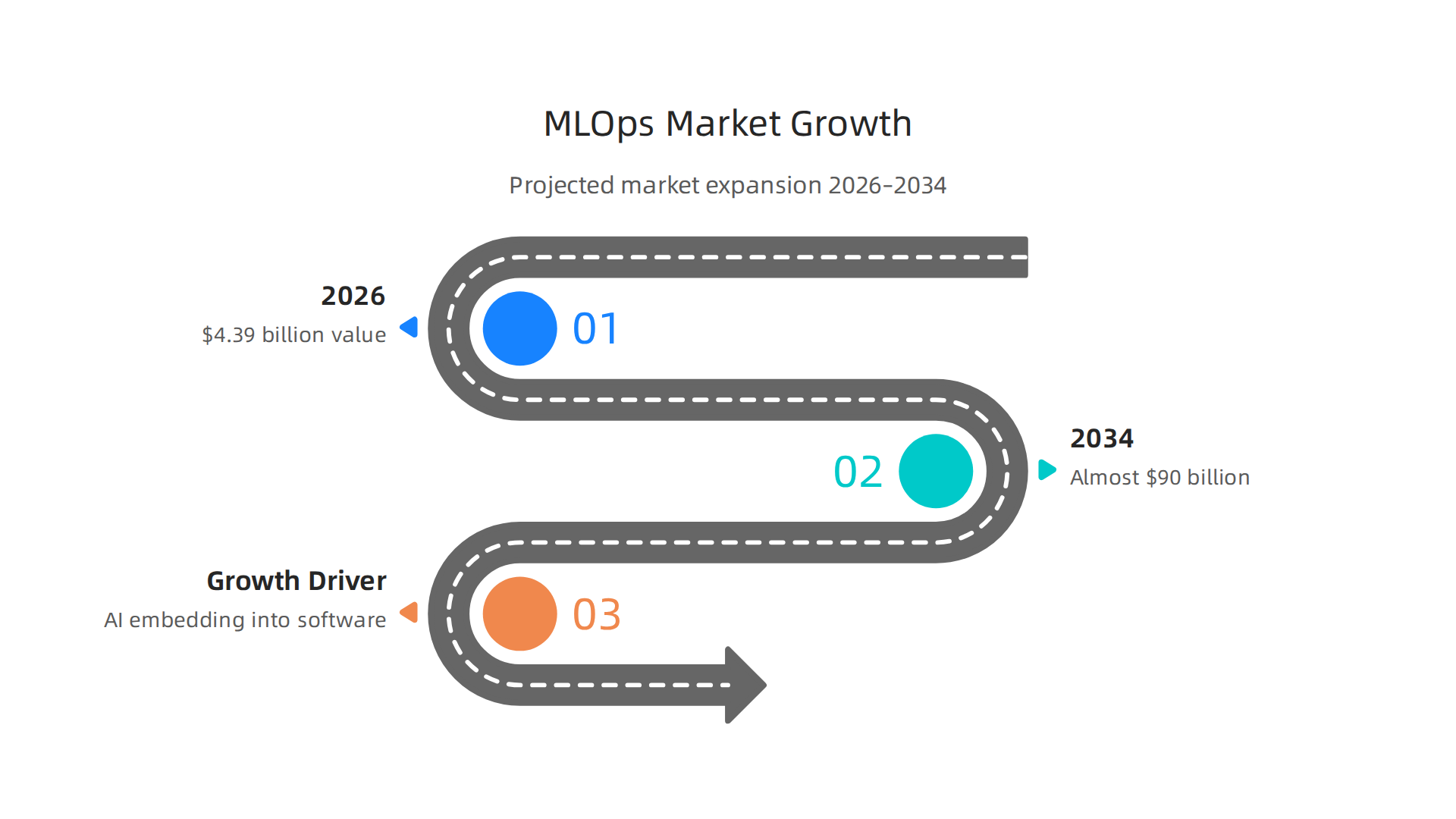
(Fortune Business Insights). That growth reflects how deeply AI is embedding into every stage of software creation.
But here is the real challenge: AI-generated code is now running in production, and that brings quality, security, and maintainability headaches. A model might write code that works in isolation but breaks under real-world load. It might introduce subtle security flaws that traditional linters miss. Teams are discovering they need new guardrails and review processes. This is where solid MLOps practices become critical. Without them, AI-native development can quickly turn into a maintenance nightmare.
What does this mean for developer roles? Productivity is surging. Early numbers from 2025, reported by GitHub and GitLab, showed that developers using AI assistants completed tasks up to 55% faster. But the nature of the job is changing. Developers now spend more time reviewing, prompting, and architecting, and less time writing boilerplate. The role shifts from coder to AI orchestrator.
If you are building or managing AI-driven products, you will want to understand how to handle the data pipelines that feed these models. Our guide on electronic data gathering and retrieval for machine learning pipelines walks through the essentials.
These ai predictions point to a future where every software team is also an AI team. To keep up with the rapid changes in how we build software, you need a daily source you can trust. That is why we recommend The Deep View Newsletter. It delivers clear, practical AI updates every day so you never miss the next shift in AI-native development.
Industry-Specific AI Predictions for 2026
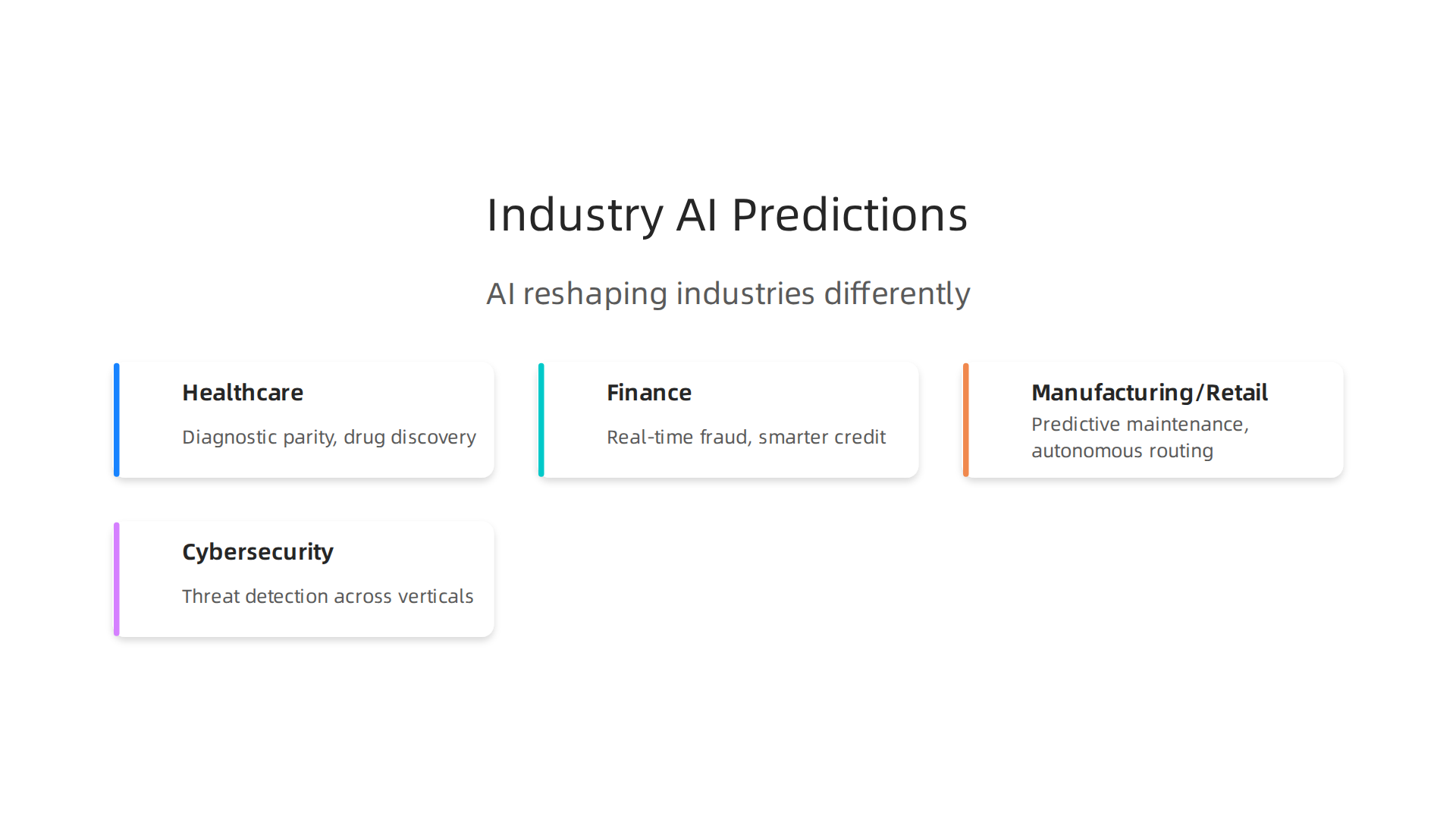
AI is not just changing how we write code, it is reshaping entire industries. The ai predictions for 2026 show that different sectors are adopting artificial intelligence at different speeds and in very specific ways.
Let us look at what is happening on the ground.
Healthcare: From Assistance to Diagnostic Parity
Healthcare is one of the fastest adopters. Around 80% of the global healthcare industry is now using AI technologies to improve patient care (ElectroIQ). In 2026, clinical decision support tools help doctors spot diseases earlier. Drug discovery timelines have shrunk from years to months. And radiology AI is reaching diagnostic parity with human radiologists for many common scans. That means faster, more accurate results for patients.
Finance: Real-Time Fraud and Smarter Credit
Banks and financial services are spending heavily on AI. The top 25% of AI spenders include financial agencies (Coherent Solutions). In 2026, real-time fraud detection systems catch suspicious transactions in milliseconds. Credit scoring now uses alternative data like utility payments or rental history to serve people who were previously invisible to the system. Regulatory compliance is also getting automated, reducing the burden on human teams. But these systems come with risks. Biased algorithms can unfairly deny loans or flag legitimate transactions. That is why we covered the dangers of AI deeply in our piece on AI bias and critical risks.
Manufacturing, Retail, and Logistics
Beyond healthcare and finance, AI is transforming the factory floor. The global AI in manufacturing market is expected to jump from $7.6 billion in 2025 to $62.33 billion by 2032 (Aristek Systems). Predictive maintenance keeps equipment running longer. In retail, personalized shopping agents recommend products based on your exact preferences. Logistics companies use autonomous routing to plan deliveries, saving fuel and time.
The Cross-Industry Layer: Cybersecurity
One trend cuts across every vertical. AI for cybersecurity threat detection is becoming a must have. Whether you run a hospital, a bank, or a warehouse, AI monitors network traffic and spots anomalies faster than any human team could.
These ai predictions show that 2026 is the year artificial intelligence moves from experimental projects to standard practice. To scale artificial intelligence responsibly, you need to watch how OpenAI and other labs shape the regulatory landscape. For daily updates on these industry shifts, get The Deep View Newsletter. It delivers clear, practical AI news every morning so you never fall behind.
The Infrastructure and MLOps Backbone
All these industry predictions sound great, but here is the real question. How do you actually run AI models without things breaking? That is where the infrastructure and MLOps backbone comes in.
In 2026, the scaling laws debate is heating up. For years, bigger models meant better results. But now the focus is shifting to inference efficiency. Huge models cost a lot to run. So smaller, specialized models called SLMs are taking over for specific tasks. They are cheaper, faster, and often more accurate for focused jobs. This is a major shift in ai predictions for the year.
At the same time, MLOps is maturing fast. The global MLOps market was valued at around $2.43 billion in 2025 and is expected to hit $56.60 billion by 2035 (Precedence Research). That is huge growth. In 2026, automated pipelines, model monitoring, data versioning, and governance are becoming standard practice.
Teams no longer build models by hand. They use structured workflows to track experiments, catch drift, and push updates smoothly. If you want to scale artificial intelligence responsibly, MLOps is non-negotiable. For a deep dive on building these pipelines, check out our guide on electronic data gathering and retrieval for ML pipelines.
Then there is compute availability. Cloud providers are still the main choice for most teams. But GPU supply remains tight, especially for training large models. Many companies are moving to inference-as-a-service to offload the heavy lifting. Others are keeping sensitive data on-premises for security. The key is choosing the right balance for your workload.
Want to stay ahead of these shifts? The best way to track openai latest news and infrastructure trends every morning is with The Deep View Newsletter. It breaks down complex topics in plain English so you can make smarter decisions.
Ethics, Regulation, and Trust in AI
As AI gets more powerful, the question of trust becomes harder to ignore. These ai predictions for 2026 highlight one big shift. Regulation is no longer a future concern. It is here right now.
The EU AI Act is the biggest example. On August 2, 2026, the rules for high-risk AI systems take full effect (EU AI Act). Nearly every company using AI in Europe must comply (Sombra Blog). The United States and China are also rolling out their own governance frameworks. This global push means businesses cannot ignore compliance anymore.
But regulation alone is not enough. Trust also comes from how AI behaves. Hallucinations, bias, and lack of transparency still cause real problems. For example, biased AI can lead to unfair hiring or loan decisions. These risks are serious. If you want to learn more about these dangers, check out our article on the dangers of AI bias and other critical risks in 2026.
At the same time, companies are struggling to find experts who can handle these issues. The demand for AI ethics roles is growing fast. New tools for bias detection and red-teaming are becoming standard practice. Even big names like OpenAI are under pressure to be more transparent. Stay up to date with OpenAI latest news to see how major players are responding.
To scale artificial intelligence responsibly, companies must invest in these trust-building practices. It is not just about following rules. It is about building systems people can actually rely on.
Keeping up with these fast changes is tough. That is why The Deep View Newsletter is a smart choice. It gives you clear daily updates on regulation, trust, and the latest AI trends so you never miss what matters.
Building Your Personal AI Prediction Framework
Now that we have covered ethics and regulation, the next question is personal. How do you know which ai predictions to trust? With so many voices online, you need your own system to separate hype from real progress.
Start by checking the source. Look at their past track record. Do they use solid methods? Are they biased toward a certain company? Tools like the Gartner Hype Cycle for AI 2025 help you see where a technology really stands. Forrester also publishes yearly predictions that can guide your thinking.
Next, focus on leading indicators. These are numbers that show where AI is heading before it gets big. What should you watch?
- Compute power – How much processing is being used for AI training.
- Patent filings – Which companies are protecting new ideas.
- Open-source activity – What tools and models the community is building.
Match these signals against expert consensus from groups like the AI Index or the AIR 2025 report. If the numbers and the experts agree, the prediction is stronger.
Now for action steps. You can set up a simple monitoring dashboard to track these indicators. A good data platform helps you stay on top of changes. Check out our guide on data analysis tools 2026 to find the right one for your team.
Another smart move is to subscribe to a curated intelligence source. Instead of hunting for news yourself, let someone filter it for you. That is why The Deep View Newsletter is so useful. It gives you a daily snapshot of the real trends and helps you build your own prediction framework over time. You can also join forecasting platforms where experts share their views and you can test your own guesses.
Building a solid framework takes a little work, but it protects you from getting swept up in every new headline. With the right sources and tools, you will make smarter bets on what comes next.
Summary
This article distills the most impactful AI predictions for 2026 and turns scattered signals into a clear, actionable roadmap for decision makers. It reviews how 2025 moved AI from demos into practical use—highlighting autonomous agents, multimodal foundation models, and AI-native software development—and explains why those trends matter for businesses. The piece covers sector-specific adoption (healthcare, finance, manufacturing, logistics), the operational backbone (MLOps, inference efficiency, compute tradeoffs), and the rising importance of regulation and trust such as the EU AI Act. You will learn which technologies to prioritize, how to stage safe deployments, what infrastructure and governance practices reduce risk, and a simple framework to separate hype from real progress. By the end, readers will have practical steps to scale AI responsibly and sources to follow for daily updates.