
Master Data Labeling for Unwavering ML System Reliability

Why data labeling is the foundation of reliable ML systems
In 2026, many people think that the cleverest part of a machine learning (ML) system is its advanced computer brain, known as the model. They believe that if you have a super smart model, it will always work well. But actually, this isn’t the whole story. The truth is, the quality of your ML model depends a lot more on the data you feed it and how that data is prepared. This preparation is called data labeling.
Imagine you’re teaching a child to recognize different animals. If you show them pictures of cats but tell them they are dogs, the child will get confused and learn incorrectly. It’s the same for machines. If the data fed to an ML model has wrong labels or poor quality, the model will learn wrong things. It doesn’t matter how powerful the model itself is. Poor data leads to poor results. This is why good data labeling is so important. It ensures your machine learning systems are truly data driven, making smart choices based on correct information. In fact, solid Data annotation quality: the cornerstone of AI success and a legitimate tech career is a key part of how well AI works.
This guide will help you understand everything about data labeling. We will look at smart strategies to use and how to build strong data pipelines. We will also cover how to make sure your labeled data is top-notch through quality assurance. We will talk about the different tools available, how much it costs, and rules you need to follow for privacy and fairness. By the end, you’ll see why getting data labeling right is the first step to building machine learning systems you can trust.

To keep learning about these important topics and more, you might like The AI Newsletter Worth Reading.
Why label quality matters: measurable effects on model performance
Getting data labeling right is indeed the first step to building machine learning systems you can trust. But what happens if the data labeling isn’t good? Well, even the smartest computer brain, or model, will struggle. Poor quality in your labeled data can cause many problems that stop your ML system from working correctly.

In 2026, we know that the quality of data has a big impact on how well machine learning models perform, how fair they are, and how safe they can be.
What Happens When Labels Are Bad?
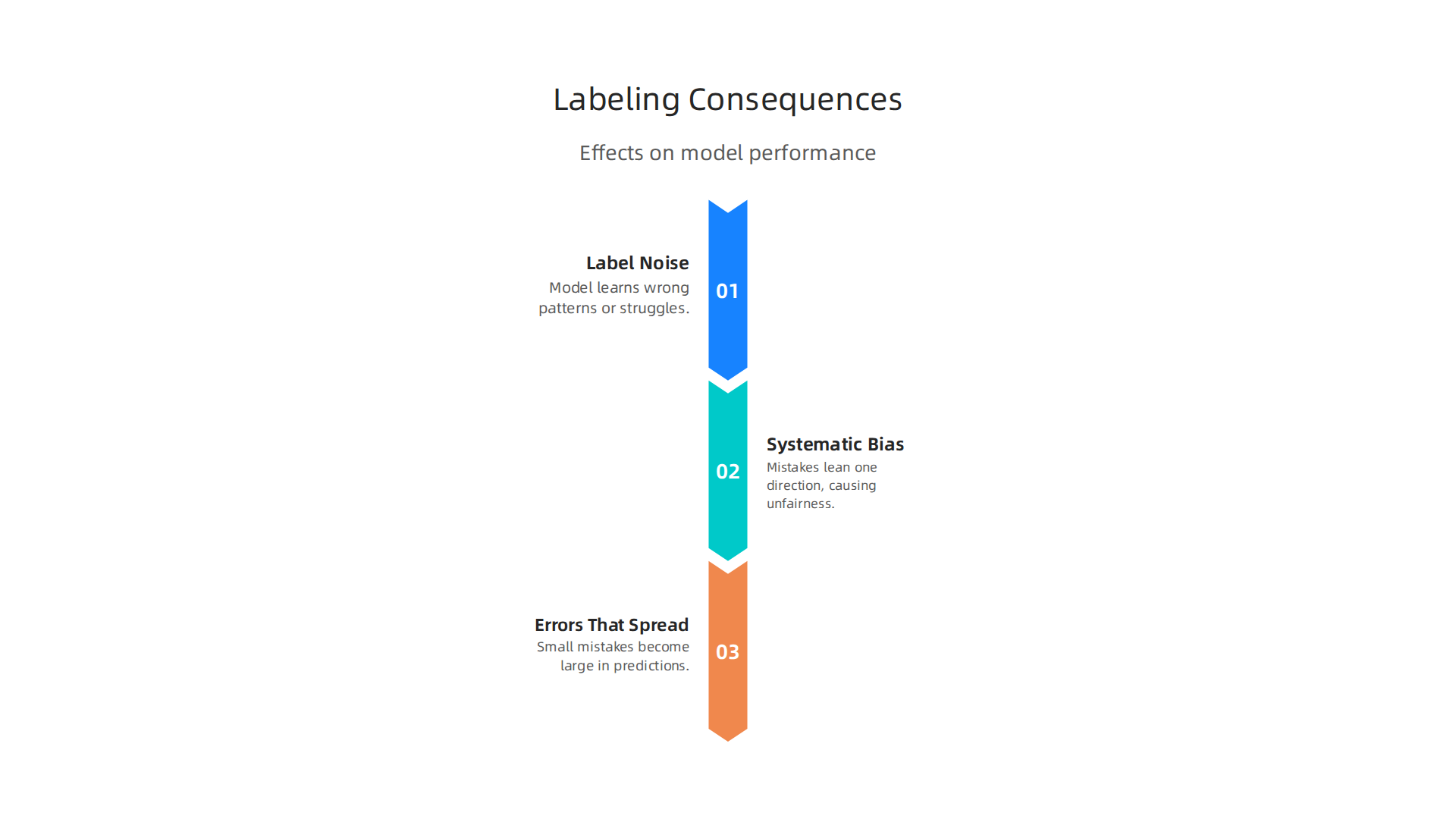
Let’s look at three main issues that happen when data labeling is not done well:
-
Label Noise: Imagine you’re teaching a machine to spot cats. If some pictures of dogs are accidentally marked as "cat," that’s label noise. The machine gets confused by these wrong labels. When there’s too much noise, the model learns the wrong patterns or struggles to learn any patterns at all. This makes its predictions unreliable. Studies show that these kinds of mistakes in labeling, called label noise, really hurt how useful the data is and how accurate the model becomes [PDF] AQuA: A Benchmarking Tool for Label Quality Assessment](https://papers.nips.cc/paper_files/paper/2023/file/fc20ea8d104cab737a5561096f9bde9b-Paper-Datasets_and_Benchmarks.pdf).
-
Systematic Bias: This happens when the mistakes in labeling are not random, but always lean in one direction. For example, if images of certain groups of people are always labeled incorrectly, the model will learn to treat those groups differently, and often unfairly. This kind of systematic bias in data labeling can lead to big problems in real-world use, making the AI system unfair or even harmful. It means the model isn’t truly
data drivenin a fair way. -
Errors That Spread: When labels have noise or bias, these errors don’t just stay small. They spread through the entire learning process. The machine learning model builds its understanding of the world based on these bad labels. So, a small mistake at the start of data labeling can become a very large mistake in the final predictions the model makes. It’s like building a house on a shaky foundation. Even if the house looks good, it won’t be stable. Researchers have looked closely at how poor data quality, including bad labels, affects machine learning performance The Effects of Data Quality on Machine Learning Performance.
How Poor Labeling Causes Models to Fail
Bad data labeling also leads to specific ways that models fail:
- Edge-Case Failures: These are problems that happen when the model sees something it hasn’t properly learned about. If your
data labelingdidn’t include enough examples of rare or unusual situations, the model won’t know what to do when it encounters them. For instance, a self-driving car system that hasn’t seen enough examples of heavy fog might fail to react correctly in those conditions. This is a big problem because these "edge cases" can be very important, like safety situations. - Distribution Shifts: Imagine you trained a model using only data from sunny California, but then you try to use it in snowy Canada. The "world" that the model learned about is very different from the "world" it now has to work in. This is called a distribution shift. If your initial data labeling doesn’t represent all the different kinds of situations the model will face, it will perform poorly when things change. It shows that good
data labelingneeds to think about the bigger picture of where and how the model will be used.
To make sure your machine learning systems are trustworthy and work well, it’s really important to focus on getting high-quality data labels from the start. It ensures your models are built on a solid foundation. If you’re working on making sure your AI systems are reliable, learning about how to build and manage trustworthy AI systems in 2026 can give you even more helpful tips.
Designing a scalable labeling pipeline (people, tools, and data flow)
After understanding how bad data labels can mess up machine learning models, the next big step is to make sure your data labeling process is strong from the start. Think of it like building a river for your data: you need to plan carefully where the water (data) comes from, how it flows, and what happens to it along the way. In 2026, building a good data labeling pipeline is key for AI success.
Core Parts of a Labeling Pipeline
A good data labeling system needs several important parts to work well:
- Data Ingestion: This is how you get all your raw data ready for labeling. It could be pictures, words, or sounds. You need a smooth way to pull this data in, like a well-oiled pump. You can learn more about how to set this up effectively in our guide on electronic data gathering and retrieval for machine learning pipelines in 2026.
- Task Design: This means making clear rules for the people doing the labeling. What should they look for? How should they mark it? Good instructions are super important for getting high-quality labels.
- Worker Pools: Who will do the actual labeling? You can use your own team (internal) or hire outside help (vendors). Hiring outside teams, or outsourcing data annotation, can offer big benefits like faster work and lower costs, but you need to check their quality and security practices carefully Data Annotation Outsourcing 2026: Vendors, GDPR/HIPAA.
- Storage and Versioning: Once data is labeled, you need to store it safely. It is also important to keep track of changes, like different versions of the labels. This helps you go back and see how things changed over time.
How to Keep the Pipeline Running Smoothly
Making this pipeline run day after day also brings up some practical concerns:
- Throughput and Latency: How much data can you label in a certain time (throughput)? And how long does it take for a piece of data to go from start to finish (latency)? You want high throughput and low latency so your
data labelingdoesn’t slow down your AI projects. - Batching: This is like grouping similar tasks together. Instead of sending one picture at a time, you send a "batch" of 100 pictures. This can make the work faster and more organized.
- Monitoring for Drift or Backlog: You need to constantly watch your pipeline. Is the quality of the labels staying consistent (no "drift")? Is too much data piling up, waiting to be labeled (a "backlog")? Regular checks help ensure everything is running well. Being
data drivenhere means using metrics to spot problems early.
Designing this kind of pipeline helps make sure your data is ready for your machine learning models, keeping them stable and accurate. It is a foundational step for any AI system aiming for success in 2026.
Get clear daily AI updates from The AI Newsletter Worth Reading.
When you have a strong plan for your data pipeline, the next step is to choose the best way to put labels on your data. Data labeling is how you give meaning to your raw information, and there are different ways to do it. Each way has its good points and not-so-good points, depending on what you need for your machine learning project.
Pure Human Annotation
This method means real people look at your data and add labels by hand. For example, if you have pictures of cats and dogs, a human would draw a box around each animal and say if it’s a "cat" or a "dog."
- Pros: Humans are very good at understanding tricky situations or new kinds of data. This often leads to very high-quality labels, which are super important for building models that work well. Poor label quality can make a machine learning model perform badly or give unreliable answers The Effects of Data Quality on Machine Learning Performance.
- Cons: It can be slow and cost a lot of money, especially if you have a huge amount of data.
Programmatic Labeling and Weak Supervision
Instead of humans doing all the work, you can use computer rules or simple programs to label data. Think of it like this: if you have text data, a rule might say, "If the word ‘urgent’ appears, label this message as ‘high priority’."
- Pros: This method is much faster and cheaper than human labeling. It’s great for quickly labeling very large datasets.
- Cons: The labels might not be as accurate as human labels. Creating good rules can be hard, and if the rules aren’t perfect, the model won’t learn correctly. This is often called "weak supervision" because the labels are generated by rules, not always perfectly accurate humans, but they still give the machine learning model a starting point.
Hybrid Pipelines: Combining the Best of Both
Most smart teams in 2026 use a mix of human and computer power to label data. This is often called a hybrid approach. It helps reduce costs while keeping label quality high.
- Active Learning: In this method, a machine learning model helps decide which pieces of data humans should label. Instead of humans labeling everything, the model asks for help only on the data it finds most confusing or important. This means humans label fewer items, which saves time and money. Active learning can help teams get to their target accuracy using much less human labeling effort, sometimes 30% to 70% less Active Learning Machine Learning: How It Reduces ….
- Model-Assisted Labeling: Here, the computer makes a first guess at the label for a piece of data. Then, a human quickly checks that guess. If the computer’s guess is right, the human just approves it. If it’s wrong, the human fixes it. This makes the human job much faster than labeling from scratch. Studies show that checking a suggested label can be 3 to 4 times faster than labeling from the start Leveraging the Full Potential of Human Interaction via Auto-Labeling ….
Using these hybrid methods makes your data labeling process more data driven. You can reduce costs and get better coverage of your data without sacrificing too much quality. The right approach depends on how much accuracy you need, how much data you have, and your budget. Choosing the best data annotation method is a cornerstone for AI success. For more in-depth information, you can read about Data annotation quality: the cornerstone of AI success and a legitimate tech career.
Staying updated on all the latest in AI is key to making these decisions. Get clear daily AI updates from The AI Newsletter Worth Reading.
No matter how you label your data, making sure the labels are good is very important. This is called quality assurance, and it helps your machine learning models work correctly. In 2026, smart teams use clear rules, checks, and ways to make things better all the time.
Quality assurance: metrics, audits, and continuous improvement
Getting good data labeling means always checking the quality of your labels. Here are some key ways to do that:
How to measure label quality
- Inter-Annotator Agreement (IAA): This checks how much different human labelers agree when they label the same piece of data. If two people label the same picture and both say it’s a "cat," their agreement is high. If they often disagree, something might be wrong with your labeling rules, or the labelers need more training. Good IAA means your rules are clear and everyone understands them the same way. You can even design a system where 15-25% of your data is labeled by more than one person to check this agreement How-to guides for physical AI data.
- Gold-Set Performance: A "gold set" is a small group of data that has been labeled perfectly by experts. You use this gold set to check how well your regular labelers are doing. If your labelers’ work matches the gold set, then they are doing a great job. This is like having answer keys for a test.
- Confusion Analysis: This is a fancy way to look at common mistakes. For example, if your labelers keep mixing up pictures of "dogs" and "wolves," you know there’s a problem. This helps you find areas where your
data labelingrules might be unclear or where labelers need more help. Understanding these mistakes helps you make your labels more accurate, which is crucial because bad labels can hurt how well a model performs Data Annotation Quality Metrics That Predict Model Performance.
Keeping quality high with checks and feedback
Good data labeling isn’t a one-time thing. It’s a continuous process that needs constant checks and ways to improve.
- Designing Audits: Audits are like regular check-ups. You pick a random sample of labeled data and have a senior labeler or expert review it. This helps you spot mistakes and make sure rules are being followed. For example, a quality assurance loop should always include pre-labeling checks Human In The Loop Labeling: Practical 2026 Guide.
- Feedback Loops: This means quickly telling labelers when they make a mistake and explaining how to fix it. It’s like giving students feedback on their homework so they can learn. Real-time feedback helps stop bad labeling habits before they get too big Data Annotation Trends 2026: Forecast & Best Practice.
- Remediation (Fixing Mistakes): When you find mistakes, you need a plan to fix them.
- Relabeling: Sometimes, a batch of data might have so many errors that it’s better to have it labeled again.
- Adjudication: If two labelers disagree, an expert can look at the data and make the final decision. This helps set a clear standard. You should also keep track of who labeled what and who changed labels. This is called an audit trail and it’s very helpful for figuring out where issues started Curate & Version Your Golden Evaluation Dataset.
- Targeted Sampling: Instead of checking all data, you might focus on checking data that is known to be tricky or where the model seems to struggle.
By using these methods, you make your data labeling process more data driven. This helps you build strong, trustworthy AI systems and makes sure your models learn from the best possible information.
To learn more about how to make sure your AI systems are reliable, check out this guide on how to build and manage trustworthy AI systems in 2026.
Good quality labels are super important, but you also need the right tools and people to make them. In 2026, many different tools and services help with data labeling. Picking the best one for your project is a big step.
Tooling and vendor evaluation: selecting the right platform
Choosing the right platform for your data labeling work can make a huge difference in how well your AI models turn out. It’s like picking the right tools for building a house. A good tool helps you work faster and better.
How to pick the best data labeling tools
When you look for a data labeling tool or service, think about these things:
- What tasks it can do: Can the tool handle the specific type of labeling you need? For example, labeling objects in pictures is different from labeling sounds. Make sure the tool fits your needs. Some tools are known for being easy to use too 30 best data labeling tools [2026 Q1 Updated].
- How it works with your other tools: Does the labeling platform easily connect with your existing machine learning systems? Good tools fit right into your workflow without causing problems. You want something that helps you move your data smoothly.
- How easy it is to use: This is called "labeling ergonomics." If the tool is hard to use, your labelers will be slow and make more mistakes. A simple, clear design helps them do their best work.
- Quality control features: Does the platform have good ways to check the quality of labels, like the ones we talked about before? Look for tools that offer many ways to catch errors before they become a bigger issue Data Labeling Platforms 2026 — Accuracy, Speed, and Governance.
- Service promises (SLAs): If you use a company to label your data, what promises do they make about speed and quality? These promises are called Service Level Agreements (SLAs). They tell you what to expect.
- Security: How does the platform keep your data safe? This is very important, especially for sensitive information. Good platforms have strong security features and ways to track who did what.
It’s about finding a platform that protects your data labeling quality and helps your work move faster, not just one with many features How to Choose the Best Data Labeling Platform in 2026 [Expert Guide].
Should you do it yourself or hire help?
When it comes to data labeling, you have two main choices: do it yourself (in-house) or hire an outside company (a vendor). Both have good and bad points:
-
Doing it yourself (In-house):
- Control: You have full control over your data and how it’s labeled.
- Ideas (IP): Your special ways of labeling stay with you.
- Workforce: You manage your own team of labelers. This can take more time and effort to build and manage.
- Cost: You pay for the tools and your team’s salaries. It might seem cheaper at first, but hiring and training take time and money.
-
Hiring a company (Vendor):
- Speed: They can often start labeling your data much faster because they already have teams and tools ready.
- Scalability: If you suddenly need a lot more data labeled, they can handle it easily.
- Cost: You usually pay per label or per project. This can make costs more predictable.
- Expertise: Many vendors specialize in different types of
data labelingand can offer expert help. - Less control: You give up some control over the process, but good contracts can help with this.
Both options have their strong points. In-house teams offer more control, while outside vendors can offer speed and flexibility In-House vs Outsourced Data Labeling: Pros & Cons. Think about what is most important for your project. If you’re wondering how to choose other AI tools for your work, you might find this guide helpful: Choosing all AI tools types evaluation and workflow for 2026.
Making the right choice for data labeling tools and services is a key part of building strong AI. It helps make sure your models get the best possible data driven information.
Get clear daily AI updates by subscribing to The AI Newsletter Worth Reading.
Making the right choice for data labeling tools and services is a key part of building strong AI. It helps make sure your models get the best possible data driven information. But choosing the right tools is just the beginning. You also need to think about how much it will cost, what rules you need to follow, and how to be fair and responsible. This is called governance, and it is very important for all your labeled data.
Cost, compliance, and ethics: governance for labeled data
Thinking about the money side of data labeling is a big deal. You want to get good results without spending too much. Also, you need to make sure your data handling follows the law and is fair to everyone.
How to figure out data labeling costs
The cost of data labeling can change a lot based on a few things:
- What you’re labeling: Simple tasks, like saying if a picture is of a cat or a dog, cost less. More complex tasks, like drawing exact outlines around many different objects in a detailed video, cost more. For example, simple image labeling can cost as little as $0.01 to $0.15 per image, while more complex tasks like segmenting an image can be $0.25 or more per image in 2026 Cost of Labeling Training Data: 2026 Pricing, Benchmarks & ….
- How much data you have: If you have a huge amount of data, you might get a better price per label.
- Who is doing the labeling: As we talked about before, doing it yourself with your own team (in-house) means you pay salaries and for tools. Hiring an outside company (vendor) usually means you pay per label or per project. This can help you know the costs upfront.
- Hidden costs: Beyond the direct labeling fee, you also need to think about the cost of checking the quality, fixing mistakes, and managing the whole process. These things can add 40-60% to your labeling costs Real Cost Data Annotation 2026.
One smart way to save money is using "sampling strategies." This means you don’t label every single piece of data. Instead, you label a smaller, well-chosen part of your data. This helps reduce costs while still getting good data driven results.
Following rules and being ethical with labeled data
It’s not just about money; it’s also about doing things the right way. Using data labeling means you need to care about rules and fairness.
- Privacy and consent: Many laws protect people’s private information. For example, GDPR in Europe and HIPAA in the US are rules about how you can collect, use, and store data, especially if it’s health information. If your
data labelinginvolves personal details, you must make sure you have permission to use it and keep it safe. Always check if your chosen vendor meets standards like ISO 27001, GDPR, or HIPAA Data Annotation Outsourcing 2026: Vendors, GDPR/HIPAA. - Provenance: This means knowing where your data came from. Was it collected fairly? Do you have the right to use it? Keeping track of your data’s journey helps ensure you’re using it correctly and legally.
- Stopping bias: People who label data can sometimes accidentally put their own biases into the labels. This can make your AI models unfair or wrong. For example, if images of certain groups of people are always labeled incorrectly, the AI will learn those mistakes. It’s very important to train labelers well and check their work often to make sure the labels are fair and unbiased. To learn more about how to create AI systems that people can trust and to manage all these rules, you can read about AI ethics for machine learning teams. Building trustworthy AI systems is key for long-term success.
By paying close attention to costs, following rules, and being fair, you can make sure your data labeling efforts create strong, responsible AI models that serve everyone well.
Summary
This article explains why high-quality data labeling is the foundation of reliable machine learning systems and shows how to build and govern labeling processes that scale. It covers the measurable harms of bad labels — from label noise and systematic bias to edge-case failures and distribution shift — and explains how those problems degrade model accuracy and trust. You’ll learn how to design a labeling pipeline (data ingestion, task design, worker pools, storage/versioning), choose between pure human, programmatic, and hybrid approaches, and apply active learning or model-assisted workflows to save time and cost. The guide also details quality assurance practices like inter-annotator agreement, gold sets, audits, and remediation steps to keep labels accurate. Finally, it walks through tooling and vendor selection, cost drivers, privacy and compliance obligations, and strategies to detect and reduce bias so models remain fair and dependable in production.