
Implement AI Virtual Assistants for Business Growth in 2026

The world of technology is moving very fast, and one of the biggest changes we see in 2026 is how important AI virtual assistants have become for businesses. These smart computer programs are like super helpers. They can talk to customers, manage tasks, and even help people make big decisions.
Why commercial AI assistants matter now (and what this guide will deliver)
Today, businesses everywhere are looking at how an AI virtual assistant can make things better. For product leaders, these assistants mean new ways to make customers happy with smarter tools and services. Imagine an AI helper that can answer customer questions instantly or guide them through a tricky website. For engineering leaders, it means building powerful new systems that use advanced machine learning platform technology to automate tasks and solve problems. And for investment leaders, it’s about seeing the big chance for growth. The market for intelligent virtual assistants is huge, already reaching around USD 25.7 billion in 2026 and expected to grow much more in the coming years Intelligent Virtual Assistant Market Size & Share 2031.
This guide is here to help you understand all about commercial AI assistants. We will cover many important topics so you can make smart choices for your business:
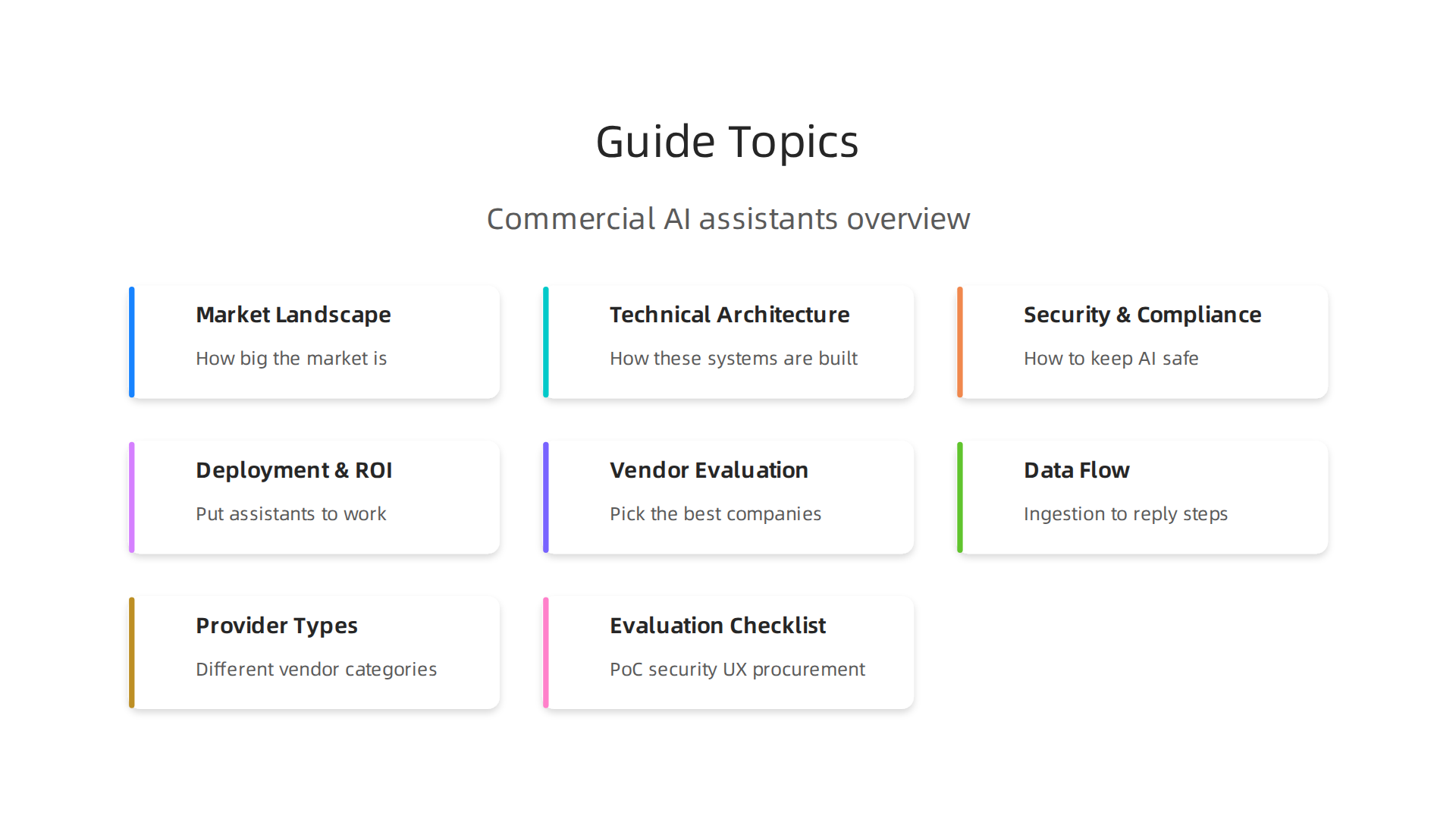
- Market Landscape: We will look at how big the market is and where it is headed.
- Technical Architecture: We will explain how these AI systems are built and work behind the scenes.
- Security and Compliance: We will talk about how to keep AI safe and follow important rules.
- Deployment and ROI: We will show how to put these assistants to work and measure how much they help your business.
- Vendor Evaluation: We will help you pick the best companies and tools for your needs.
By the end of this guide, you will have a clear picture of how AI agent automation can change your business for the better. This deep look at AI will help you stay ahead. You can also get more updates and insights by subscribing to The AI Newsletter Worth Reading. We will also touch on broader topics, like understanding the AI overview 2026: what machine learning practitioners need to know.
Commercial AI assistants are becoming very important for businesses. To really use them well, it helps to understand who makes them and what they can do. The market for these smart helpers is already quite big, reaching about USD 37.7 billion in 2026 Intelligent Virtual Assistant Statistics and Facts (2026). It is expected to keep growing fast.
Types of Companies That Offer AI Assistants
When you look for an AI virtual assistant, you will find different kinds of companies that offer them. Each type helps businesses in a slightly different way.
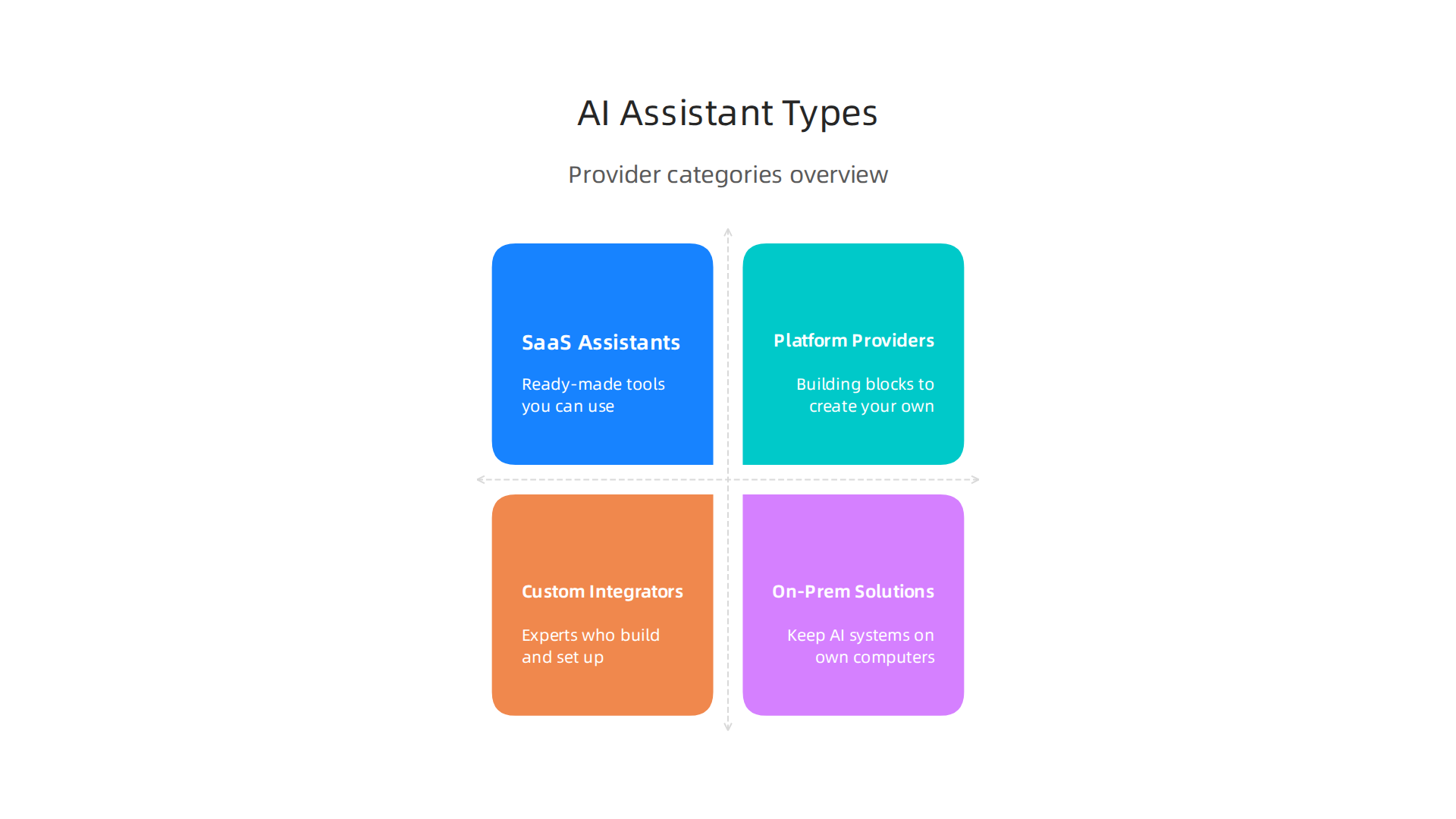
- SaaS Assistants: These are like ready-made tools you can use right away. SaaS stands for "Software as a Service." You pay a monthly fee, and the company handles all the technical stuff. These are great for common jobs like answering customer questions or helping with simple tasks. They are often used by smaller businesses or teams that need a quick solution.
- Platform Providers: These companies give you the building blocks to create your own AI virtual assistant. Think of it as getting a powerful toolkit instead of a finished product. You can customize them a lot to fit your exact needs. This usually needs more technical skill, often using a machine learning platform, and is chosen by bigger companies with specific, complex problems.
- Custom Integrators: These are experts who help you build and set up an AI virtual assistant from scratch, or connect it with your other business tools. They make sure the AI assistant works perfectly with your company’s unique systems. Businesses often hire them when they need something truly special and don’t have the in-house team to do it.
- On-Prem Solutions: Some businesses, especially big ones with strict rules about data, want to keep their AI systems on their own computers. "On-prem" means "on-premises." This gives them total control over their data and security. It is more costly and complex, but it offers the most privacy and customization.
Typical buyers include companies of all sizes looking to make their work easier. Small businesses might start with SaaS, while large companies might look at platform providers or custom solutions. For help in picking the right tools, you might want to read our guide on Choosing All AI Tools Types, Evaluation, and Workflow for 2026.
How Businesses Use AI Virtual Assistants
AI virtual assistants are not just for answering phone calls. They can do many helpful things, making work smoother for different teams.
- Customer Support: This is one of the most common uses. An AI virtual assistant can answer frequently asked questions, help customers find information, or guide them through simple problems, all day and night. This frees up human agents to handle harder issues.
- Internal Knowledge Assistant: Inside a company, these assistants can help employees find information quickly, like company policies or details about projects. This boosts developer productivity and helps everyone work smarter.
- Sales Enablement: An AI virtual assistant can help sales teams by finding leads, giving information about products to customers, or even setting up meetings. This means sales people can focus more on closing deals.
- Developer Productivity: AI tools can help developers write code faster, fix mistakes, and even suggest new ways to build software. This kind of AI agent automation saves a lot of time and makes development teams more efficient.
Understanding these different ways AI is used helps businesses see how an AI companion robot or smart assistant can fit into their daily work. It is all about making tasks easier and more efficient. To learn more about how these smart programs work, take a look at Unlock AI Agents Definition, Types, and Real-World Examples for ML Teams.
When looking at how AI virtual assistants help businesses, it is important to know what makes a good one. It is not just about what tasks they do, but how well they do them. Here are the key things to look for when you are choosing an AI virtual assistant.
What Makes an AI Virtual Assistant Good?
Think about how an AI virtual assistant actually works and feels. These are its main skills:
- How it Talks (Conversational Flow): A good AI virtual assistant should talk back and forth smoothly, almost like a person. It should understand what you mean, even if you do not say it perfectly. The conversation should feel natural, not jumpy or confusing.

- Finding and Using Information (Retrieval-Augmented Generation or RAG): This is a fancy name for how an AI virtual assistant finds facts and uses them to answer your questions. Instead of just guessing, it searches through many documents or webpages to get the right information, then creates a clear answer using those facts. This helps the AI agent automation give accurate replies and avoids making things up Engineering retrieval augmented generation-based virtual assistants. It is a key part of how these smart programs work in 2026, combining finding info with creating responses RAG Architecture: 4 Key Components & Example Implementation 2026.
- Remembering What You Said (Multi-Turn Context and Memory): Imagine talking to someone who forgets what you said two sentences ago. That would be frustrating, right? A good AI virtual assistant remembers earlier parts of your chat. This "memory" helps it understand the bigger picture and keep the conversation going without you having to repeat yourself.
- Changing Its "Personality" (Persona Controls): Sometimes you want an AI companion robot to be friendly, other times more serious. Persona controls let businesses adjust how the AI virtual assistant talks and behaves. This helps it fit better with a company’s brand or the type of help a customer needs.
- Using Other Tools (Tool Use): The best AI virtual assistants are not just talkers. They can also use other apps or systems. For example, a customer service AI might use a booking system to schedule an appointment or look up your order details. This makes them much more powerful and helpful.
How Well Does It Work? Important Things to Check
Besides what an AI virtual assistant can do, it is also important to know how well it does it.
- Speed (Latency): How quickly does the AI virtual assistant respond? No one likes to wait. A fast response makes the experience better for users.
- Handling Many Requests (Throughput): Can the AI handle lots of people asking questions at the same time without slowing down? This is very important for busy businesses.
- Seeing How It Works (Observability): Can you easily check if the AI is working correctly? Can you see if it is making mistakes or getting stuck? Good observability means you can fix problems fast.
- Measuring Quality:
- Accuracy: Is the information it gives correct? This is super important.
- Making Things Up (Hallucination Rates): Sometimes, AI can "hallucinate" or invent facts that are not true. You want an AI with very low hallucination rates.
- Happy Users (User Satisfaction): Do the people using the AI virtual assistant find it helpful and easy to use? Getting feedback from real users is key. Tools like RAGAS help measure how well an AI understands context and gives relevant answers Development of a Retrieval-Augmented Generation Virtual Assistant.
When choosing an AI virtual assistant, looking at these functional and non-functional aspects will help you find the best fit for your needs. It is all about finding a smart helper that does what you need, does it well, and makes your customers and employees happy.
For more deep insights into artificial intelligence and broader technology trends, sign up for The AI Newsletter Worth Reading. You will get clear daily updates from The Deep View Newsletter. You can also explore how to improve your overall machine learning systems by learning about Mastering AI Automation Tools Selection, Deployment, and Governance 2026.
When choosing an AI virtual assistant, looking at the different parts that make it up, called architecture patterns, is very helpful. Think of it like building a house. You can buy a ready-made house or build one from scratch. The way you put all the smart pieces together impacts how well your AI agent automation works.
Architecture Patterns: Integrating LLMs, Retrieval, and Orchestration
In 2026, there are main ways businesses set up their AI virtual assistants:
- Using Ready-Made Brains (Hosted LLM APIs + RAG): Many companies use big AI brains, called Large Language Models (LLMs), that are hosted by other companies. These are like renting a very smart helper. But these brains might not know everything about your business. So, you add a special system called Retrieval-Augmented Generation, or RAG. RAG helps the AI find facts from your own documents, like your company’s product manuals or customer chats. It works by looking up information and then using the hosted LLM to create an answer that is based on real facts. This approach is popular because it is often easier to set up and manage, mixing the power of external LLMs with your unique data RAG Best Practices for 2026.
- Building Your Own Brain (Self-Hosted Models + Vector Stores): Some businesses, especially larger ones with special needs, choose to build and run their own LLMs. This means they have full control over the AI brain. They store their company’s information in special databases called vector stores. These stores hold data in a way that makes it easy for the AI to find related pieces of information very quickly. This setup needs more effort but offers maximum control over privacy and how the AI behaves. Building these kinds of systems in 2026 means putting many parts together carefully Production-Ready RAG Architecture Patterns for 2026.
How Information Moves (Data Flows)
No matter which path you choose, information follows a journey:
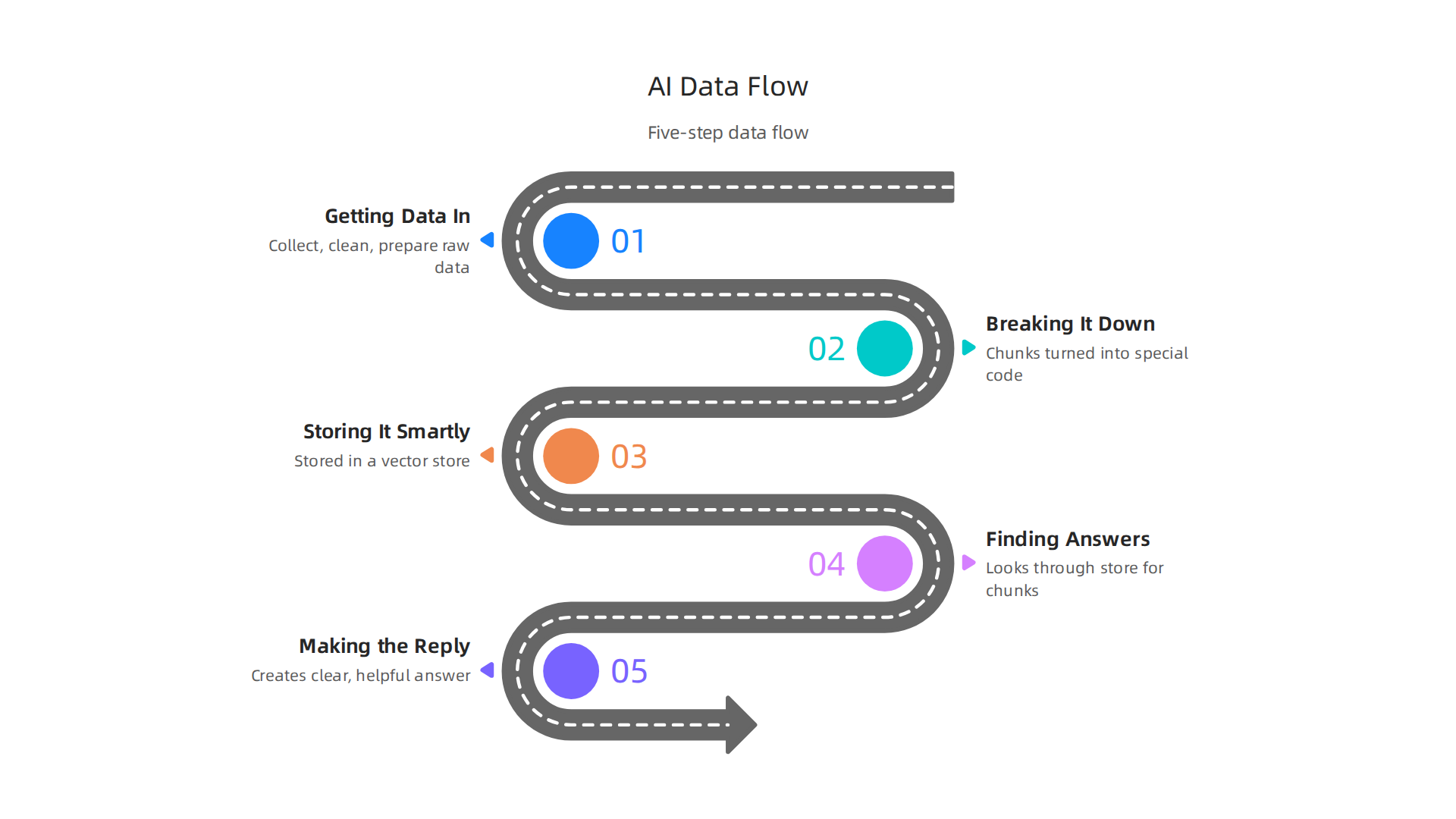
- Getting Data In (Ingestion): First, you collect all the documents, web pages, and other text your AI needs to know about. This raw data is cleaned and prepared.
- Breaking It Down (Chunking and Embedding): Large documents are broken into smaller pieces, called "chunks." Then, each chunk is turned into a special code of numbers. This process, called embedding, lets the AI understand the meaning of the text.
- Storing It Smartly (Indexing and Vector Stores): These numbered chunks are then stored in a "vector store." Think of it as a super-organized library where the AI can quickly find information related to a user’s question. A good setup might use different ways to index information, like a hybrid approach that mixes keyword search with semantic search RAG LLM Architecture in 2026: A Practical Implementation Guide.
- Finding Answers (Retrieval): When a user asks a question, the system looks through the vector store to find the most helpful chunks of information. This is called retrieval.
- Making the Reply (Generation): Finally, the AI uses these retrieved facts and its own big brain to create a clear, helpful answer for the user.
For businesses to really get the most out of their AI companion robot, they need to know how these pieces fit together. You can learn more about how to build powerful AI systems by exploring how to build production AI agents with hands-on machine learning.
Keeping Watch and Setting Rules (Observability and Guardrails)
After setting up your AI virtual assistant, it is important to watch how it works and make sure it stays safe.
- Observability: This means having ways to check if your AI is running well. You need to see if it is answering questions correctly, if it is fast enough, and if it is making any mistakes. Tools can help track how the AI is performing, ensuring it’s always giving good, truthful answers RAG LLM Explained 2026: Architecture, Eval, Hybrid Search.
- Guardrails: These are rules and safety checks built into the system. Guardrails make sure the AI does not give out private information, says anything harmful, or acts inappropriately. They protect both your business and your users. This involves setting up security checks, watching who accesses what data, and having audit logs to see everything the AI does AI Governance Policy. Implementing these controls is very important for any ai agent automation in 2026 to ensure trust and compliance.
After setting up your AI virtual assistant, it is important to watch how it works and make sure it stays safe. This includes thinking very carefully about security, privacy, and following all the rules. For any AI agent automation, protecting user information is a top job.
Security, privacy, and compliance considerations
When you use an AI virtual assistant, you need to be careful about a few things. These smart helpers work with a lot of information, and some of it can be very private. If not handled right, there can be big problems like personal data getting out. This is called PII (Personally Identifiable Information) leakage. Also, every question a user asks and every answer the AI gives might be saved. This is called query logging, and it needs to be protected, too. If you train or fine-tune your AI model with private company data, you must make sure that information stays safe and does not get seen by the wrong people.
Companies need strong rules to keep data safe. This means knowing where your data is stored. For example, some rules might say that data from people in one country must stay in that country. This is called data residency.

Many AI systems process customer data only in the region where it was collected, and they do not move it across different areas. This helps keep data safe and follow local laws AI Assistant Security Technical Paper.
You also need good access controls. This means making sure only the right people can see or change the AI system and its data. Identity checks and strict rules about who can access sensitive information are key to stop unwanted peeks BEST PRACTICES. For example, an AI assistant should only access data it is allowed to use, following rules for authenticated access and least privilege AI Regulation 2026: Current Laws, Compliance Requirements, and ….
Another important part is having audit trails. These are like detailed logs that show everything the AI system does. If something goes wrong, you can look back at the logs to see what happened. This helps with fixing problems and making sure rules were followed. Strong controls also mean making sure that data is scrambled (encrypted) both when it is stored and when it is being moved Govern and secure AI agents.
Lastly, some companies do "red-team testing." This is like hiring friendly hackers to try and find weaknesses in your AI system before bad actors do. They check for ways to trick the AI or make it reveal secrets. Making sure your AI companion robot is secure helps build trust with users and meets all the important laws for handling data. Thinking about these things from the start makes your machine learning platform much stronger and safer.
To learn more about keeping your AI systems in line, you can explore guides on AI Ethics for Machine Learning Teams. For daily updates on AI and technology, consider subscribing to The AI Newsletter Worth Reading.
After making sure your AI system is safe and follows all the rules, the next big step is to think about how much it costs and how much good it actually does. This means looking at different ways to set up an AI virtual assistant and figuring out if it’s worth the money and effort.
Deployment models, TCO, and measuring ROI
When you decide to bring an AI virtual assistant into your work, you have choices about how it’s set up. You can use an AI service that’s already built for you, or you can build one from scratch. These choices affect the total cost of ownership (TCO). TCO is not just the price tag; it’s all the costs over time, including setting it up, keeping it running, and making it better.
The true cost of an AI agent, or any machine learning platform, involves many things. It includes the "build phase," which is getting everything ready, like preparing data and connecting the AI to your other systems. Then there’s the "run phase," which covers the day-to-day costs, such as the fees for the AI to "think" (called inference cost) and storing all the information it uses (embedding storage). Finally, there’s the ongoing work of making the AI better, like fine-tuning it and regular check-ups The True Cost of AI Agents in the Enterprise.
A big part of running an AI is the "inference cost." This is how much it costs each time the AI processes a request or gives an answer. Complex tasks can use more "tokens," which are like units of AI work, making them more expensive than simpler tasks AI tokens: How to navigate AI’s new spend dynamics. Also, you need people to manage the AI, which is called "engineering upkeep." This includes fixing problems, making updates, and adding new features. These hidden costs can sometimes be a big part of the total spending AI Software Development Costs 2026.
Getting Value Back: Measuring ROI
After spending money on an AI virtual assistant, you’ll want to know if it’s actually helping. This is where measuring Return on Investment (ROI) comes in. ROI tells you if the money you put into the AI is coming back to you as savings or new income. For businesses, the focus must be on three main areas: saving money, making operations smoother, and helping bring in more sales The ROI of Voice AI in 2026.
Here are some ways to measure if your AI agent automation is working well:
- Time Savings: How much time do employees or customers save because the AI handles tasks faster?
- Deflection Rate: This is very important. It measures how many customer questions or issues the AI solves without a human needing to step in Measuring Conversational AI ROI. Some AI chatbots can handle up to 45% of customer tickets, leading to big savings AI Chatbots Deflect 45% of Tickets at 340% ROI in 2026. In fact, using conversational AI can cut interaction costs by 65% to 90% compared to a human agent Voice AI Contact Center Cost Reduction.
- Revenue Enablement: Does the AI help you sell more products or services? For example, an AI could help recover abandoned shopping carts.
- Developer Productivity Gains: If the AI helps your developers work faster on other projects, that’s also a big win.
When checking the performance of your AI companion robot, look at things like how quickly it completes tasks, the quality of its answers, and how often it makes mistakes. User surveys can also tell you if people are happy with the AI AI Performance Review. By carefully tracking these numbers, you can see the real value your AI brings. Learning how to identify and deploy high-value AI solutions is critical for success in 2026. For more on building and deploying these smart helpers, check out guides on unlock AI agents definition types.
Now that you know how to measure if an AI virtual assistant is worth the money, the next step is to choose the best one for your needs. This means looking at different options carefully. Picking the right AI companion robot or machine learning platform can make a big difference, so it’s important to have a clear plan for checking out vendors.
Practical evaluation checklist and shortlist process
Finding the perfect AI virtual assistant means going through a thoughtful process. You can’t just pick the first one you see. You need a checklist to make sure you think about everything important. This helps you compare different AI solutions and find the one that fits best.
Step-by-Step Vendor Evaluation Checklist
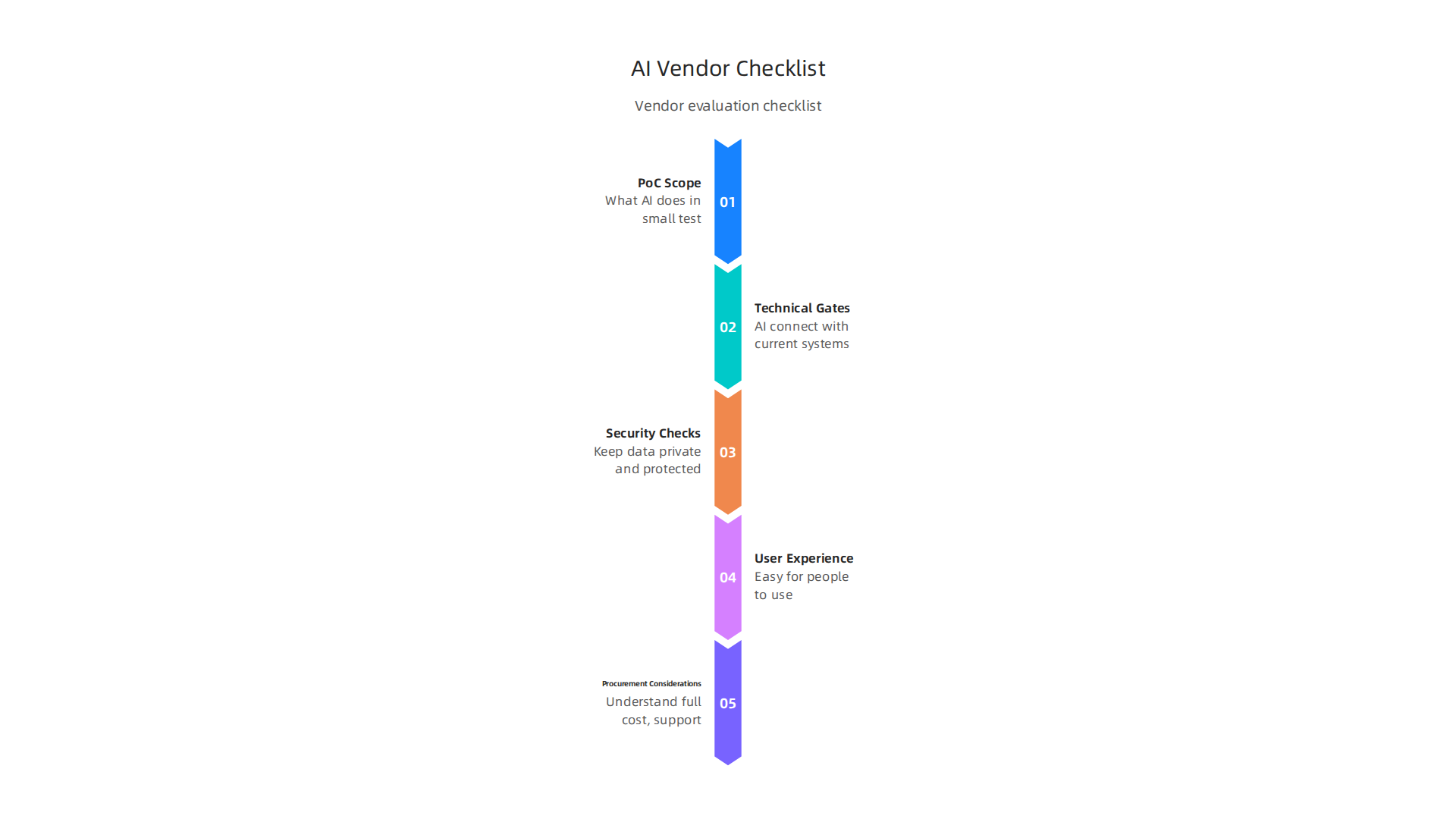
Here is a simple checklist to guide you when looking at different AI vendors:
-
Proof-of-Concept (PoC) Scope:
- What exactly do you want the AI to do in a small test? Be very clear about the job and how you’ll know if it worked well AI Vendor Evaluation Checklist | Dan Cumberland Labs. For example, "Can this AI answer 80% of common customer questions?" This helps you see if the AI agent automation can actually solve your problems AI Vendor Evaluation Checklist & Comparison Criteria.
- Set clear goals before you start any pilot program Detailed Evaluation Sections.
-
Technical Gates:
- How easily does the AI connect with your current computer systems? It’s like checking if a new puzzle piece fits into your existing puzzle.
- How does the AI handle your data? Is it easy to use and manage?
- Can the AI grow with your business? You want a system that can handle more work as you grow AI Vendor Evaluation Checklist: 30+ Enterprise Questions.
-
Security Checks:
- Is your information safe with this AI vendor? Ask about their security steps to keep your data private and protected.
- Do they follow important privacy rules and laws, like GDPR or HIPAA, that are active in 2026? This is very important for trust and legal reasons 9 key questions for evaluating AI assistant vendors in 2026. Check their certifications Enterprise AI Assistant Buyer’s Guide: Key Evaluation Criteria for 2026.
-
User Experience (UX) Pilot:
- Have a small group of people try out the AI. Is it easy for them to use and understand?
- Do they like interacting with the AI virtual assistant? User feedback is key to how well it will be adopted.
- Look at both how well it does tasks (like how fast or accurate) and how happy users are with it The Evaluation Process: Step….
-
Procurement Considerations:
- Understand the full cost, not just the upfront price. Think about ongoing fees, support, and updates.
- What kind of help will the vendor provide after you buy the AI? Good support is a big plus.
- What is the vendor’s long-term plan? Do they seem stable and able to keep improving their AI?
- Make sure the vendor’s way of measuring how well their AI works matches your own goals Voice AI Case Study 2026: Metrics, Examples & Checklist.
Prioritization Matrix for Shortlisting Vendors
After you’ve checked out a few vendors using the checklist, you’ll want to compare them side-by-side. A prioritization matrix helps you do this. It’s like giving scores to each important area to see which vendor comes out on top.
Here’s what to look at:
- Technical Fit: How well does the AI solution work with your current tech setup and future plans? Does it do exactly what you need it to?
- Data Posture: How does the vendor protect and handle your data? Do they meet all privacy and security rules? This is super important for any machine learning platform.
- Cost: What is the total cost over time? Does it fit your budget, and is the pricing clear?
- Long-Term Roadmap Alignment: Does the vendor’s future vision for their AI match where your business is heading? You want a partner who will grow with you.
- Company Stability: It’s also smart to check how well the vendor company is doing financially AI Vendor Due Diligence Checklist for 2026: What to Ask ….
By scoring each vendor on these points, you can easily see which ones are the best match. This helps you narrow down your choices to a few top contenders. Choosing the right AI virtual assistant is a big decision, and this process helps ensure you make an informed one.

To stay on top of all the latest changes and insights in the world of AI, make sure you’re always learning.
Get clear daily AI updates from The AI Newsletter Worth Reading.## Practical evaluation checklist and shortlist process
Now that you know how to measure if an AI virtual assistant is worth the money, the next step is to choose the best one for your needs. This means looking at different options carefully. Picking the right AI companion robot or machine learning platform can make a big difference, so it’s important to have a clear plan for checking out vendors.
Step-by-Step Vendor Evaluation Checklist
Finding the perfect AI virtual assistant means going through a thoughtful process. You can’t just pick the first one you see. You need a checklist to make sure you think about everything important. This helps you compare different AI solutions and find the one that fits best.
Here is a simple checklist to guide you when looking at different AI vendors:
-
Proof-of-Concept (PoC) Scope:
- What exactly do you want the AI to do in a small test? Be very clear about the job and how you’ll know if it worked well. This helps you see if the AI agent automation can actually solve your problems AI Vendor Evaluation Checklist & Comparison Criteria.
- Set clear goals before you start any pilot program Detailed Evaluation Sections.
-
Technical Gates:
- How easily does the AI connect with your current computer systems? It’s like checking if a new puzzle piece fits into your existing puzzle.
- How does the AI handle your data? Is it easy to use and manage?
- Can the AI grow with your business? You want a system that can handle more work as you grow AI Vendor Evaluation Checklist: 30+ Enterprise Questions.
-
Security Checks:
- Is your information safe with this AI vendor? Ask about their security steps to keep your data private and protected.
- Do they follow important privacy rules and laws, like GDPR or HIPAA, that are active in 2026? This is very important for trust and legal reasons 9 key questions for evaluating AI assistant vendors in 2026. Check their certifications Enterprise AI Assistant Buyer’s Guide: Key Evaluation Criteria for 2026.
-
User Experience (UX) Pilot:
- Have a small group of people try out the AI. Is it easy for them to use and understand?
- Do they like interacting with the AI virtual assistant? User feedback is key to how well it will be adopted.
- Look at both how well it does tasks (like how fast or accurate) and how happy users are with it The Evaluation Process: Step….
-
Procurement Considerations:
- Understand the full cost, not just the upfront price. Think about ongoing fees, support, and updates.
- What kind of help will the vendor provide after you buy the AI? Good support is a big plus.
- What is the vendor’s long-term plan? Do they seem stable and able to keep improving their AI?
- Make sure the vendor’s way of measuring how well their AI works matches your own goals Voice AI Case Study 2026: Metrics, Examples & Checklist.
Prioritization Matrix for Shortlisting Vendors
After you’ve checked out a few vendors using the checklist, you’ll want to compare them side-by-side. A prioritization matrix helps you do this. It’s like giving scores to each important area to see which vendor comes out on top.
Here’s what to look at:
- Technical Fit: How well does the AI solution work with your current tech setup and future plans? Does it do exactly what you need it to?
- Data Posture: How does the vendor protect and handle your data? Do they meet all privacy and security rules? This is super important for any machine learning platform.
- Cost: What is the total cost over time? Does it fit your budget, and is the pricing clear?
- Long-Term Roadmap Alignment: Does the vendor’s future vision for their AI match where your business is heading? You want a partner who will grow with you.
- Company Stability: It’s also smart to check how well the vendor company is doing financially AI Vendor Due Diligence Checklist for 2026: What to Ask ….
By scoring each vendor on these points, you can easily see which ones are the best match. This helps you narrow down your choices to a few top contenders. Choosing the right AI virtual assistant is a big decision, and this process helps ensure you make an informed one.
To stay on top of all the latest changes and insights in the world of AI, make sure you’re always learning.
Get clear daily AI updates from The AI Newsletter Worth Reading.
Summary
This guide explains how commercial AI virtual assistants work, why they matter for product, engineering, and investment leaders, and how to choose and operate them safely and profitably. It surveys the market landscape and vendor types (SaaS, platform providers, custom integrators, on‑prem), shows common business uses from customer support to developer productivity, and describes the core technical building blocks like RAG, vector stores, and multi‑turn memory. The article covers non‑functional checks — latency, throughput, observability — and practical security, privacy, and compliance controls including data residency, access controls, and audit trails. It walks through deployment options, the main TCO drivers (inference, embedding storage, engineering upkeep), how to measure ROI (time saved, deflection rates, revenue enablement), and a step‑by‑step vendor evaluation and prioritization process for pilots and procurement. Readers will finish knowing how to scope a PoC, evaluate technical and legal risks, compare vendors, and set up monitoring and guardrails to keep assistants useful and trustworthy.