
Master the Elements of AI A Practitioner’s Guide for 2026

Why the foundations of AI still matter in 2026
It feels like every day brings new breakthroughs in Artificial Intelligence. In 2026, we see smarter AI tools pop up constantly. This quick growth can make it hard for everyone, especially those working with machine learning, to keep up. There’s so much new information out there, it’s easy to feel lost in a sea of updates and new ideas. You might wonder if the basic elements of AI even matter anymore when everything is changing so fast.
Actually, they do. Even with the smartest AI systems we see today, understanding the core ideas is more important than ever. Companies are quickly using AI; for example, worker access to AI went up by 50% just last year in 2025, with many projects now in full swing The State of AI in the Enterprise – 2026 AI report. But, one big challenge is making sure people are ready for these new tools. A recent report found that getting the workforce ready is a top concern for businesses trying to use AI Global AI Pulse – Q1 2026 – KPMG agentic corporate services. This means that even with all the fancy new technology, people still need a solid grasp of how it works.
Knowing the foundations of artificial intelligence and machine learning helps you cut through the noise.

It allows you to really understand what’s happening, instead of just seeing the surface. This article will walk you through the essential elements of AI. We will cover key concepts, what they mean for you, and where to look next to deepen your knowledge. Our goal is to give you clear, trustworthy information so you can make sense of the AI world today.
Want to stay informed without getting overwhelmed? Get clear daily AI updates from The AI Newsletter Worth Reading. You can also dive deeper into current AI trends by reading our AI Overview 2026: What Machine Learning Practitioners Need to Know.
Core definitions: AI, ML, statistical learning, and related terms
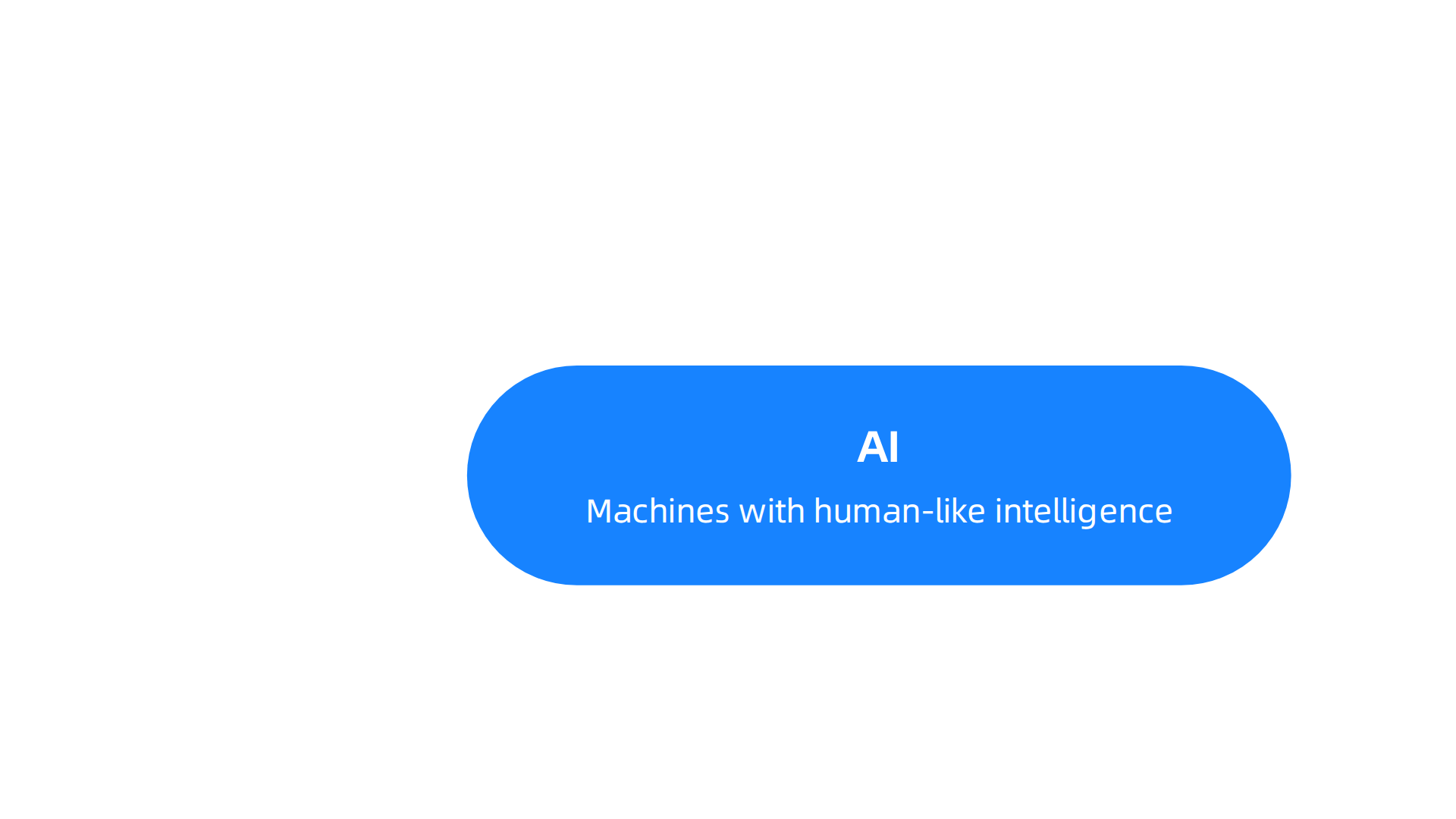
To really get a handle on the elements of AI, it helps to first understand what we mean by "Artificial Intelligence" and other related terms. Sometimes, people use these words interchangeably, but they actually mean different things. Think of it like this: "Artificial Intelligence" is a big umbrella. Under that umbrella, you find "Machine Learning," and under Machine Learning, you find "Deep Learning."
Let’s break them down:
-
Artificial Intelligence (AI): This is the biggest idea. AI is about making machines smart enough to do things that usually need human intelligence. This includes solving problems, understanding language, recognizing pictures, making decisions, and even learning new things. The goal is to create systems that can think, reason, and learn like a person. Many different tools and methods fall under this broad term, some very old and some very new Defining AI, Machine Learning, and Deep Learning in the Lab. If you want to explore more about how AI is categorized, you can learn about the different Types of AI Understanding Intelligence Capabilities.
-
Machine Learning (ML): This is a key part of AI. Machine learning focuses on how computers can learn from data without being told exactly what to do. Instead of someone writing every single instruction, the machine "learns" by looking at lots of examples. For instance, if you show a machine thousands of pictures of cats and dogs, it can learn to tell them apart on its own. It’s about finding patterns in data and using those patterns to make predictions or decisions What is Machine Learning?. In 2026, machine learning is at the heart of many smart AI tools we use every day.
-
Deep Learning (DL): This is a specific type of machine learning. Deep learning uses something called "neural networks," which are inspired by the way the human brain works. These networks have many layers, letting them learn very complex patterns from huge amounts of data. Deep learning is behind many of the latest advancements in AI, especially in areas like voice recognition, self-driving cars, and creating realistic images. It’s often what people refer to when they talk about the "smartest AI" or cutting-edge AI systems.
-
Statistical Learning: This term is closely related to machine learning. Actually, many of the methods used in machine learning come from the field of statistics. Statistical learning uses mathematical models to understand data and make predictions. It helps us see relationships in data, just like machine learning does. In fact, some experts say that artificial intelligence is just "fancy Statistics" because of how much it relies on these methods Artificial Intelligence is just fancy Statistics – NASA Science.
Why these definitions matter for you
Understanding these differences is super helpful, especially if you work with artificial intelligence and machine learning.
- For Team Roles: If you’re hiring for an AI team, knowing these terms helps you find the right people. Someone who is a "Deep Learning Engineer" might have different skills than an "AI Researcher" who works on broader AI ideas or an "ML Engineer" who builds and maintains machine learning models.
- For Projects: When you start a new AI project, being clear about what kind of AI you’re using helps everyone stay on the same page. Are you building a simple rule-based AI, a machine learning model, or a complex deep learning system? This affects the tools you’ll use, the data you’ll need, and how long the project will take.
- For Learning: If you’re looking to learn more about the elements of AI, these definitions help you pick the right courses or books. You can decide if you want to start with general AI concepts, dive into machine learning techniques, or specialize in deep learning. Understanding your path can greatly help your Career Progression for Data Specialists.
Knowing these core definitions helps you speak the same language as other professionals and makes it easier to navigate the fast-paced world of AI.
Understanding the basic definitions of AI, machine learning, and deep learning is a great start. Now, let’s look at how these ideas have changed over time. The field of artificial intelligence has seen big shifts in how people think about and build smart machines.
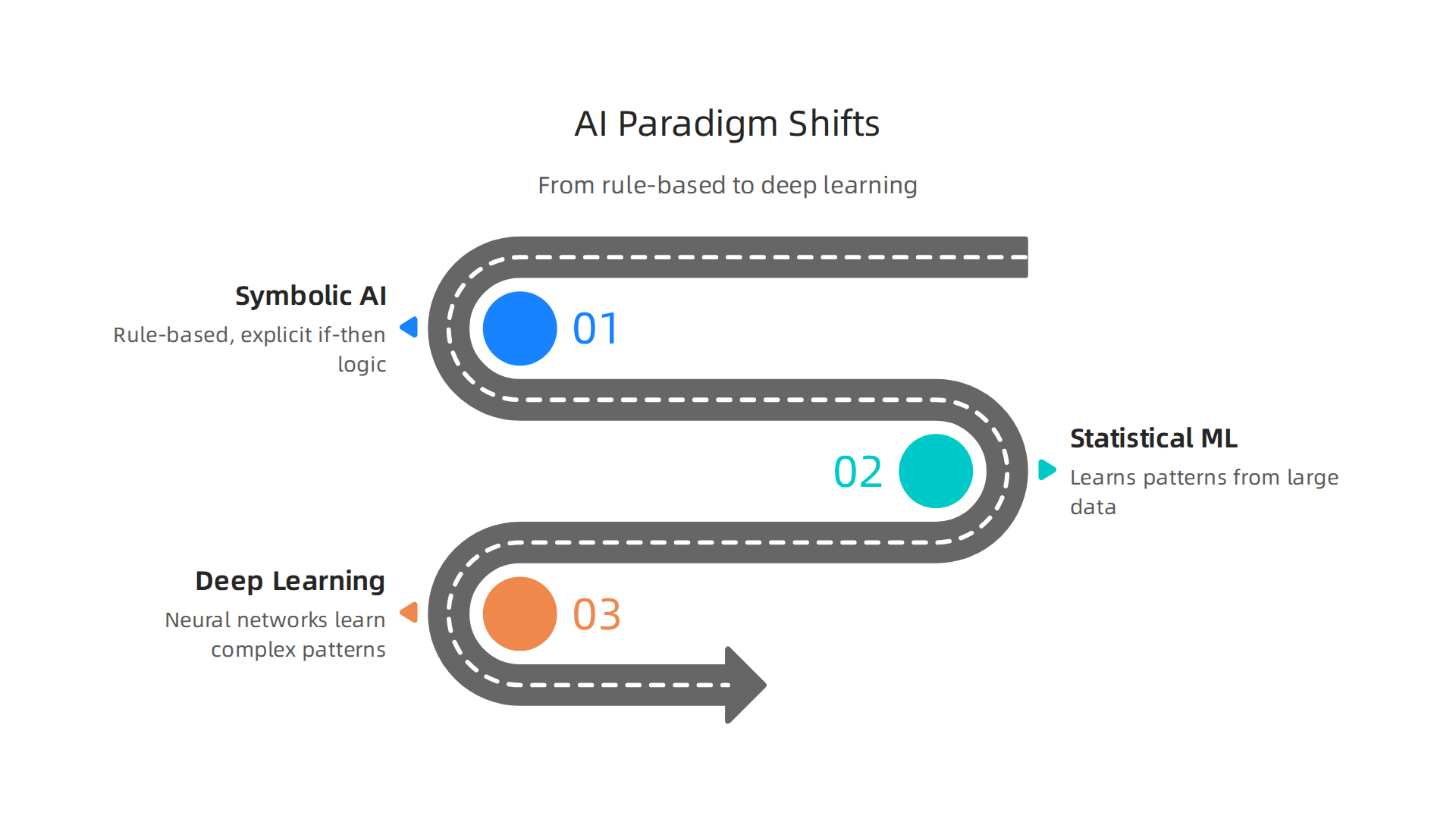
These changes are sometimes called "paradigm shifts" because they completely changed the main way of working on AI The Paradigm Shifts in Artificial Intelligence.
Early Days: Symbolic AI (Rule-Based Systems)
In the beginning, from the 1950s through the 1980s, much of AI focused on what we now call "Symbolic AI" or rule-based systems. This approach was all about trying to teach computers by giving them clear rules and facts, just like a human might think through a problem step-by-step.
- How it worked: Experts would write down specific "if-then" rules. For example, "IF a patient has a fever AND a cough, THEN they might have the flu." The computer would follow these rules to make decisions or solve problems. These were often called "expert systems."
- Why it mattered: These systems worked well for very specific problems with clear rules, like certain medical diagnoses or game playing. They were easy to understand because you could see the rules they were following.
- The problems: The main issue was complexity. The real world isn’t always neat and tidy. As tasks became more complicated, it was impossible for humans to write down every single rule. These systems also struggled with things like understanding spoken language or recognizing images, where the rules are not always obvious. They didn’t generalize well, meaning they couldn’t apply what they learned in one area to a new, slightly different situation. This led to what some call an "AI winter" because progress seemed to slow down.
The Shift to Statistical Machine Learning
Around the 1990s, the focus began to change. Researchers realized that instead of telling computers every rule, it might be better to let computers learn the rules themselves from data. This was the start of the big move towards statistical machine learning.
- How it worked: Instead of "if-then" rules, machine learning uses math and statistics to find patterns in large amounts of data. For instance, if you want a machine to tell spam emails from real emails, you’d show it thousands of examples of both. The machine would then learn what features (like certain words or sender addresses) usually mean "spam."
- Why it mattered: This approach was much better at handling real-world data that was messy or unclear. It allowed AI to tackle problems like image recognition and natural language processing with much greater success than symbolic AI. This was a major paradigm shift, moving from explicitly coded knowledge to learned knowledge Artificial intelligence: reflecting on the past and looking towards the next paradigm shift.
- Lessons Learned: The key lesson here was the power of data. The more data a machine had, the better it could learn and make predictions. However, even machine learning had its limits, especially when dealing with very complex data like raw video or audio.
The Rise of Deep Learning
In the 2010s, we saw another big shift with the rise of deep learning, a special type of machine learning. This was made possible by three main things: huge amounts of data, much more powerful computers, and new ways of building "neural networks" (inspired by the human brain).
- How it worked: Deep learning models use many layers of these neural networks, allowing them to learn incredibly complex patterns from massive datasets. Think of it like building a huge brain for the computer, where each layer helps refine its understanding.
- Why it mattered: Deep learning has led to amazing breakthroughs in areas like self-driving cars, voice assistants, and facial recognition. It’s often what people mean when they talk about the "smartest AI" in 2026. This move meant AI systems could learn from any kind of data, without needing as much human help to prepare it The Paradigm Shifts in Artificial Intelligence.
- Impact: The advancements in artificial intelligence and machine learning through deep learning have been truly game-changing, making many previously impossible tasks now possible.
Key Takeaways from These Shifts
The journey of AI shows us some important lessons about the elements of AI:
- Data is Gold: The more data, the better. Modern AI, especially deep learning, thrives on vast amounts of information.
- Generalization is Key: AI systems need to learn from examples and apply that learning to new, unseen situations. Statistical and deep learning methods are much better at this than old rule-based systems.
- Computing Power Matters: The ability to process huge amounts of data quickly has been essential for deep learning’s success.
- No Single Solution: Each approach has its strengths and weaknesses. What works best depends on the problem you’re trying to solve.
These shifts highlight that the elements of AI are constantly evolving, pushing the boundaries of what machines can do.

To keep up with these fast changes, it helps to stay informed.
Get clear daily AI updates from The AI Newsletter Worth Reading.
Understanding this history helps us see why modern AI looks the way it does and where it might be headed next. If you’re interested in how these shifts affect planning for new projects, consider exploring an AI development roadmap for 2026.
Understanding this history helps us see why modern AI looks the way it does and where it might be headed next. While AI systems are getting smarter, the core ideas behind them still rely on important math. To truly understand the elements of AI and how these systems make decisions, it helps to know a bit about the math that powers them. This isn’t about becoming a math expert, but about knowing the basic building blocks.
Mathematical foundations: probability, linear algebra, optimization, and information theory
Even the smartest AI in 2026, like those used in deep learning, uses special kinds of math to work. These math ideas help computers learn from data, make good guesses, and get better over time. Think of them as the hidden tools that make artificial intelligence and machine learning possible.
Here are the main math areas that are super important for anyone working with AI:
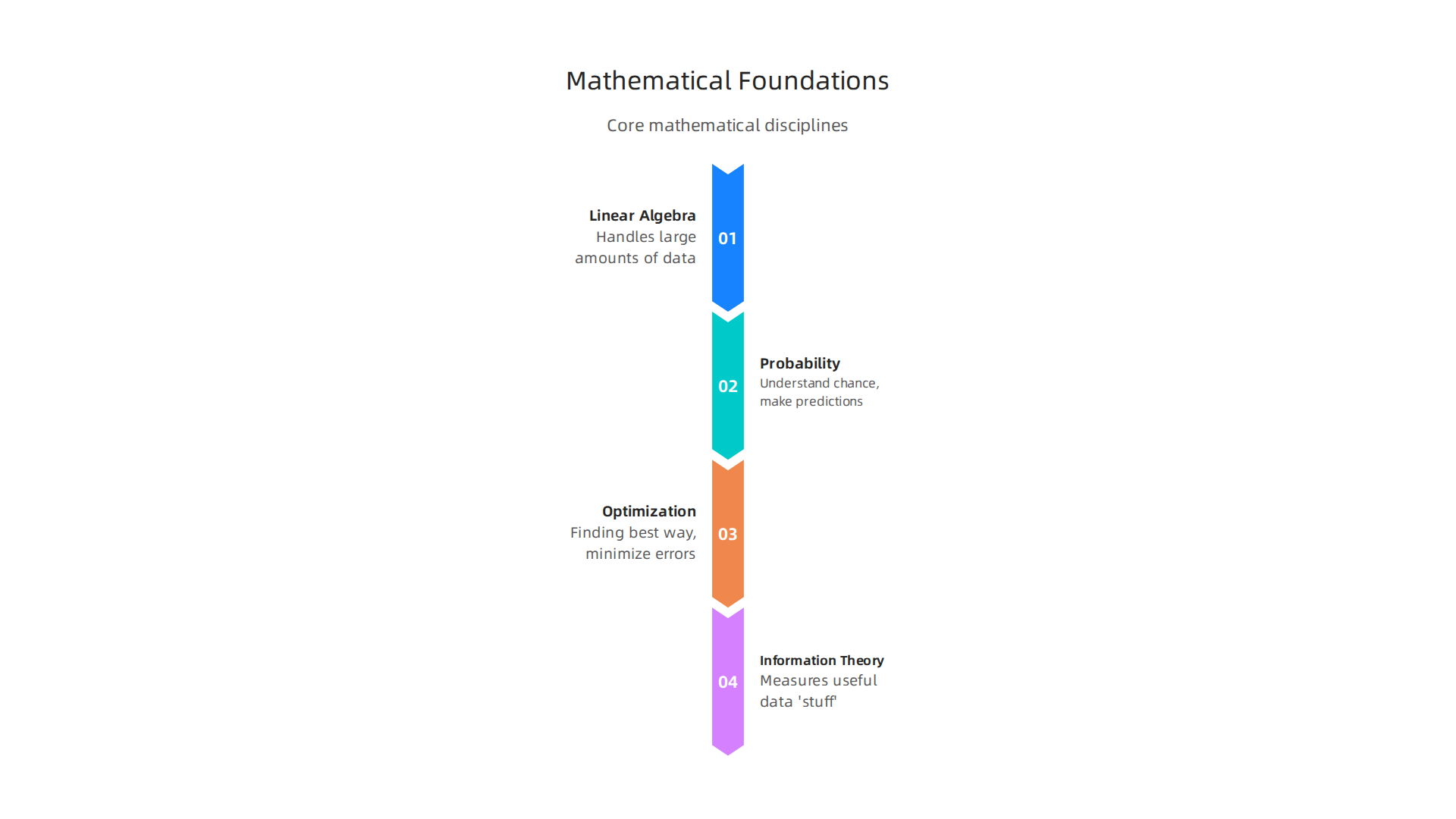
Linear Algebra: The Language of Data
Imagine your data as big tables of numbers or lists. Linear algebra is the math that helps us work with these numbers in an organized way.
- What it is: It deals with things like vectors (lists of numbers) and matrices (tables of numbers). It’s like having a special language to talk about groups of numbers and how they move or change together.
- Why it matters for AI: AI models use linear algebra to handle and change huge amounts of data. When an AI looks at an image, that image is turned into a big matrix of numbers. Linear algebra helps the computer move these numbers around, resize them, and find patterns. It’s key for how models learn from complex data Mathematical Foundations for Machine Learning.
Probability: Dealing with Uncertainty
The world is full of unknowns. Probability is the math that helps us understand chance and make choices when we are not sure what will happen.
- What it is: It helps us figure out how likely something is to happen. For example, what’s the chance it will rain tomorrow? Or what’s the chance this email is spam?
- Why it matters for AI: AI models often have to make guesses or predictions. Probability helps them measure how confident they are in those guesses. For example, a medical AI might say, "There’s an 80% chance this patient has X condition." This math also helps in making AI models learn new things, weighing different possibilities to find the most likely answer M.TECH. – Khwaja Moinuddin Chishti Language University.
Optimization: Finding the Best Fit
When an AI model learns, it’s really trying to find the "best" way to do something. This could mean being the most accurate, the fastest, or using the least amount of resources. Optimization is the math that helps it find that "best" way.
- What it is: It’s about finding the highest or lowest point of a function. Imagine trying to find the bottom of a valley or the top of a hill.
- Why it matters for AI: Training an AI model is often an optimization problem. The model tries to adjust its internal settings (called parameters) to make its predictions as good as possible. This means minimizing errors or maximizing correct answers. This math helps the model get better and better with each piece of data it sees Mathematical Foundations of Optimization Techniques in Machine Learning.
Information Theory: Measuring Knowledge
Information theory helps us understand what information is and how to measure it. It’s about figuring out how much useful "stuff" is in a message or a set of data.
- What it is: It looks at things like how to compress data without losing important parts, or how to measure the surprise in an event. If something is very likely, it carries less "information" than something very unexpected.
- Why it matters for AI: This math helps AI models understand the value of different pieces of data. It guides choices about which features are most important for learning and helps in making models that are efficient and don’t get confused by too much unnecessary data Various Course Proposals for: Mathematics with a View.
These math foundations are the unsung heroes behind AI. They help practitioners make smart choices when building models and figuring out why a model behaves the way it does. Understanding these mathematical elements of AI helps us evaluate results and diagnose problems.

For those looking to apply these concepts, a deep dive into Python for Data Science and Machine Learning in 2026 can be very helpful. Knowing these math basics is crucial for making sense of model evaluation and diagnostic practices, which often involve checking how well a model predicts uncertain outcomes or handles complex data structures. This knowledge also supports good practices for evaluating machine learning systems to ensure they are fair and accurate Good practices for evaluation of machine learning systems.
After learning about the math behind AI, it’s time to see how we build and check these smart systems in real life. This part is about how we train an AI model, make sure it works well, and measure its success. It’s like teaching a child and then giving them tests to see what they’ve learned and if they’re ready for the real world. This process is very important for all elements of AI and machine learning projects.
Model development: training, validation, evaluation metrics, and avoidable pitfalls
Building a good AI model is a bit like baking a cake. You need good ingredients (data), a good recipe (the algorithm), and you have to taste it along the way to make sure it’s turning out right.
Training the Model: Learning from Data
First, we train the AI model. This means showing it a lot of examples so it can learn patterns. Imagine teaching a computer to tell the difference between pictures of cats and dogs. You show it thousands of cat pictures and thousands of dog pictures. The AI looks for small details that help it make these decisions.
- Data Splits: We divide our data into special groups.
- Training Data: This is the biggest part. The AI uses this data to learn. It’s like the textbook the student studies from.
- Validation Data: This is a smaller part. We use it to check how well the AI is learning while we’re still training it. It helps us make small adjustments without using the test data too soon. Think of it as practice quizzes.
- Test Data: This is the secret data. The AI has never seen it before. We use this only at the very end to see how well the AI really performs on new, unseen examples. This is the final exam. Properly splitting data is a key step in evaluating machine learning models Model Evaluation, Model Selection, and Algorithm Selection in Machine Learning. You might also find it helpful to learn more about exploratory data analysis techniques for machine learning in 2026 to prepare your data.
Evaluation Metrics: Measuring Success
Once the AI is trained, we need to know if it’s actually any good. This is where evaluation metrics come in. These are ways to give the AI a score.
- What to Measure:
- Accuracy: How many times did the AI guess correctly? If it guessed 90 out of 100 times, its accuracy is 90%.
- Precision and Recall: These are a bit more detailed. Imagine the AI is looking for signs of a rare disease. Precision tells us how many of the "positive" guesses were actually correct. Recall tells us how many of the real disease cases the AI actually found.
- Other Metrics: There are many other ways to score an AI, depending on what it’s trying to do. It’s important to pick the right metric for the job A review of model evaluation metrics for machine learning in … – PMC. For example, a credit card fraud detection system needs different metrics than an AI that recommends movies.
Cross-Validation: Making Sure It’s Not Just Luck
Sometimes an AI might seem to perform well on one test set, but not because it’s truly smart. It could just be lucky with that specific group of data. Cross-validation is a trick to make sure our results are stable. We split the data into many different training and test sets and run the model many times. This gives us a more reliable idea of how well the AI works.
Calibration: Trusting the AI’s Confidence
A well-calibrated AI doesn’t just make guesses; it also tells us how confident it is in those guesses, and that confidence should be right. If an AI says it’s 90% sure about something, it should be correct about 90% of the time. This is especially important for critical systems, like a medical AI where knowing the confidence helps doctors make better choices.
Avoidable Pitfalls: Common Mistakes
Even the smartest AI can be messed up by simple errors in how we check it.
- Using the wrong metric: If you use accuracy to measure a rare disease detector, it might seem good even if it misses most sick people. The wrong metric can lead to bad business decisions.
- Data Leakage: This happens when some information from the test data accidentally "leaks" into the training data. This makes the AI seem much better than it is, because it’s seen parts of the "final exam" already.
- Overfitting: The AI learns the training data too well, almost memorizing it. This means it won’t do well on new data it hasn’t seen. It’s like a student who memorizes answers but doesn’t understand the subject.
Making good choices in model evaluation helps ensure that the AI is not only smart but also fair and ready for real-world use. It helps us know if the model is truly ready for deployment and will make good decisions for your business. Remember, what we measure and how we measure it directly affects the success of any artificial intelligence and machine learning project Evaluating Supervised Machine Learning Models: Principles, Pitfalls …. Knowing how to avoid these common issues is a core part of developing reliable AI solutions. You can dive deeper into best practices for making sure your machine learning workflows are efficient and robust to speed up delivery of models.
To stay on top of all the latest advancements in AI and machine learning, you need a trusted source for daily updates.
The AI Newsletter Worth Reading
After we know an AI model works well in testing, the next big step is to put it to use in the real world. This is where MLOps comes in. MLOps helps us move AI models from the lab to actual use, making sure they keep working great over time. It’s a key part of handling all the elements of AI in a smart way.
Deployment and MLOps essentials: reproducibility, monitoring, and scaling
Getting an artificial intelligence and machine learning model ready for real use is more than just training it. It means setting up a system that can reliably deploy the model, watch it, and make sure it keeps performing well.
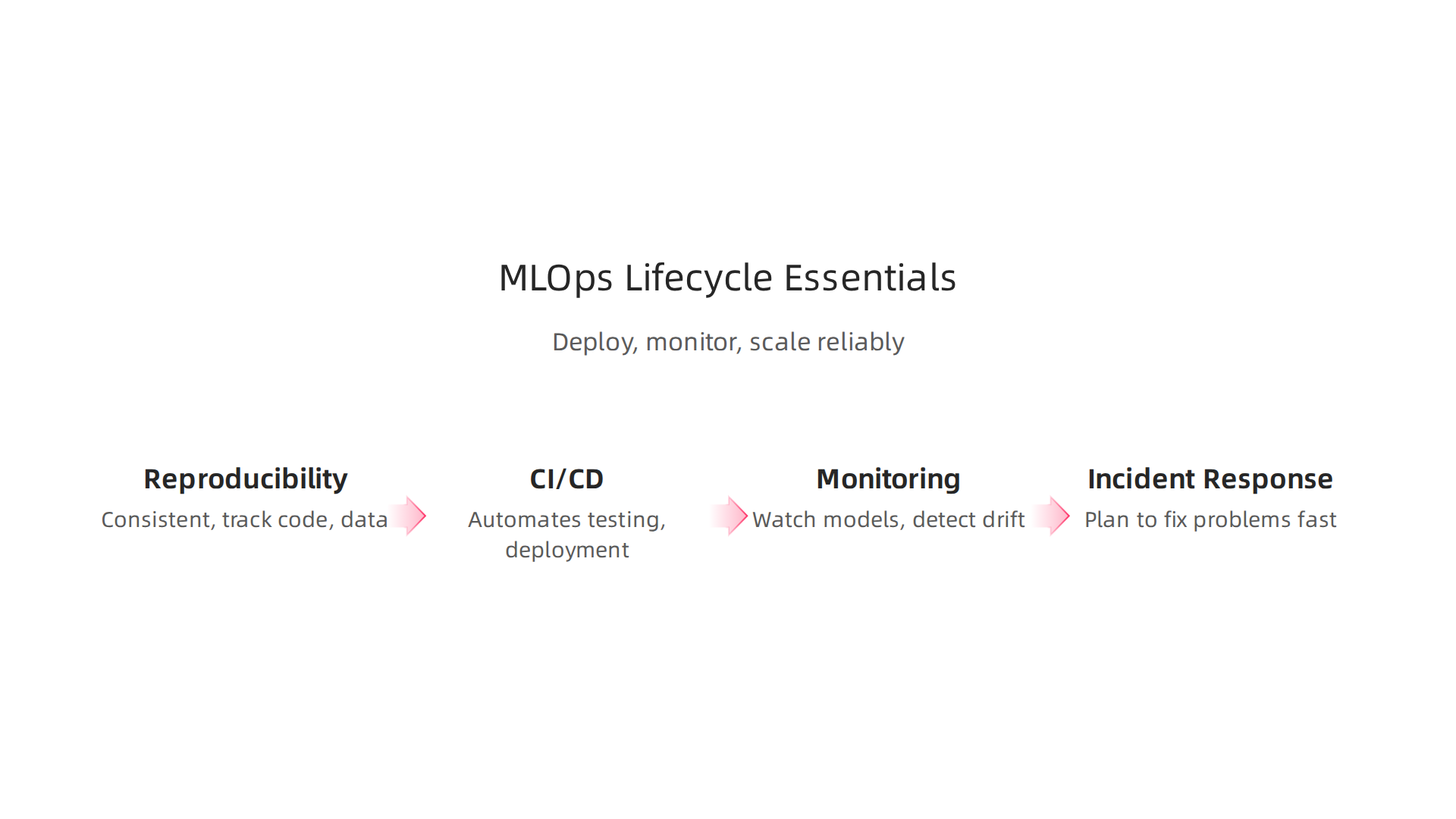
Think of it like building a self-driving car. You don’t just test it once; you need systems to check it all the time on the road.
Reproducibility: Making it Consistent
One big challenge is making sure that if you build the same model again, you get the exact same results. This is called reproducibility. It’s super important for trust and fixing problems. To do this, we need to keep track of everything:
- Version Control: We save different versions of the code, the data used for training, and even the settings that made the model. This is like having a detailed recipe and knowing exactly which ingredients you used each time. This also includes versioning data, environments, and other key details to ensure reproducibility in automated systems MLOps pipeline automation best practices.
Continuous Integration and Continuous Deployment (CI/CD): Always Ready to Go
Once a model is ready, we need to get it out quickly and safely. CI/CD helps with this. It’s a set of steps that automates testing and deployment.
- Automated Testing: Every time we make a change, the system runs tests to catch mistakes early.
- Automatic Deployment: When tests pass, the new model can be sent out to do its job without someone having to do it by hand. This makes things much faster and safer. MLOps aims to automate the entire machine learning lifecycle from training to deployment and monitoring MLOps in 2026: The Complete Guide.
Monitoring: Keeping an Eye on Things
After a model is deployed, its work isn’t done. Things in the real world can change. So, we need to watch our models closely.
- Performance Monitoring: We check if the model is still making good guesses.
- Data Drift: Sometimes the real-world data starts to look different from the data the model was trained on. This is called "data drift," and it can make the model less accurate. We need to detect it fast.
- Alerts: If something goes wrong, the system tells us right away so we can fix it. Effective MLOps includes monitoring for data drift and automatically retraining models when needed MLOps monitoring and drift detection.
Incident Response: Fixing Problems Fast
Even with the best planning, problems can happen. MLOps includes a plan for what to do when they do. This is called incident response. It means having clear steps to take when a model breaks or acts unexpectedly, so you can fix it and get it back to normal quickly.
Tooling and Trade-offs for Companies
Different companies need different tools for MLOps.
- Small Teams: Might use simpler tools that are easy to set up.
- Big Companies: Often need more complex tools that can handle many models, lots of data, and high security. They might use specialized platforms that help them build production ML systems at a large scale. The choice of tools depends on how much risk a company can take and how many models they want to run.
By thinking about these non-research challenges, businesses can make sure their artificial intelligence and machine learning projects work well not just in testing, but also when they are truly helping customers and making important decisions. It’s all about making AI reliable and helpful for a long time. For those interested in planning their AI journey, an AI development roadmap for 2026 can provide further guidance.
When artificial intelligence and machine learning models go out into the real world, it’s not enough for them to just work. They also need to be fair, private, and follow rules. This is about making sure AI is used in a good way and does not cause harm. It’s a very important part of handling all the elements of AI responsibly.
Fairness: Treating Everyone Right
Imagine an AI system that helps decide who gets a loan or a job. If this AI learns from old data that had unfair ideas in it, the AI itself might also become unfair. This is called bias. Making sure AI is fair means actively working to remove these unfair parts so that the AI treats everyone equally, no matter their background. Ignoring this can lead to real-world harms, as we explored in a previous discussion about the dangers of AI bias, deepfakes, job loss, and other critical risks in 2026.
Explainability: Understanding How AI Thinks
Sometimes, AI models can be like a "black box." They give an answer, but it’s hard to understand why they gave that answer. For important decisions, like in healthcare or law, we need to know how the AI got its answer. This is called explainability. It helps us trust the AI and fix it if it makes a mistake.
Privacy-Preserving Methods: Keeping Your Data Safe
AI often needs a lot of data to learn. But this data can hold private information about people. Protecting this privacy is key. We use special methods to keep personal information safe while still letting the AI learn. One way is called "differential privacy." It adds a little bit of "noise" to the data so that no single person’s information can be easily picked out, but the AI can still learn general patterns. The National Institute of Standards and Technology (NIST) provides Guidelines for Evaluating Differential Privacy Guarantees to help with this.
Regulatory Context: Following the Rules
Governments around the world are making rules for how AI should be used. This is the regulatory context. Teams building AI need to know these rules. For example, many places now require "privacy impact assessments" before deploying AI systems that handle personal information. These assessments help teams think about and fix privacy risks early on, setting a strong privacy as the foundation of responsible AI governance. Staying up-to-date with these rules is essential for any project involving artificial intelligence and machine learning. You can learn more about AI in Government Policy, Procurement, and Building Public Trust.
Governance Primitives: Simple Steps for Teams
To avoid problems later, teams should start thinking about these issues early. Here are some simple steps:
- Have Clear Rules: Make clear rules for how your team will design, build, and use AI.
- Check for Bias: Always test your AI to make sure it’s not being unfair.
- Think About Privacy: Plan how to protect data right from the start.
- Be Accountable: Know who is in charge of making sure the AI acts responsibly.
- Document Everything: Keep good records of how your AI was built and why certain choices were made.
Adopting these simple ideas early on can help teams build trust and avoid legal or reputation problems. Responsible AI governance is a growing area of study to help organizations make good decisions about AI. For a deeper dive into these topics, consider exploring AI ethics for machine learning teams building public trust and navigating regulation. It’s all about making sure that as AI becomes smarter, it also becomes more trustworthy and helpful for everyone.
Want to stay on top of the latest in AI and machine learning? Get clear daily AI updates.
The AI Newsletter Worth Reading
Summary
As AI advances rapidly in 2026, this article argues that the basic elements of artificial intelligence still matter more than ever. It explains the differences between AI, machine learning, and deep learning, walks through the field’s historical paradigm shifts, and shows why data and computing power became central. The piece outlines the key mathematical foundations—linear algebra, probability, optimization, and information theory—that underlie modern models, and it describes practical model-development steps including proper data splits, evaluation metrics, cross-validation, and common evaluation pitfalls. It also covers deployment and MLOps essentials like reproducibility, CI/CD, monitoring, and incident response, and it emphasizes fairness, explainability, privacy, and governance for responsible AI. After reading, you’ll understand the core concepts you need to hire, design, evaluate, deploy, and govern AI systems more effectively and with less risk.