
Engineering Recommendation System Machine Learning for Real-World Success

In today’s fast-moving world, businesses need to truly understand what their customers want. This is where recommendation system machine learning comes in. Think about your favorite streaming service or online store. How do they always seem to know just what you’ll like next?

That’s the power of a recommendation system at work. These smart systems are no longer just a nice-to-have; they are crucial for keeping people interested, bringing them back, and boosting sales across many different fields.
The Big Impact of Recommendation Systems
From helping you find your next binge-watch to suggesting products you might actually buy, recommendation systems are everywhere in 2026. They drive growth by:
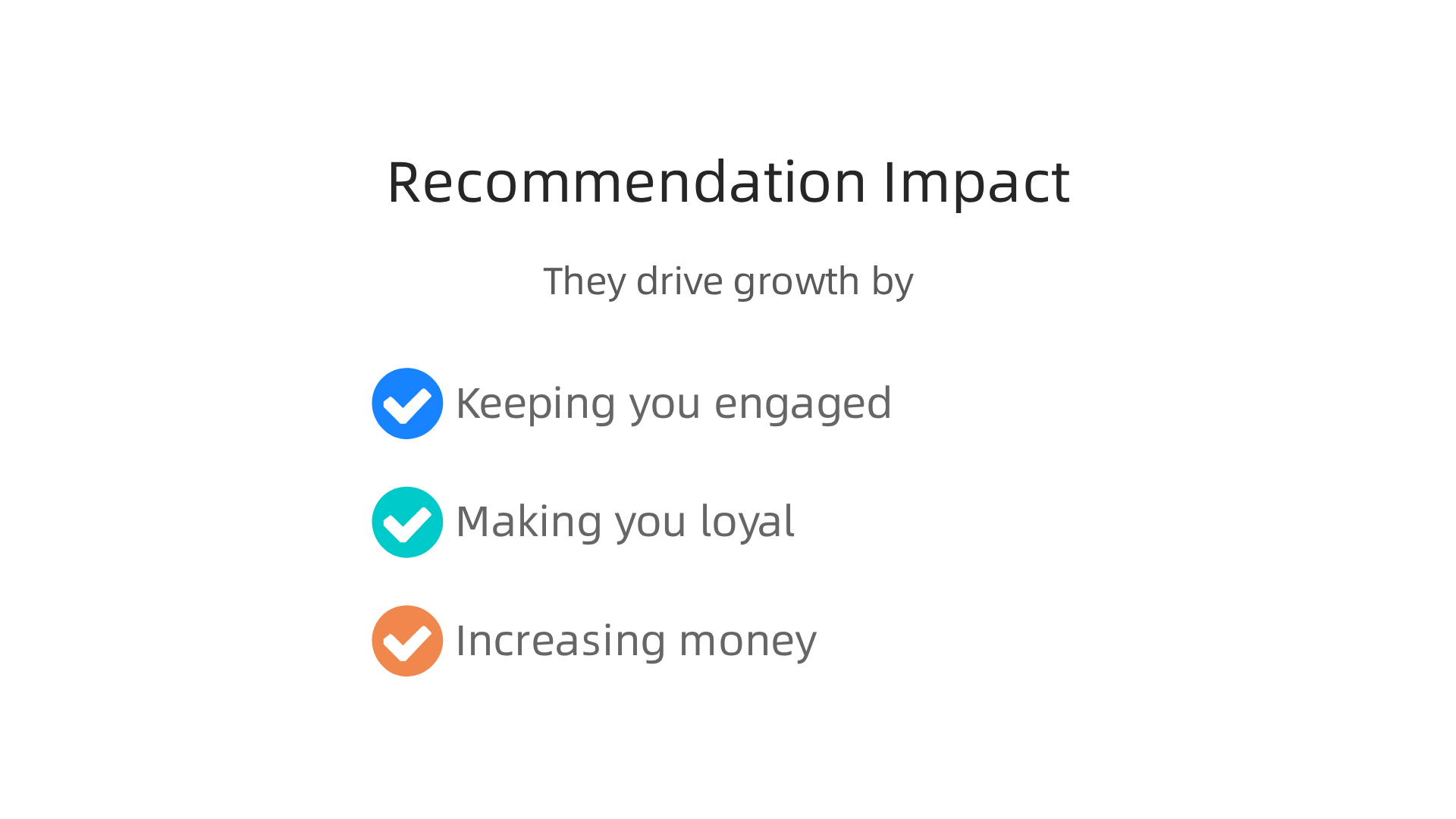
- Keeping you engaged: When you see things you like, you spend more time on a platform.
- Making you loyal: A great, personalized experience makes you want to come back again and again.
- Increasing money: Better suggestions often mean more purchases or subscriptions.
This holds true whether we’re talking about online shopping, music apps, news feeds, or even specialized areas like healthcare analytics and sports data, such as advanced NBA data analysis python models that predict player performance. These systems personalize experiences, which is key to success in the modern digital space. If you want a deeper look at the world of AI, consider signing up for The AI Newsletter Worth Reading.
The Challenge: Turning Smart Ideas into Real-World Tools
While the idea of smart recommendations is exciting, actually building these systems for daily use can be tricky. Many technical teams face big challenges when trying to take their clever research ideas and make them work smoothly in real life. One major problem is making sure the "features" or pieces of data used to train a model are exactly the same as the features used when the model makes a live suggestion. This problem, often called "train/serve skew," can make a recommendation system much less effective if not handled carefully.
To avoid this, many teams are now building special tools called feature stores. These stores help keep data consistent and fresh for both training the model and using it in real time. For example, some designs use a hybrid approach with both online and offline stores, making sure features are always ready and consistent whether for quick suggestions or long-term training needs, as explained in discussions around Feature Store Patterns for CRM Recommenders. Others focus on very fast data pipelines using tools like Apache Kafka and Redis to handle data quickly, keeping system latency low to avoid delays in recommendations and improve overall AI automation performance. The goal is to get information to the system in less than a second so that suggestions are always timely and relevant, as highlighted in insights on Real-Time Feature Store Training. This attention to data freshness and consistency is key for any high-performing recommendation system machine learning project.
What You’ll Learn in This Guide
This guide is for technical teams who want to build and improve their recommendation systems. We will cover how to bridge the gap between smart ideas and tools that work well every day. We’ll look at best practices for handling data, building efficient systems, and making sure your recommendation models perform at their best. If you want to know more about the big picture of AI and machine learning, a good place to start is our AI Overview 2026: What Machine Learning Practitioners Need to Know.
Let’s now dive into how these smart systems actually work. At the heart of every recommendation system machine learning project are different methods that help computers guess what people will like. Thinking about these main techniques can help you build better systems.
Core ML techniques powering modern recommendation systems
There are a few key ways that recommendation system machine learning models learn your preferences.
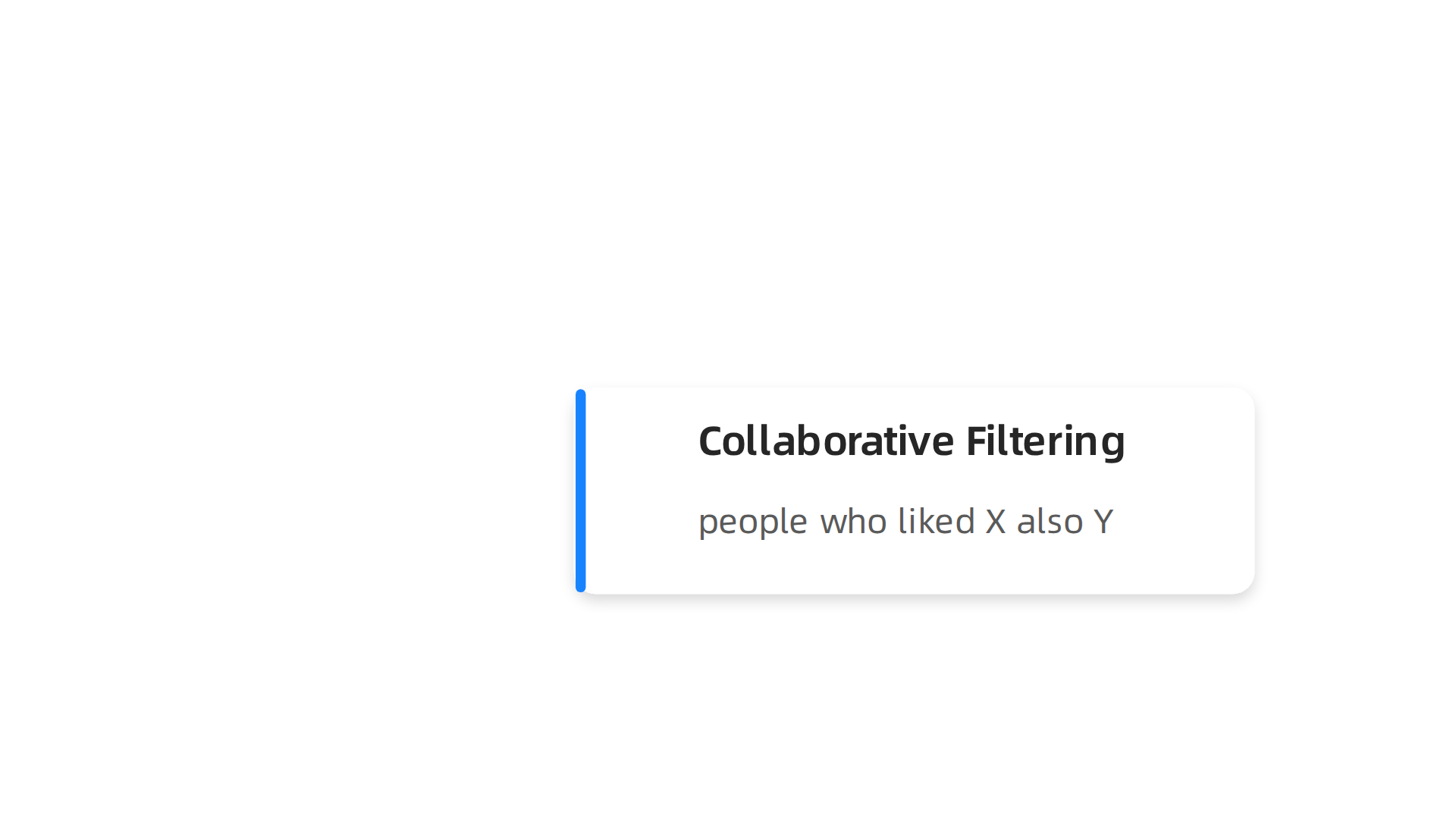
They mostly fall into two big groups: "collaborative filtering" and "content-based" methods.
-
Collaborative Filtering: The "People Like You" Approach
This method looks at what many users have liked or done and finds patterns. It’s like saying, "People who liked movie X also liked movie Y, so if you liked X, you might like Y too."- Matrix Factorization: Imagine a giant table where rows are users and columns are items. Each cell shows how much a user liked an item. Matrix factorization tries to break this big table into smaller, hidden tables that explain why people like certain things. This helps fill in the blanks for items a user hasn’t seen yet. Early work on understanding user preferences often used datasets like MovieLens, which greatly helped develop these methods A Survey on Generative Recommendation: Data, Model, and Tasks.
- Embeddings: Think of embeddings as turning every user and every item into a special number code. These codes are placed in a kind of number-space where similar users or similar items are located close to each other. If your number code is close to a movie’s number code, the system thinks you’ll like that movie.
-
Content-Based Approaches: The "Like This, Like That" Method
This way of recommending looks at the features or details of the items themselves. If you watched a science fiction movie with robots, a content-based system might suggest another science fiction movie that also has robots. It pays close attention to what the item is about, rather than what other people think of it.
The Rise of Modern Techniques
While the older ways are still helpful, the world of recommendation system machine learning is always changing. In 2026, we see more powerful and complex methods being used, often thanks to advances in Types of AI Understanding Intelligence Capabilities Learning Architectures.
- Deep Learning: These are like advanced brain-inspired computer programs that can find very complex patterns in huge amounts of data. Deep learning models can understand many different types of information at once, like pictures, words, and user actions. This helps them make even smarter suggestions In-depth survey: deep learning in recommender systems.
- Retrieval-then-Ranker Architectures: Many modern systems use a two-step plan. First, a fast "retrieval" step quickly picks out a small group of items that might be interesting from a huge list. Then, a more powerful "ranker" model carefully looks at this small group and sorts them to find the very best suggestions for you. This two-step process makes systems both fast and accurate. For building these kinds of systems, strong programming skills are key, and you can learn more about this by exploring Python for Data Science and Machine Learning in 2026 Tools and Workflows.
- Large Pretrained Models: These are very big models that have learned a lot from a vast amount of general information. After this first big training, they can be "fine-tuned" or adjusted for specific tasks, like making recommendations. This is a growing trend, especially with how we use AI today, and you can track more about these developments with LLM AI 2026 Technologies and Research You Need to Track.
These advanced methods are helping businesses offer truly personalized experiences, making recommendation system machine learning more important than ever for large-scale operations Large-Scale Recommender Systems: State-of-the-Art and ….
Building powerful recommendation system machine learning models isn’t just about smart math; it also needs good data and strong engineering. In 2026, creating reliable recommenders means focusing on the right data, clever feature engineering, and pipelines that can handle information quickly and accurately.
Essential Data Sources for Recommenders
Think of data as the food that feeds your recommendation system machine learning model. Without the right ingredients, even the best recipe won’t work. The most common types of data include:
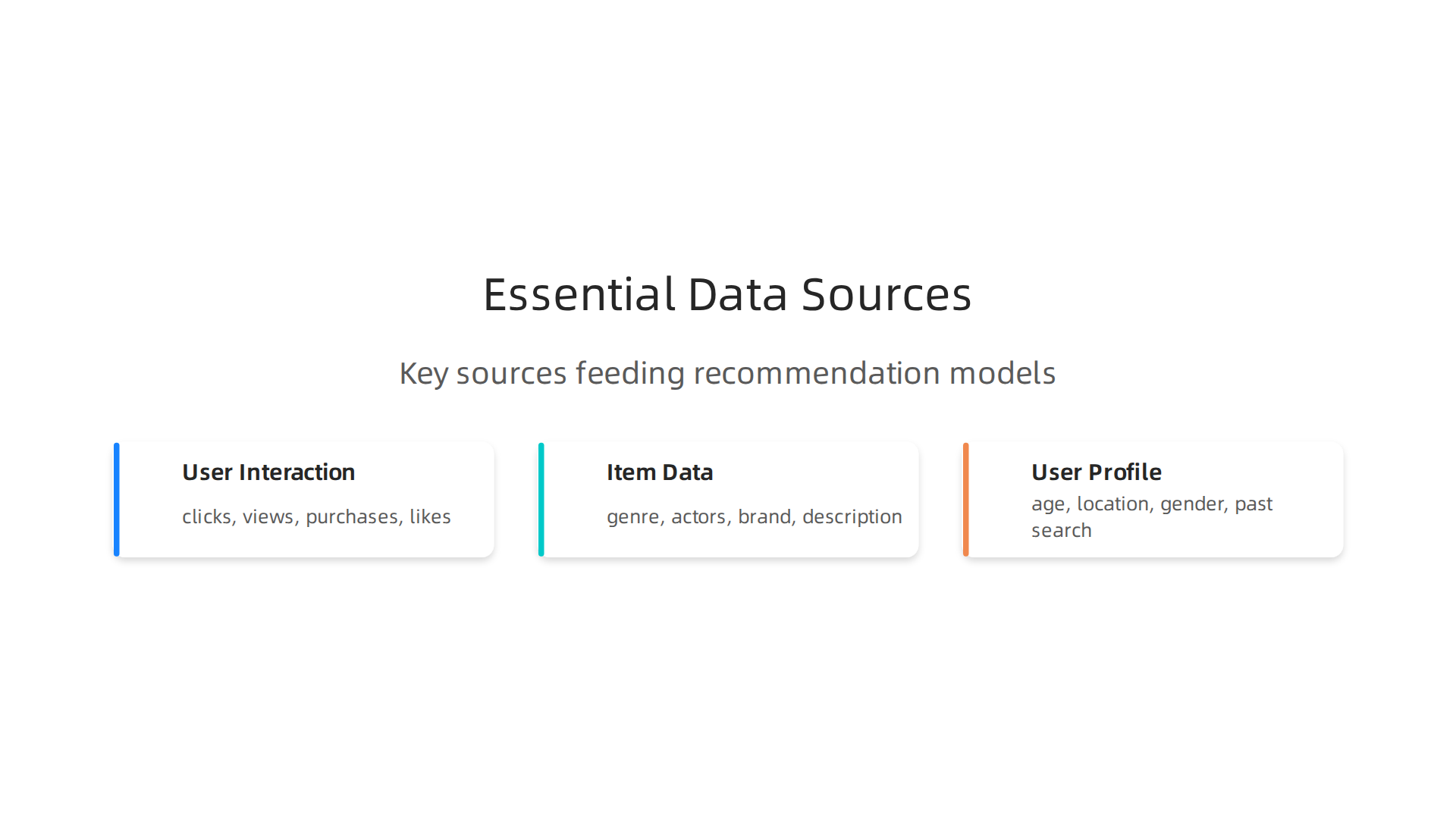
- User Interaction Data: This is what users actually do. It includes clicks, views, purchases, likes, dislikes, ratings, and even how long someone watches a video. This data helps the system learn what individual users prefer. Many research studies use datasets like MovieLens, Yelp, and Amazon to test new recommendation ideas Datasets for recommender systems: A survey and comparative overview.
- Item Data: These are the details about the things being recommended. For movies, it could be genre, actors, director, and plot. For products, it’s category, brand, color, and description. This helps content-based systems suggest similar items.
- User Profile Data: Information about the users themselves, like age, location, gender, or past search history. This can help group users with similar tastes.
For areas like healthcare analytics or nba data analysis python, the "items" might be health interventions or player actions, and the "users" are patients or teams. The quality of this raw data is key to any successful recommendation system. To understand your data better, exploring exploratory data analysis techniques for machine learning in 2026 can be a great first step.
Feature Engineering: Making Data Smarter
Raw data often isn’t ready for machine learning models. Feature engineering is like refining that raw data into special "features" that the model can easily understand and learn from.
- User Features: These can be summaries of a user’s past actions, like "average rating given," "number of items purchased in the last week," or "most frequent genre watched."
- Item Features: Beyond basic details, you can create features like "popularity score," "average user rating," or "how recently this item was added."
- Contextual Features: This is important for "session-based" recommendations. It includes things that change moment-to-moment, such as:
- Time of day: Is the user browsing late at night or during work hours?
- Device: Are they on a phone or a computer?
- Location: Are they at home or in a different city?
- Current session history: What have they just clicked on or viewed in this single visit?
These features give the recommendation system machine learning model rich information, allowing it to make more timely and relevant suggestions.
Engineering Pipelines for Real-Time Recommenders
For recommenders to be useful in 2026, especially for things like real-time product suggestions or dynamic content feeds, they need fresh data, fast. This is where robust engineering pipelines come in.
- Feature Stores: Imagine a special database built just for machine learning features. A feature store keeps features organized and makes sure they are updated quickly and consistently for both training your models and making real-time predictions. Companies use "hybrid" feature stores with both online (super fast) and offline (for large training tasks) parts Feature Store Patterns for CRM Recommenders. This helps prevent issues where the data used for training is different from the data used in real life.
- Real-Time Enrichment: To get those crucial contextual features right when a user needs a recommendation, systems use tools like Apache Kafka and Apache Flink. These tools help collect user actions, process them instantly, and update features in the feature store, ensuring data is fresh. This setup allows for very low-latency serving, meaning recommendations can appear almost instantly after a user action Real-Time Feature Store Training: Kafka & Redis for <10ms….
- Freshness and Consistency: It’s super important that features are always up-to-date. Setting clear rules for how old a feature can be (like "click count over the last 5 minutes must be less than 1 second old") helps maintain high quality. Building efficient data workflows is a cornerstone for such systems. If you’re looking to streamline your processes, check out mastering Python data workflows for peak performance.
These careful engineering steps, from gathering electronic data to setting up real-time pipelines, are what truly make recommendation system machine learning reliable and valuable in today’s fast-paced digital world.
Get clear daily AI updates from The AI Newsletter Worth Reading.
For a recommendation system machine learning model to be truly helpful, you need to know if it’s actually working well. This means we must check its performance. There are two main ways to do this: offline checks and online experiments, both looking closely at how users react.
Offline Metrics: Looking at Past Data
Offline evaluation is like practicing a play before the big game. You use old information, called historical data, to see how good your recommendation system would have been in the past. This helps you choose the best model before showing it to real users. However, these metrics are just a good guess of what you truly care about: what users will do in the future Offline vs. Online Recommender Evaluation.
Some common ways to measure performance offline include:
- Precision@K: Imagine you recommend 10 items (K=10). Precision@K tells you how many of those 10 items the user actually liked or interacted with. It’s about how many of your recommendations were correct.
- Recall@K: This metric asks: out of all the items a user would like, how many did your top K recommendations actually include? It’s about not missing things the user would have loved. For example, in something like healthcare analytics, missing a crucial health recommendation could be very bad.
- NDCG@K (Normalized Discounted Cumulative Gain): This is a fancier version of the above. It also cares about the order of recommendations. If you put a super relevant item at the top of the list, NDCG@K gives you more points than if that same item was at the bottom Evaluating Recommenders.
- Mean Reciprocal Rank (MRR): This looks at where the first correct recommendation shows up. If the first correct item is at position 1, you get a high score. If it’s at position 5, a lower score.
These metrics help you quickly compare different models and make changes. But they don’t always show the full picture of how real people will react. For more detailed insights into these measures, see Evaluating Recommender Systems Metrics.
Online Experiments: Real Users, Real Results
To truly know if your recommendation system machine learning model is good, you have to try it out with real users. This is called online evaluation, and it’s where the real magic happens in 2026.
- A/B Testing: This is a very popular method. You split your users into groups. One group (Group A) sees the current recommendation system, and another group (Group B) sees your new recommendation system. You then compare how these groups behave. Do users in Group B click more? Do they buy more? Do they spend more time on the platform? Many companies use A/B testing to measure how effective their recommendations are Using A/B testing to measure the efficacy of recommendations. This is crucial for guiding product development, like when optimizing your machine learning workflow to cut bottlenecks and speed up model delivery.
- Interleaving: This is a clever trick for when you want to compare two systems quickly. Instead of showing one group System A and another group System B, you mix the recommendations from both systems for the same user. For example, the user might see item 1 from System A, item 2 from System B, item 3 from System A, and so on. You then track which items the user interacts with more. If an item from System B gets more clicks, that system is likely better.
- Multi-Armed Bandits: Think of this like playing a slot machine (a "bandit") with many arms. Each arm is a different recommendation strategy. Instead of sticking with one, the system automatically learns which strategies are giving the best results (like more clicks or purchases) and gradually sends more traffic to those better-performing "arms." This is a form of AI automation that helps continuously improve recommendations without constant human oversight.
These online methods give you true user feedback. They help answer questions like, "Does this new recommendation system make people happier?" or "Does it lead to more sales?" In specialized fields like NBA data analysis Python might be used to quickly evaluate player recommendation strategies based on game performance metrics collected in real time. Combining offline tests with online experiments gives a complete picture of a recommendation system’s performance Online and Offline Evaluations of Collaborative Filtering.
After figuring out how well a recommendation system machine learning model works, the next big step is getting it ready for real users. This means setting up how the recommendations are delivered and making sure the system keeps running smoothly over time. This whole process is often called MLOps, which stands for Machine Learning Operations.
How Recommendations are Delivered
Getting recommendations to users involves different ways of serving the model. The best way depends on how quickly users need new recommendations.
- Batch Serving: This is like preparing recommendations in advance. You might run your recommendation system machine learning model once a day or once a week to create lists of suggested items for everyone. These lists are then saved and shown to users when they visit. This method works well for things that do not change very fast, like recommending movies on a streaming service or products in an online store that don’t need instant updates. It is a good choice for large-scale operations where speed isn’t the absolute top priority.
- Micro-Batch Serving: This is a bit faster than regular batch serving. Instead of running the model once a day, you might run it every few hours or minutes. This gives users fresher recommendations without needing super-fast, always-on calculations for every single request.
- Online Inference with Low Latency: For many modern recommendation systems, users expect instant suggestions. Think about shopping online or scrolling through a social media feed. When you click on an item, you want to see related items right away. This is called low-latency online inference.
- Caching: To make things super fast, systems often use "caching." This means saving common recommendations or parts of the recommendation system’s work so they can be shown again quickly without having to re-calculate everything.
- Approximate Nearest Neighbors (ANN): Finding similar items or users very quickly is key for instant recommendations. Approximate Nearest Neighbors is a smart technique that helps the system find items that are "close enough" to what a user likes, even in huge lists of millions of items. This helps a recommendation system quickly suggest relevant content Approximate Nearest Neighbor Search in Recommender Systems.
Building systems that can handle these different speeds and large numbers of users is a big challenge in 2026 Scalable High-Performance Architecture for Evolving Recommender System.
Keeping Recommendation Systems Healthy with MLOps
After you build and deploy a recommendation system machine learning model, the work isn’t over. MLOps helps make sure your models stay useful and reliable.
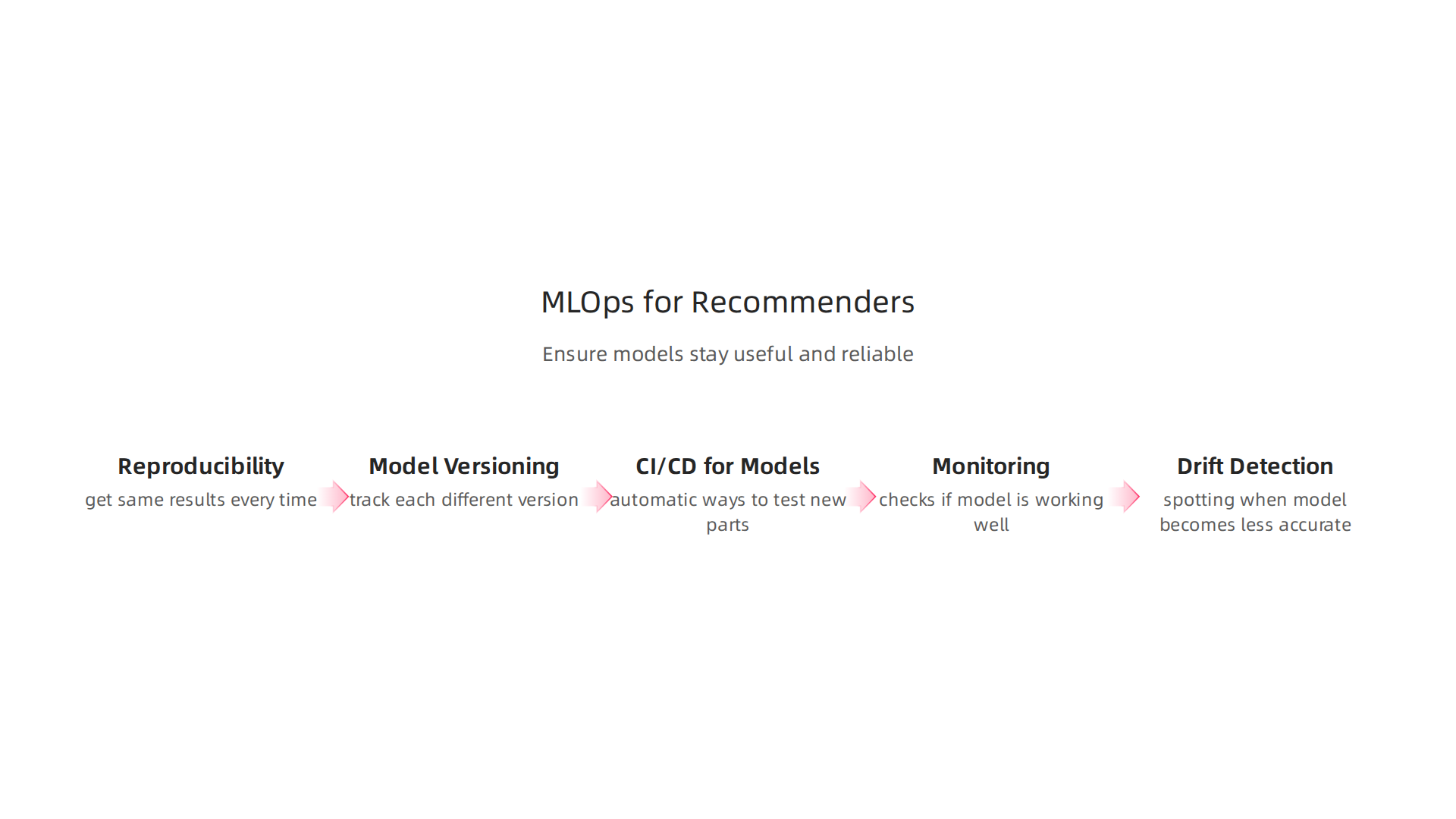
- Reproducibility: This means you can get the same results every time you run your model with the same data and settings. It is like having a recipe you can follow exactly. This is important for fixing problems and for showing how a model was built. Tools that help with project structure can boost reproducibility, like a cookiecutter data science project structure.
- Model Versioning: Just like software, your models will change and improve over time. Model versioning means keeping track of each different version of your recommendation system. This way, you know which version is running, what data it was trained on, and how it performs.
- CI/CD for Models: Continuous Integration and Continuous Delivery (CI/CD) means setting up automatic ways to test new parts of your model and then put the best parts into action. This helps you update your recommendation system machine learning model regularly and quickly NVIDIA Merlin meets the MLOps ecosystem.
- Monitoring: Once your recommendation system is live, you need to watch it closely. Monitoring checks if the model is still working well, if it is fast enough, and if it is fair to all users.
- Drift Detection: Over time, what users like can change. New trends appear, and old ones fade. "Drift detection" is about spotting when your model starts to become less accurate because user behavior or data has changed. When drift is found, it is a signal that your model might need to be retrained with newer data to stay effective Integrating MLOps for Monitoring, Drift Detection, and Adaptive.
By properly handling serving patterns and using strong MLOps practices, companies can ensure their recommendation systems remain valuable tools, guiding users to content they love and helping businesses grow.
Ready to stay ahead in the fast-paced world of AI? Get clear daily AI updates from The AI Newsletter Worth Reading.
Even with a smoothly running system thanks to MLOps, there are still big questions to answer. How do we make sure our powerful recommendation system machine learning models respect people’s privacy? How do we make sure they are fair to everyone? And how do we let users have a say in what they see? These are tough but important trade-offs for personalization.
Keeping User Privacy Safe
Recommendation systems learn what you like by looking at your data. But collecting and using this data can be a worry for privacy. In 2026, protecting user information is a top concern, especially in sensitive areas like healthcare analytics.
One way to protect privacy is called Differential Privacy. Imagine you want to know how many people like a certain movie, but you do not want to know which specific person likes it. Differential Privacy works by adding a little bit of "noise" or randomness to the data before the model learns from it. This makes it very hard to figure out individual user details, while still letting the recommendation system machine learning model learn overall trends. However, there’s a trade-off: adding too much noise can make the recommendations less accurate. Research shows that differential privacy can help protect users’ data, but it might also make recommendations a bit less precise Differential privacy in collaborative filtering recommender systems and can impact how well recommendations work The Impact of Differential Privacy on Recommendation Accuracy and Popularity Bias.
Another smart way to protect privacy is Federated Learning. Instead of collecting all user data in one central place, federated learning lets the recommendation system model learn on each user’s device (like their phone or computer). Only the learned patterns or model updates are sent back to a central server, not the raw personal data. This means your private information stays on your device. This method aims to keep recommendation quality high while protecting user privacy Privacy Preserving Recommender Systems Balancing Personalization with Privacy.
Ensuring Fairness and Reducing Bias
Another big challenge is making sure recommendation system machine learning models are fair. A model can sometimes show unfair preferences or treat certain groups differently, even if it is not meant to. This is called bias. For example, a system might unknowingly recommend fewer job opportunities to women or show a limited range of content to certain age groups. This bias often comes from the data used to train the model, as past data might reflect unfairness that already existed in the world Bias and Debias in Recommender System.
To fight this, teams work on bias mitigation. This means finding and fixing unfairness in the data or in the model itself. It involves carefully checking how recommendations are given to different user groups (like by age, gender, or location) and ensuring items are promoted fairly. It’s about making sure the system provides equitable treatment for everyone Fairness and Diversity in Recommender Systems. Understanding the dangers of AI bias is a crucial step for any team working with AI.
Giving Users Control and Transparency
Users often want to feel like they have some control over their online experience. For recommendation systems, this means:
- User Control: Allowing users to easily say "I don’t like this" or "I want to see more of that." This can be through simple buttons or settings where they can adjust their preferences, maybe even telling the system to ignore certain past behaviors.
- Transparency: Explaining why a certain recommendation was made. For instance, a system might say, "Because you watched X, we thought you’d like Y," or "People who bought A also bought B." This helps users understand and trust the recommendation process.
Building trust and managing these ethical concerns are key for responsible AI automation.

Companies need to think about AI ethics for machine learning teams to ensure their systems are not just smart, but also responsible. By focusing on privacy, fairness, and user control, we can create recommendation systems that truly serve people well.
After discussing the important ethical concerns around privacy and fairness, it is clear that building a strong recommendation system machine learning model also means thinking about how it helps a business grow. For companies in 2026, it is not enough for a model to be smart; it also needs to make a real difference in their bottom line.
Making Smart Choices for Business Growth
To really see the value from a recommendation system, teams need to connect the technical improvements they make to how the business performs. This means looking at more than just how accurate the recommendations are. It is about linking things like:
- Better user engagement: If users click more on recommended items or spend more time on a platform, that is a good sign. For example, systems that show "similar to viewed" options can boost conversion rates by about 20% on average Recommender Systems Industry: 2026 Verified Stats. This increased engagement often leads to users sticking around longer and spending more.
- Higher sales and revenue: The real prize for many businesses. When a recommendation system machine learning model works well, it helps people find things they love, leading them to buy more or spend more per visit. Some companies have seen big jumps in revenue. For instance, an e-commerce platform boosted its revenue by 30% thanks to a new recommendation engine that improved user satisfaction and engagement Recommender engine for a …. Another case showed a 62% increase in same-session revenue from personalized quizzes and recommendations Sweaty Betty’s 62% Revenue Uplift from Quiz Personalization.
- Customer loyalty: Happy customers who find what they need are more likely to return. This long-term relationship is valuable.
Measuring these impacts helps teams show that their work with recommendation system machine learning is not just cool tech, but also a key driver for business success. Sometimes, even a small improvement in engagement can lead to a big boost in money, like how a global retailer saw a 10% revenue increase in just three months from ML-powered product recommendations ML-Powered Retail Product Recommendations Driving Growth.
Putting Recommendation Systems to Work
For a recommendation system to truly deliver, how it is built and used within a company matters a lot. Here are some common ways to make sure these systems have a measurable impact:
- Start small, then grow: Companies often begin by testing new recommendations in one small part of their business, like a single page on a website. If it works well, they can then use it in more places.
- Work together: Teams that build the models (like data scientists and machine learning engineers) need to work closely with business teams (like marketing or product managers). This helps make sure the recommendations fit the company’s goals and serve customer needs. This kind of collaboration is vital for successful AI automation.
- Set up for continuous improvement: Recommendation systems are not a "set it and forget it" kind of thing. They need to be watched and updated over time. This means having tools and people ready to check how well the system is doing and make changes. Looking at how a system impacts user retention and engagement over time is crucial for long-term success Long-term User Engagement Optimization through ….
By focusing on these steps, businesses can ensure their recommendation system machine learning efforts are not just technically sound, but also a powerful force for growth. This careful planning helps to ensure they truly get a return on their investment.
Want to stay on top of all the latest advancements in AI and machine learning?
Get clear daily AI updates from The AI Newsletter Worth Reading.
Summary
This article explains recommendation system machine learning for technical teams who must turn research ideas into reliable, production-ready recommenders. It describes key methods (collaborative filtering, content-based, deep learning, retrieval-then-ranker and large pretrained models), the essential data sources and feature engineering practices, and the engineering needed for low-latency, real-time serving such as feature stores, Kafka/Flink pipelines, and ANN search. The guide also covers how to evaluate models with offline metrics and online experiments (A/B, interleaving, bandits), plus MLOps practices—versioning, CI/CD, monitoring, and drift detection—to keep systems healthy. Finally, it addresses privacy and fairness (differential privacy, federated learning, bias mitigation), and ties model work to business outcomes like engagement and revenue so teams can deploy recommenders that are both effective and responsible.